This guide is educational, not personalized financial, legal or security advice. A checklist reduces avoidable mistakes; it cannot make a transaction risk-free.
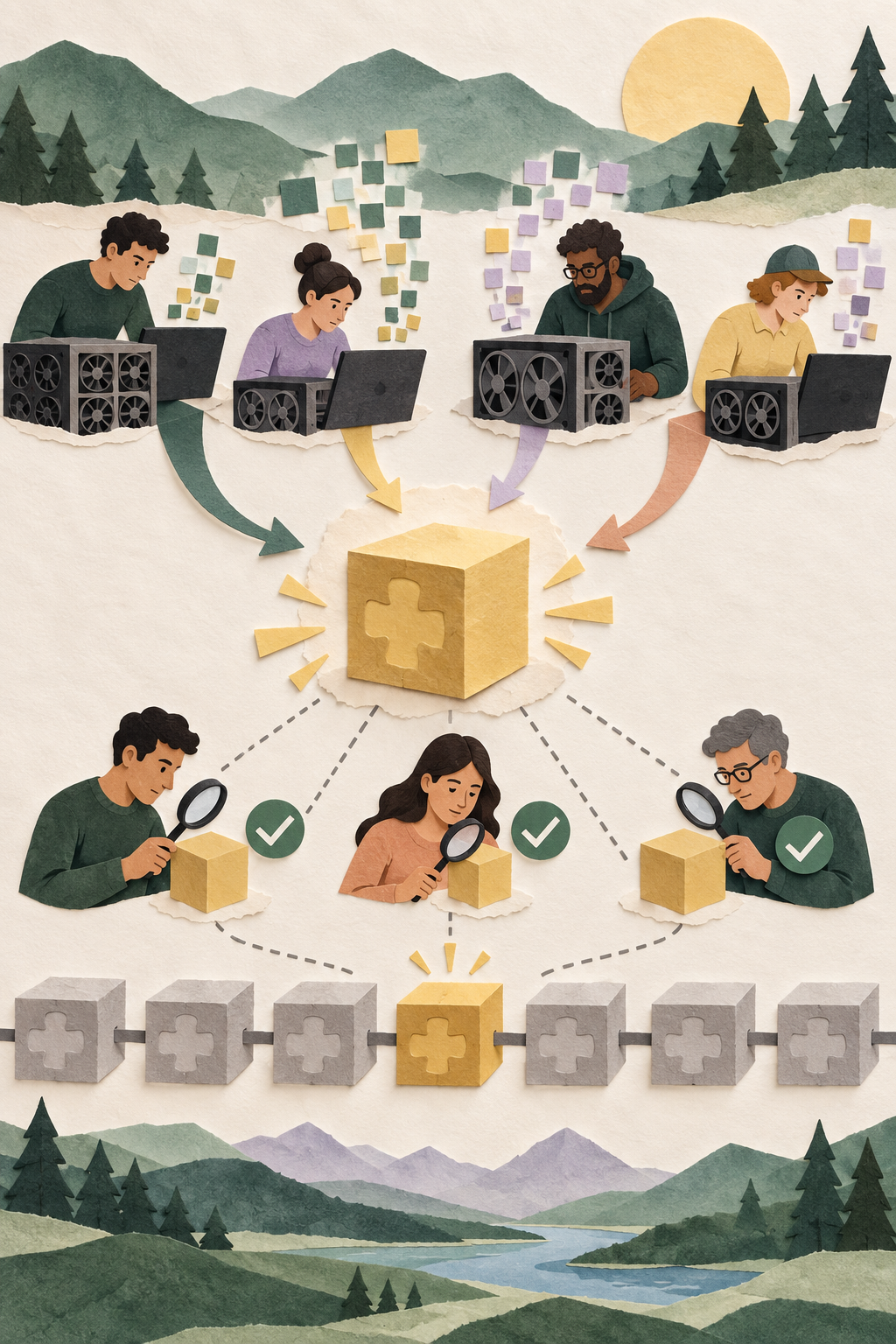
Mining involves competition to propose a block and verification by other participants; it is not a guaranteed personal income stream.
- Multiple participants spend resources searching under the network rules.
- One candidate block is proposed when a valid result is found.
- Other participants check the candidate before accepting it.
- The network record extends, while the business economics remain uncertain.
Which part of the image explains network operation, and which business claims would need evidence outside the chain?
What a miner contributes
Bitcoin mining is the proof-of-work process used to propose blocks of transactions. A miner assembles a candidate block, links it to earlier history and searches for a valid result under the network's rules. Other nodes do not accept the block merely because a miner found it; they independently check the block, its transactions and its relationship to the chain they follow.
Mining therefore helps create an ordered public history, but the word “mining” is not shorthand for passive income. A participant needs equipment, electricity, connectivity, operations and a way to manage changing competition. The protocol reward and transaction fees are inputs to a business calculation, not a guaranteed return.
Proof of work is not proof of an external claim
A valid block can show that the block satisfies the network's consensus rules. It cannot show that an equipment seller is honest, that a hosted-mining dashboard reports real output, that a promised yield will continue or that Bitcoin's market price will rise. A network rule and an off-chain business proposition require different evidence.
This distinction also explains why mining does not recover a lost key or reverse a mistaken payment. The process orders and validates transactions under the protocol; it does not adjudicate every dispute between people or businesses.
A paper model of the process
Draw a chain of three blocks. For each block, mark the previous-block reference, the transaction set, the proof-of-work search and the independent checks performed by nodes. Then create a separate column for business costs: hardware, power, cooling, space, maintenance, pool terms and downtime. Keeping those columns separate prevents a technical diagram from becoming an investment pitch.
Read mining offers with suspicion
Treat guaranteed daily income, fixed returns and urgency as claims that need strong independent evidence. Ask who owns the hardware, where it operates, how payouts are measured and what happens when conditions change. Never send funds solely because a dashboard uses the words hash rate, block reward or passive mining. For the underlying record and confirmation model, continue with how Bitcoin transactions work.
Check your understanding.
What does mining not establish by itself?
A correct answer records local learning progress, not a qualification or proof of financial readiness.
Sources & context
- Bitcoin.org — Some things you need to know ↗Consulted 2026-09-23
- Bitcoin.org — Securing your wallet ↗Consulted 2026-09-23
Original educational content prepared for this project. Sources provide context, not endorsement or a guarantee that every statement remains current. Rules, product interfaces and availability can change.
Take what you learned.
Leave the pressure behind.