This guide is educational, not personalized financial, legal or security advice. A checklist reduces avoidable mistakes; it cannot make a transaction risk-free.
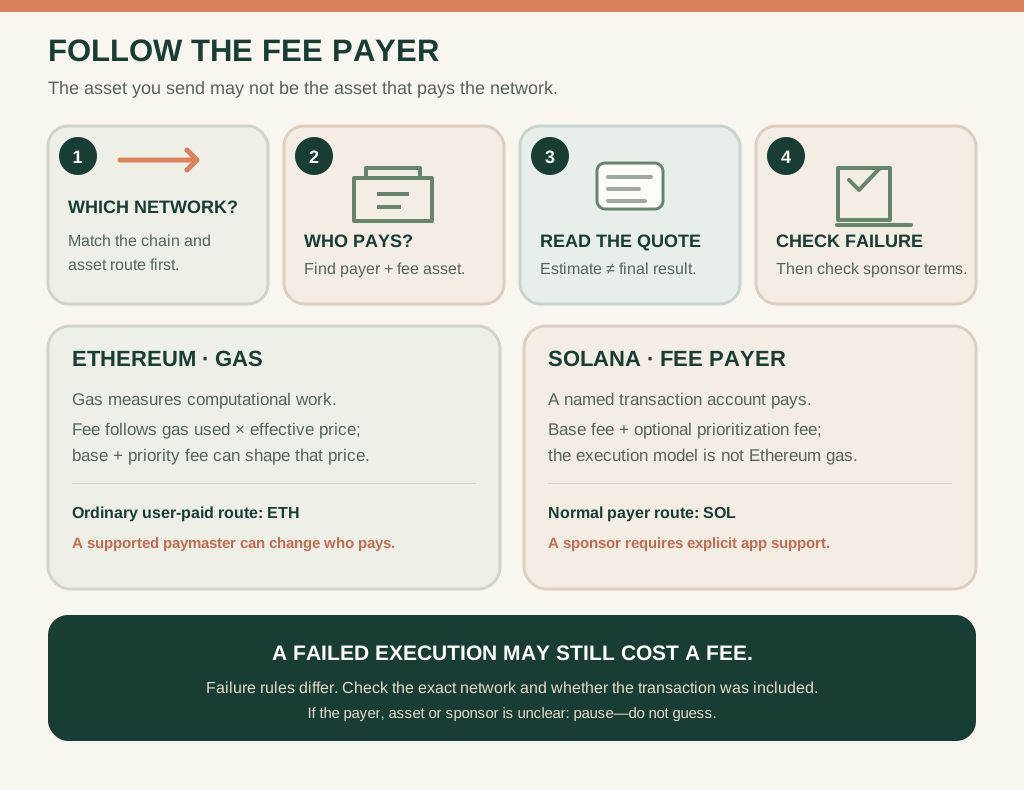
A token balance is not automatically the balance that pays for a network transaction. Fee rules, payer roles and sponsorship support vary by protocol and application.
- Confirm the exact network and token route before reading a fee quote.
- Identify the fee payer and fee asset for that protocol; the token being sent may be separate.
- Treat a quote as an estimate; inspect optional or maximum components and separate service charges.
- Check failure behavior and any explicit sponsor terms before approving; do not assume sponsorship.
A wallet shows 50 fictional stablecoin units and an estimated fee. What network is selected, who pays the fee, and which asset will actually be charged?
A token balance is not automatically a fee balance
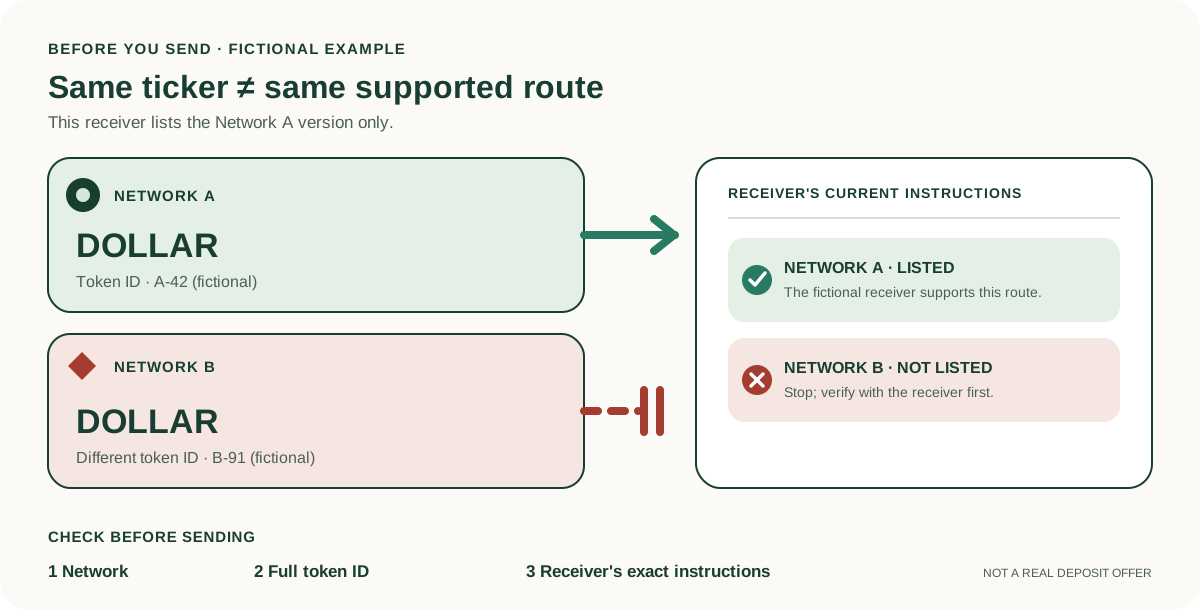
A network fee pays for a transaction's use of that network. Tokens can be valuable and transferable while still being unable to pay the fee for the network on which they live. First check the exact network selected in the wallet; the same token name can appear on different networks, and a fee asset on one network does not pay a transaction on another.
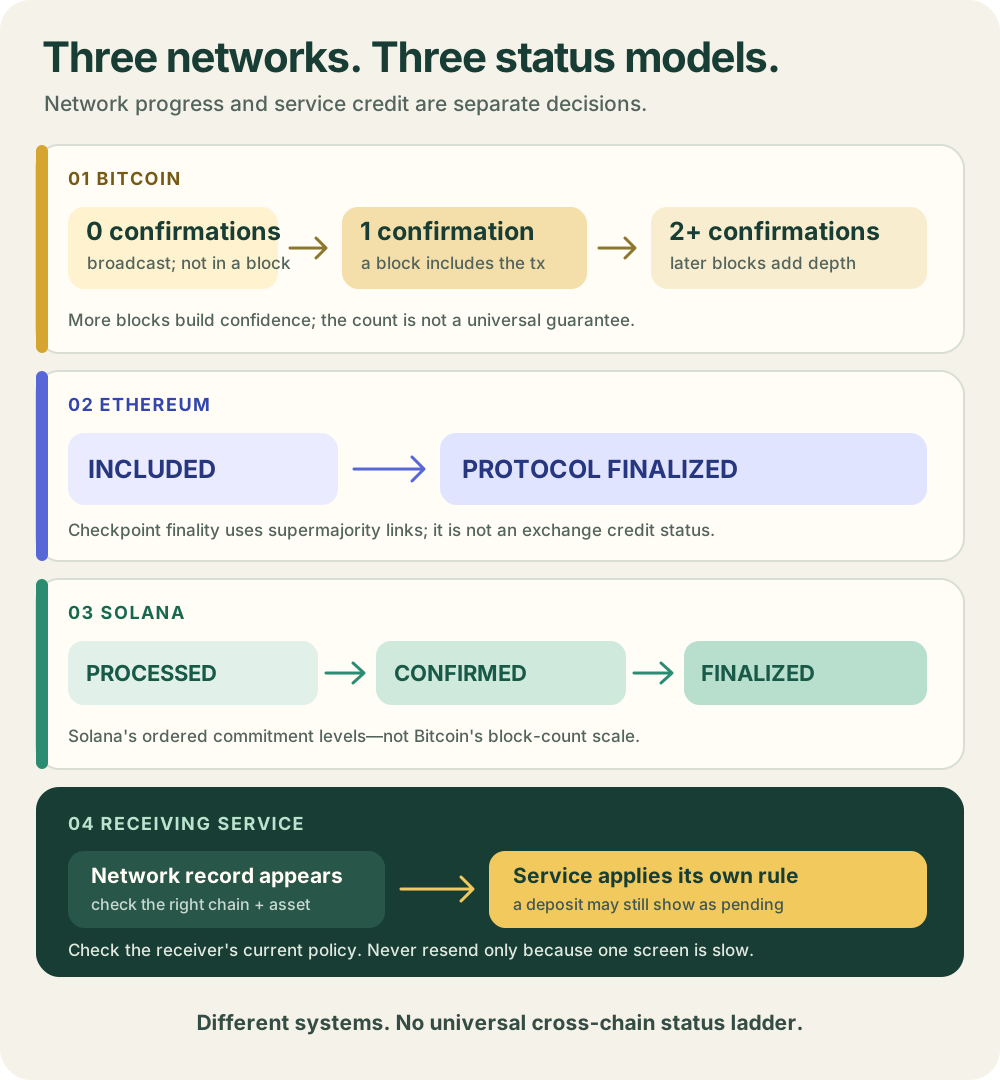
The details are protocol-specific. On Ethereum, gas measures computational work; an ordinary user-paid transaction uses ETH for the gas charge. The amount depends on gas used and the effective price, which can include the protocol base fee and a priority fee. See Ethereum's gas explanation. Some smart-account or application flows can arrange sponsorship, but that is a specific supported route—not a property to assume from the token balance alone.
On Solana, a transaction has a designated fee payer. The fee model includes a base fee and may include an optional prioritization fee; the payer normally needs SOL unless the application explicitly supports a fee-payer or sponsorship arrangement. Solana documents the fee calculation and fee-payer abstraction. These are different systems, so do not compare two wallet estimates as if they were the same unit or formula.
Follow the fee before you approve
1. Confirm the network and the asset being sent. 2. Find who will pay the network fee and which asset will be charged. 3. Read the estimate, its maximum or adjustable parts, and any separate service charge. An estimate is not a promise that the final charge or outcome will be identical. 4. Check what happens if execution fails. On Ethereum, an included transaction that reverts can still use gas; a transaction rejected before inclusion is different. Solana's fee documentation says the fee is deducted before execution and can still be charged when execution fails. 5. If sponsorship is offered, check who provides it, what action it covers, and whether any conditions or limits apply. Never send funds to an unsolicited person who says a wallet must be “activated.”
For example, imagine a wallet holding 50 fictional stablecoin units but no fee asset. The dollar value of those tokens does not itself pay the network charge. A supported sponsor could cover a particular transaction, but without a clearly documented sponsor the user may need the network's fee asset; sending the full token balance may also leave no amount for any separate service requirement. Do not test this with real funds.
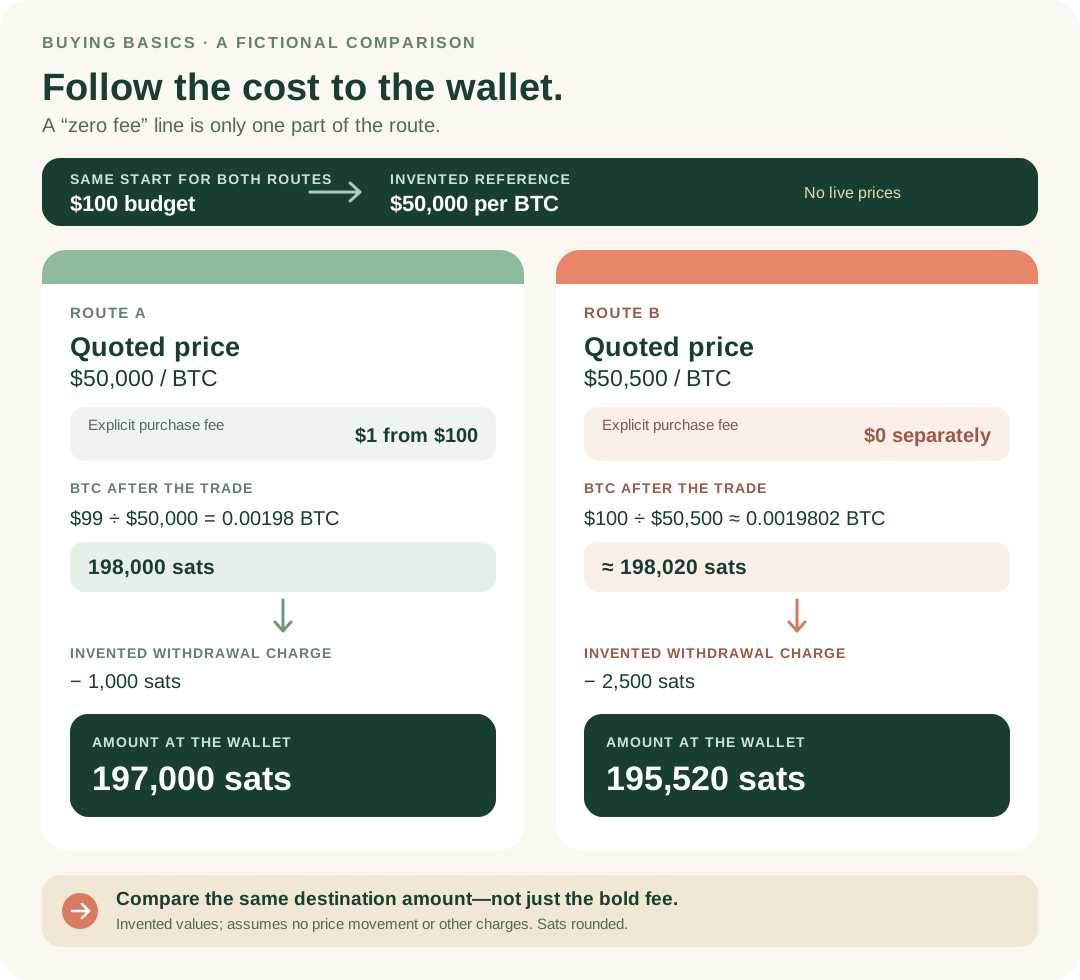
Keep network fees separate from a platform's trading, card, conversion or withdrawal charges. For a route-cost comparison, read crypto fees and spreads; for Bitcoin's distinct fee model, see Bitcoin fees explained. The network and wallet documentation—not a generic chart or token price—should answer the fee-payer question for the exact transaction.
Check your understanding.
Can a token-rich wallet still lack transaction-fee funds?
A correct answer records local learning progress, not a qualification or proof of financial readiness.
Put this lesson in context
Work through the asset, network and destination checks, then learn to interpret a transaction result.
Sources & context
- ethereum.org — Gas and fees ↗Consulted 2026-10-05
- ethereum.org — Interacting with smart contracts ↗Consulted 2026-10-05
- Solana documentation — Fee Structure ↗Consulted 2026-10-11
- Solana documentation — Fee Abstraction ↗Consulted 2026-10-11
Original educational content prepared for this project. Sources provide context, not endorsement or a guarantee that every statement remains current. Rules, product interfaces and availability can change.
Keep learning in Telegram.
Open this published guide in the learning bot. No account connection or wallet is needed.
Join the $STONKB community.
Follow project updates, share useful ideas and meet other builders. You do not need to buy $STONKB to join.
Take what you learned.
Leave the pressure behind.