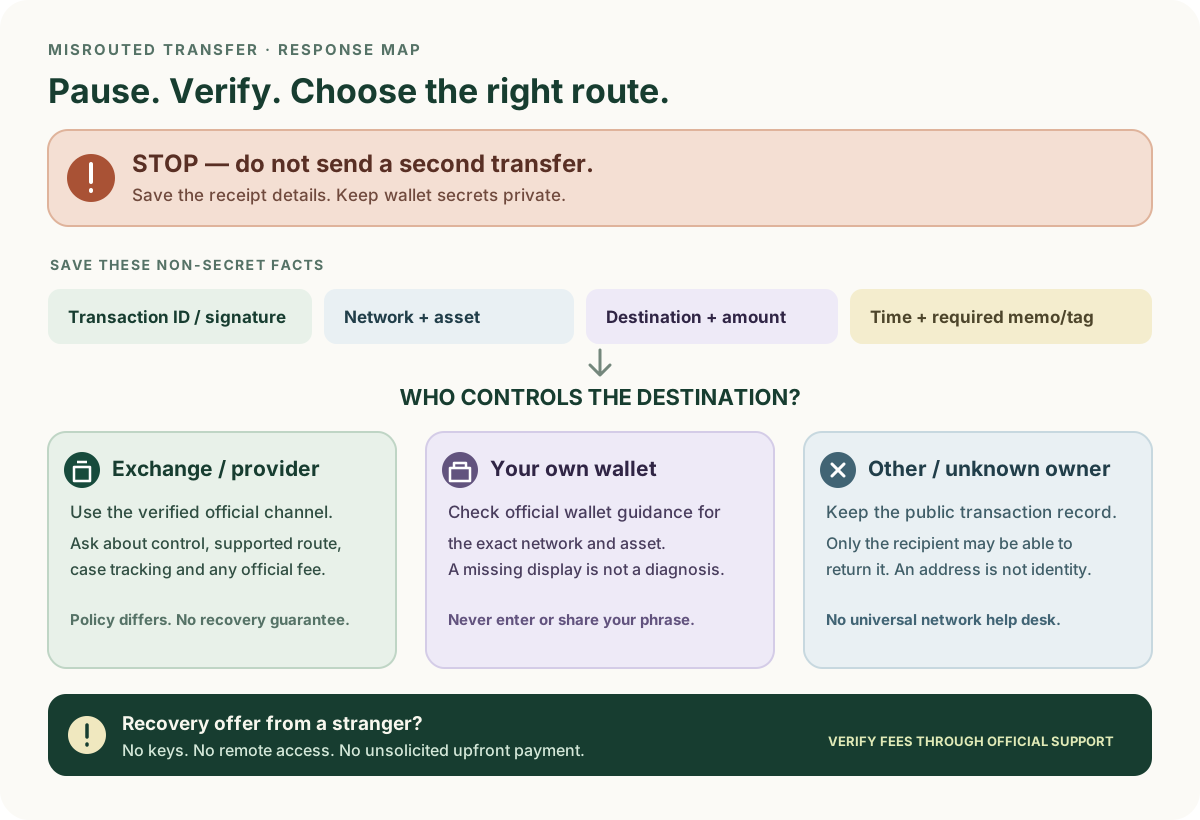
This guide is educational, not personalized financial, legal or security advice. A checklist reduces avoidable mistakes; it cannot make a transaction risk-free.
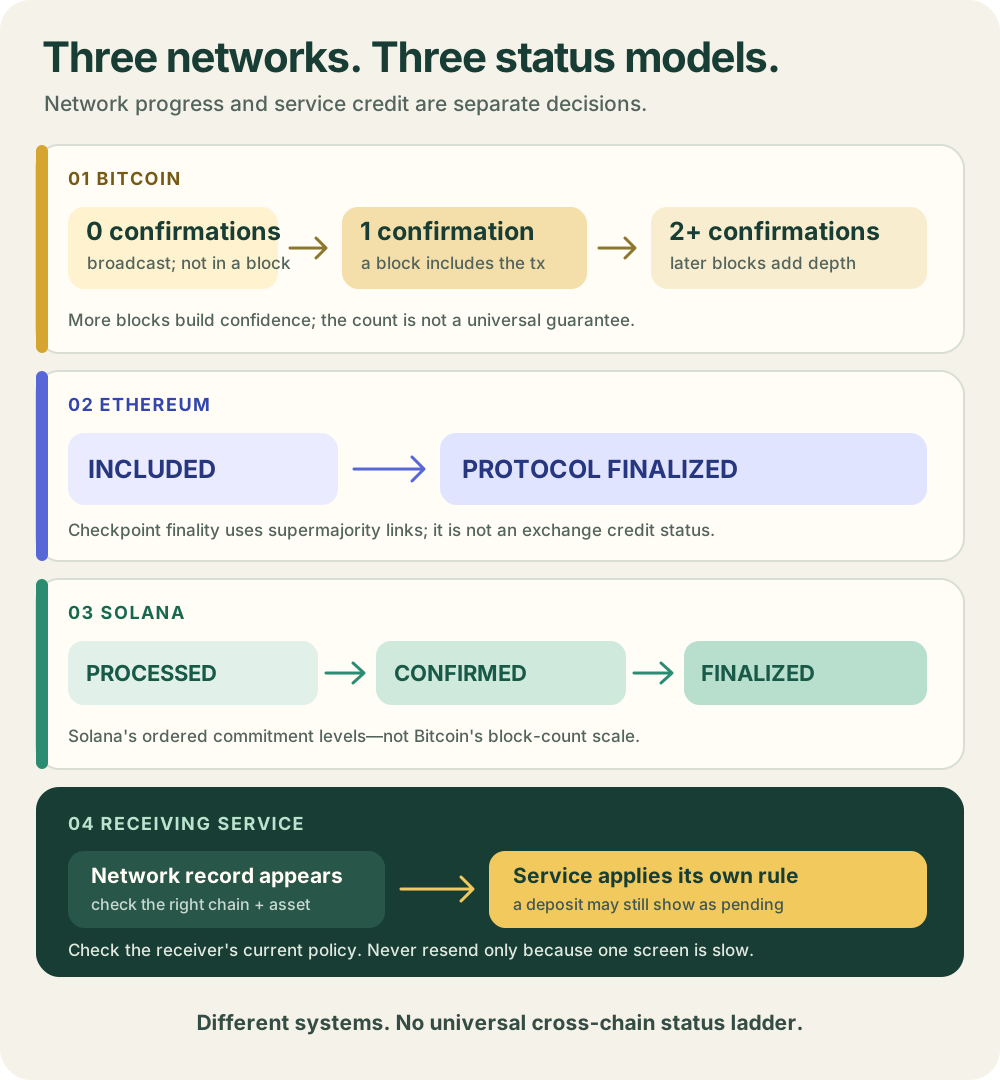
Different networks use different status models. A network record and a provider's deposit decision are separate; there is no universal cross-chain confirmation count.
- Identify whether the status is reported by a wallet, network explorer or receiving service.
- Bitcoin counts later blocks; Ethereum has protocol finality; Solana uses its own ordered commitment labels.
- Do not compare the labels as if they were one universal scale or guarantee.
- A provider may still apply its own deposit rule after a network record appears.
A fictional Bitcoin transfer has one confirmation while an exchange still says pending. Name the network fact, the service fact, and the current receiver rule you would check next.
Status labels belong to a particular system
A wallet, network explorer and receiving service can describe different stages of the same transfer. “Pending” may mean a request is waiting to be included, or that a service is waiting for its own deposit rule. “Confirmed” and “finalized” also depend on the network: the words are not one shared cross-chain scale. First identify which system is showing the status.
Bitcoin: confirmations accumulate by block
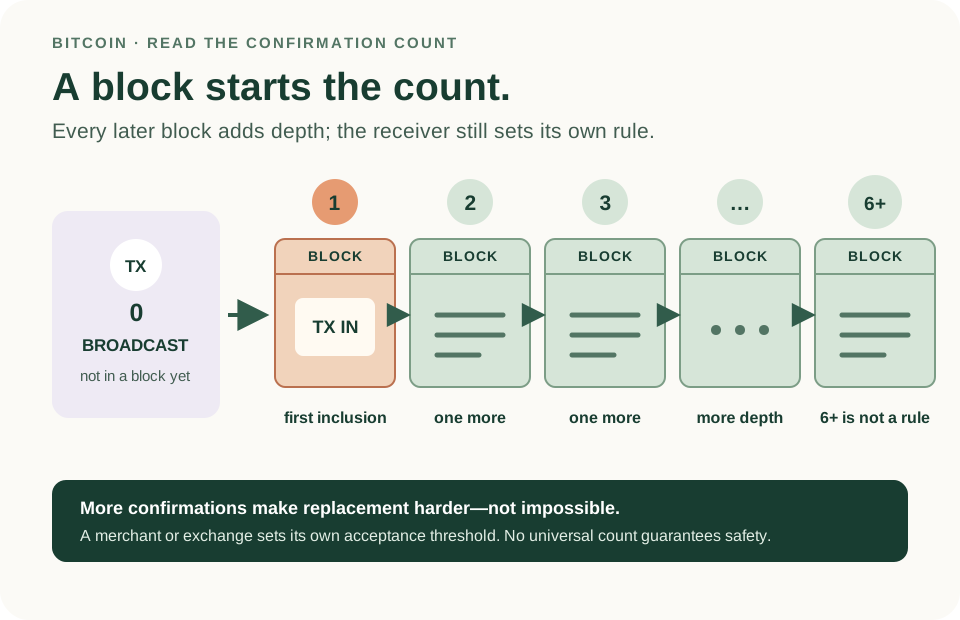
A broadcast Bitcoin transaction has zero confirmations until a block includes it; that block gives it one confirmation, and each later block adds another. More blocks build on its history, but the count is not a universal guarantee: a reorganization can replace recent history, and the receiving service chooses what count it accepts. See Bitcoin confirmations explained for the count and its limits.
Ethereum: included is not the same as finalized
Ethereum records executed transactions in ordered blocks. Its proof-of-stake protocol has a separate finality process: checkpoints become finalized through supermajority links backed by at least two-thirds of staked ETH. That describes the protocol's chain status; it does not say whether an exchange has credited a deposit or completed its own checks.
Solana: three ordered commitment labels
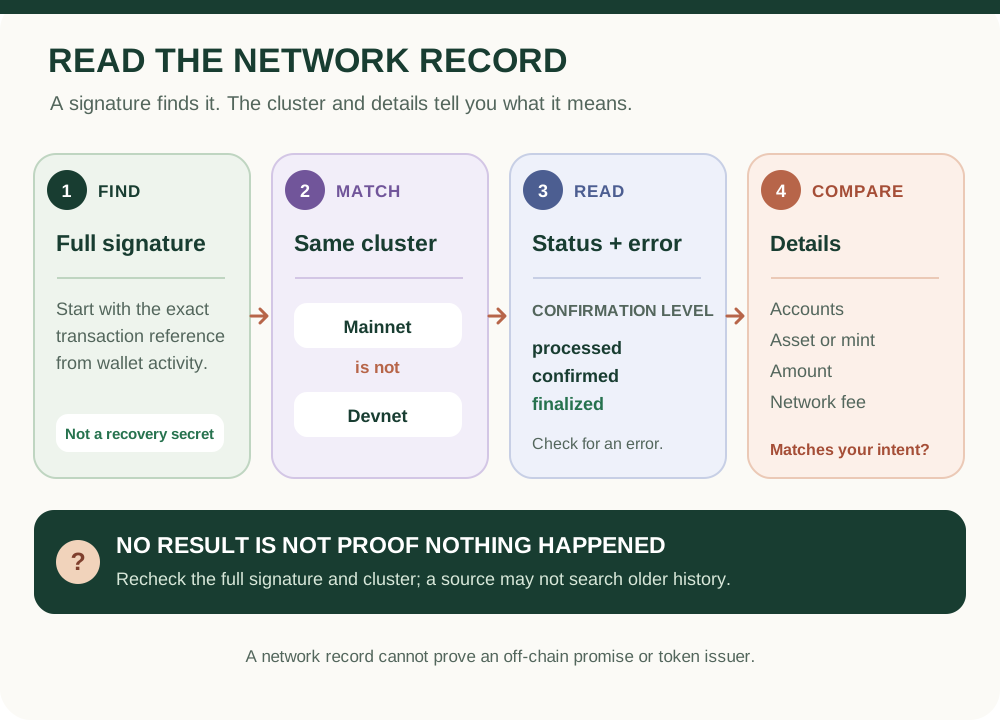
Solana RPC status can report processed, confirmed or finalized. These are ordered commitment levels defined by Solana, with finalized stronger than confirmed and confirmed stronger than processed. They are not interchangeable with Bitcoin's block count or Ethereum's finality process. For one transaction, match its signature and cluster, then read the status and any error together in the Solana explorer guide.
The receiving service has a separate decision
An exchange may show a deposit as pending after the network has recorded it because its current crediting rule or internal processing is not complete. Check that service's own deposit status and asset/network instructions; do not borrow a confirmation threshold from another service. There is no universal number that applies to every chain, asset or receiver.
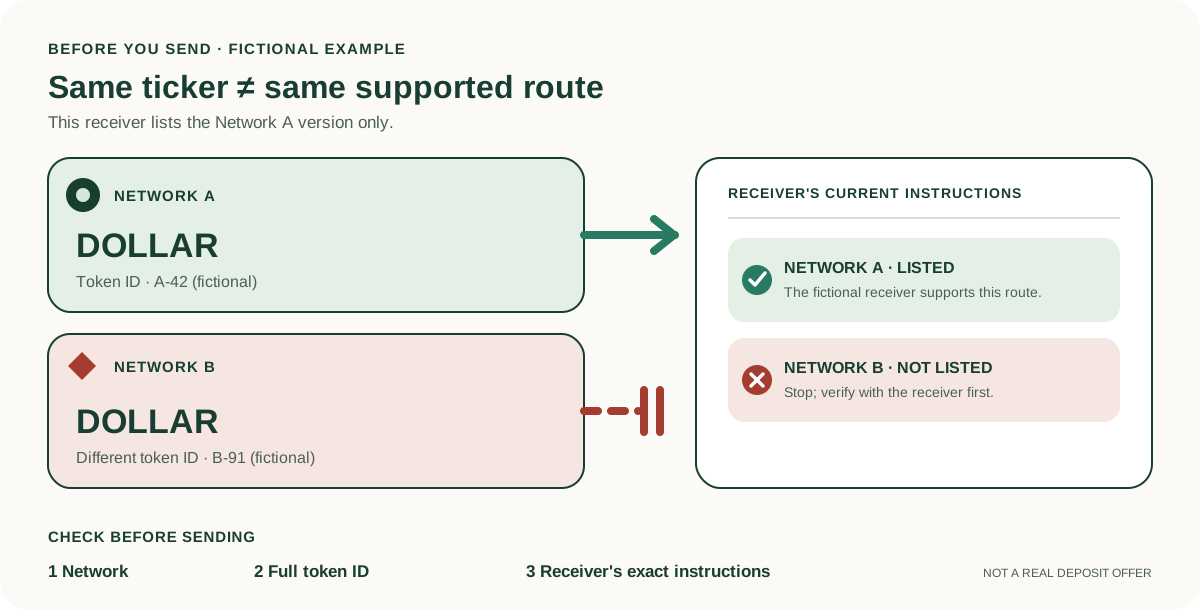
Before retrying, match the full transaction reference, network, asset and destination, then inspect the network result and the receiver's current policy. A slow screen alone is not proof that the transfer failed, so do not submit a duplicate just to make the display change. Do not pay an unsolicited “validation fee”; reach support through a route you independently trust.
Practise without money
A fictional Bitcoin transfer has one confirmation, while the receiving exchange still says pending. Name the two separate facts: the transaction appears in a block, and the service has not yet marked the deposit complete. Which current service rule would you check next? No wallet or transfer is needed.
For the full Bitcoin signing-to-confirmation path, continue with how Bitcoin transactions work. For Solana transaction status, see how to check a Solana transaction.
Check your understanding.
A Bitcoin explorer shows one confirmation, but a receiving exchange still says pending. What does that establish?
A correct answer records local learning progress, not a qualification or proof of financial readiness.
Put this lesson in context
Work through the asset, network and destination checks, then learn to interpret a transaction result.
Sources & context
- Bitcoin Developer Guide — Payment Processing ↗Consulted 2026-10-11
- Bitcoin Developer Guide — Block Chain ↗Consulted 2026-10-11
- ethereum.org — Blocks ↗Consulted 2026-10-11
- ethereum.org — Proof-of-stake: transaction execution and finality ↗Consulted 2026-10-11
- Solana documentation — Production Readiness: Understanding Confirmation Levels ↗Consulted 2026-10-04
- Solana documentation — getSignatureStatuses RPC method ↗Consulted 2026-10-04
- US Federal Trade Commission — Cryptocurrency and scams ↗Consulted 2026-10-09
Original educational content prepared for this project. Sources provide context, not endorsement or a guarantee that every statement remains current. Rules, product interfaces and availability can change.
Keep learning in Telegram.
Open this published guide in the learning bot. No account connection or wallet is needed.
Join the $STONKB community.
Follow project updates, share useful ideas and meet other builders. You do not need to buy $STONKB to join.
Take what you learned.
Leave the pressure behind.