This guide is educational, not personalized financial, legal or security advice. A checklist reduces avoidable mistakes; it cannot make a transaction risk-free.
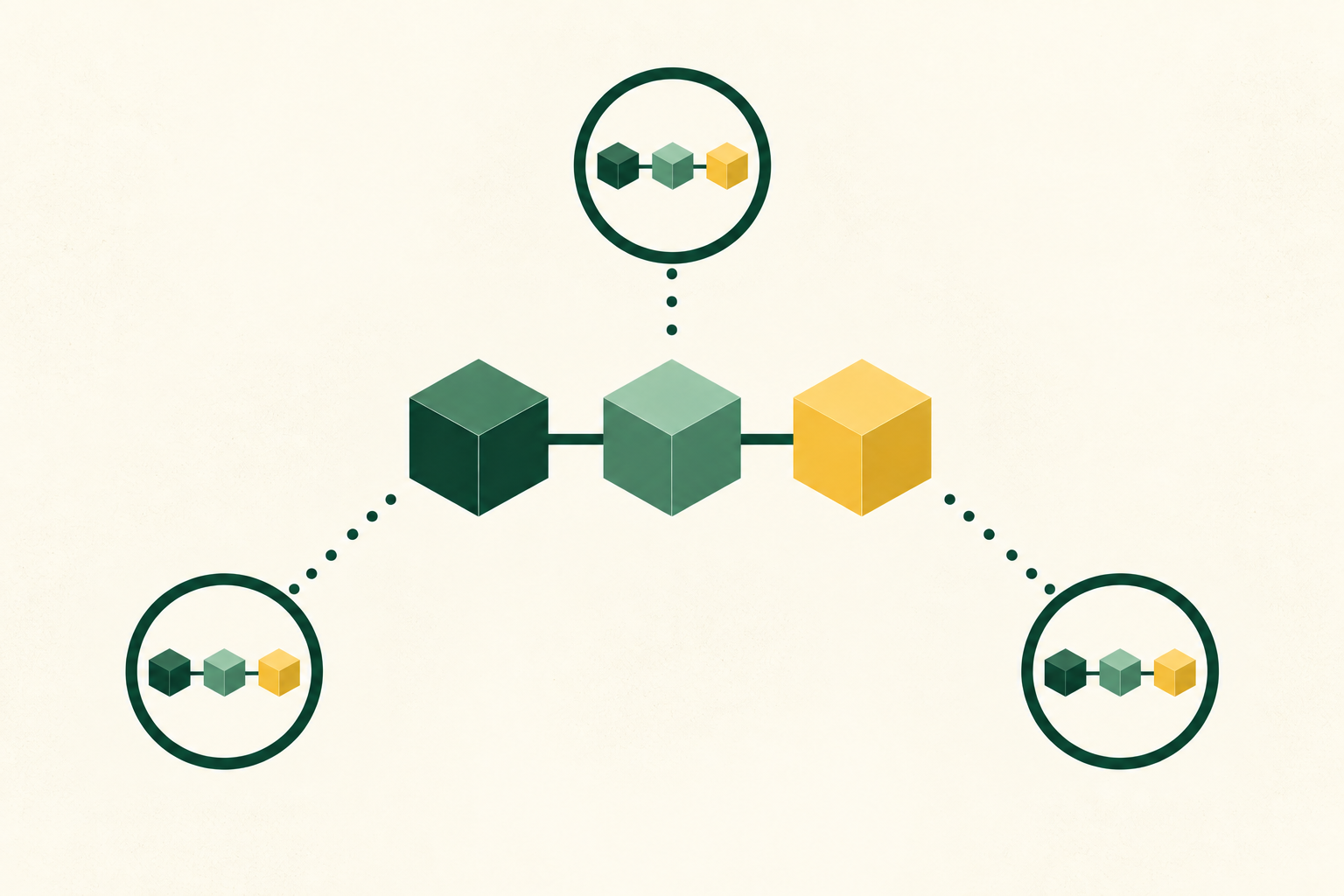
The ledger can show an accepted update. It cannot, by itself, prove that an off-chain claim is true.
- A transaction proposes a change.
- Network rules check whether the change is valid.
- Accepted updates join ordered history.
- Outside evidence is still needed for outside-world claims.
Point to one thing this picture can help you verify and one thing it cannot verify.
The idea in plain English
A blockchain is a record of ordered updates shared among network participants. Transactions propose changes; network rules determine whether those changes are valid. Blocks package updates and link them to previous history. This makes unauthorized rewriting difficult under the network’s security assumptions, but not every public network has the same security or finality.
The distinction that matters
The ledger checks rules it can observe. It cannot independently decide whether a seller shipped a real object, whether a link is honest or whether a token issuer owns a building. Those claims require outside evidence. Consensus about a record is not consensus about the quality of a business.
A practical example
Picture a public notebook whose accepted entries must follow a rulebook. An entry can prove that one address transferred a token to another. It does not prove that the token is a legal title to a house. The missing connection lives in contracts, registries and other off-chain systems.
Try this without moving money
- Draw a transaction entering a block and the block joining prior history.
- List one claim the ledger can show and one it cannot.
- Look for the network’s own explanation of confirmation and finality.
A mistake to avoid
A record being difficult to alter does not make the original input truthful. Bad information can be recorded durably too.
Before you act
Learning the vocabulary is not a recommendation to buy. A technology can be useful while a particular token is unsuitable for you. Keep essential expenses outside an experiment, and separate facts about a network from opinions about its price. The most useful beginner question is often what could fail, not how much it might earn.
Check your understanding.
What does a blockchain transfer establish?
A correct answer records local learning progress, not a qualification or proof of financial readiness.
Sources & context
- Bitcoin.org — Some things you need to know ↗Consulted 2026-09-23
- ethereum.org — Ethereum accounts ↗Consulted 2026-09-23
- Bitcoin Developer Guide — Block Chain ↗Consulted 2026-09-23
Original educational content prepared for this project. Sources provide context, not endorsement or a guarantee that every statement remains current. Rules, product interfaces and availability can change.
Take what you learned.
Leave the pressure behind.