This guide is educational, not personalized financial, legal or security advice. A checklist reduces avoidable mistakes; it cannot make a transaction risk-free.
A learning route, not a recommendation to buy. A provider listing, small test, or completed transaction is not proof that an asset or service is safe.
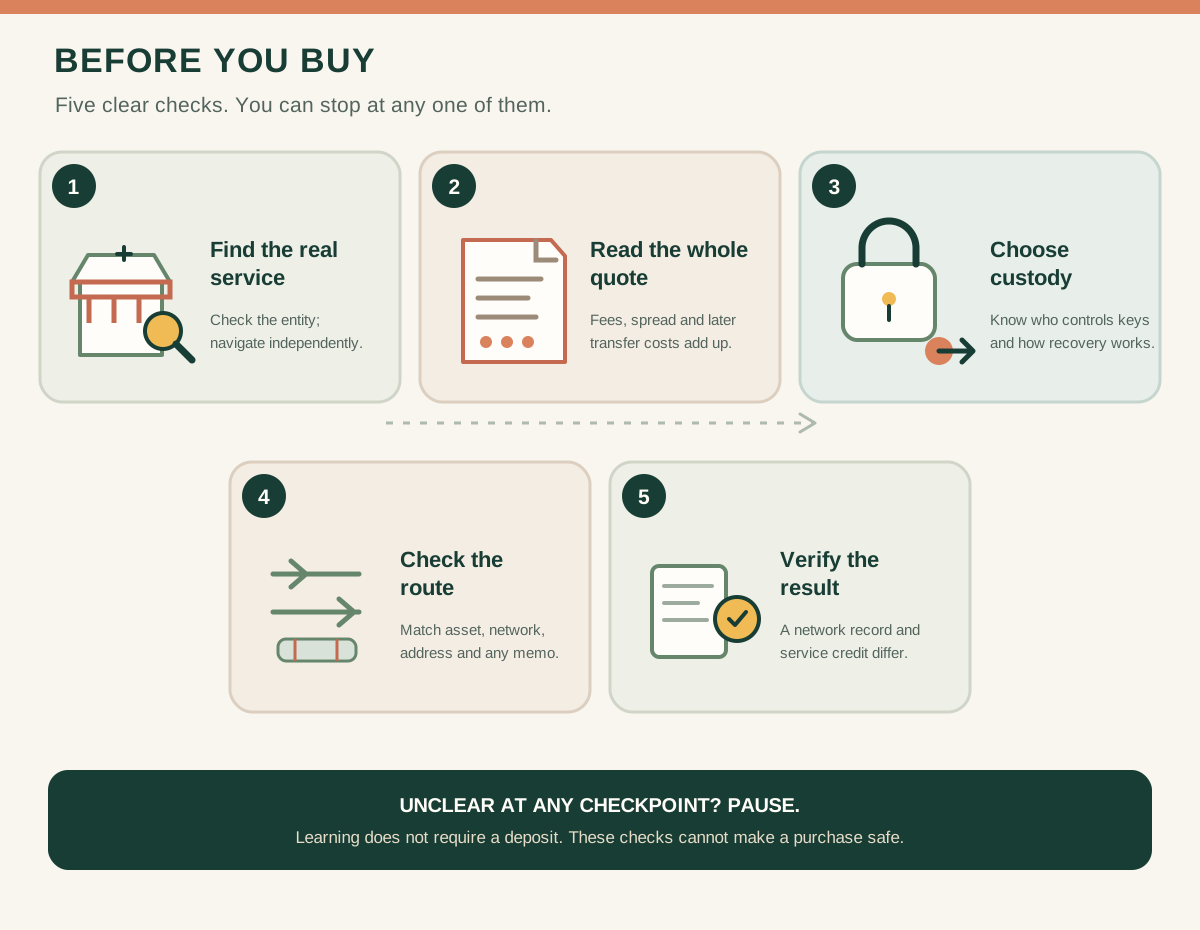
- Identify the legal entity and independently reach its genuine service; check what any local registration actually covers.
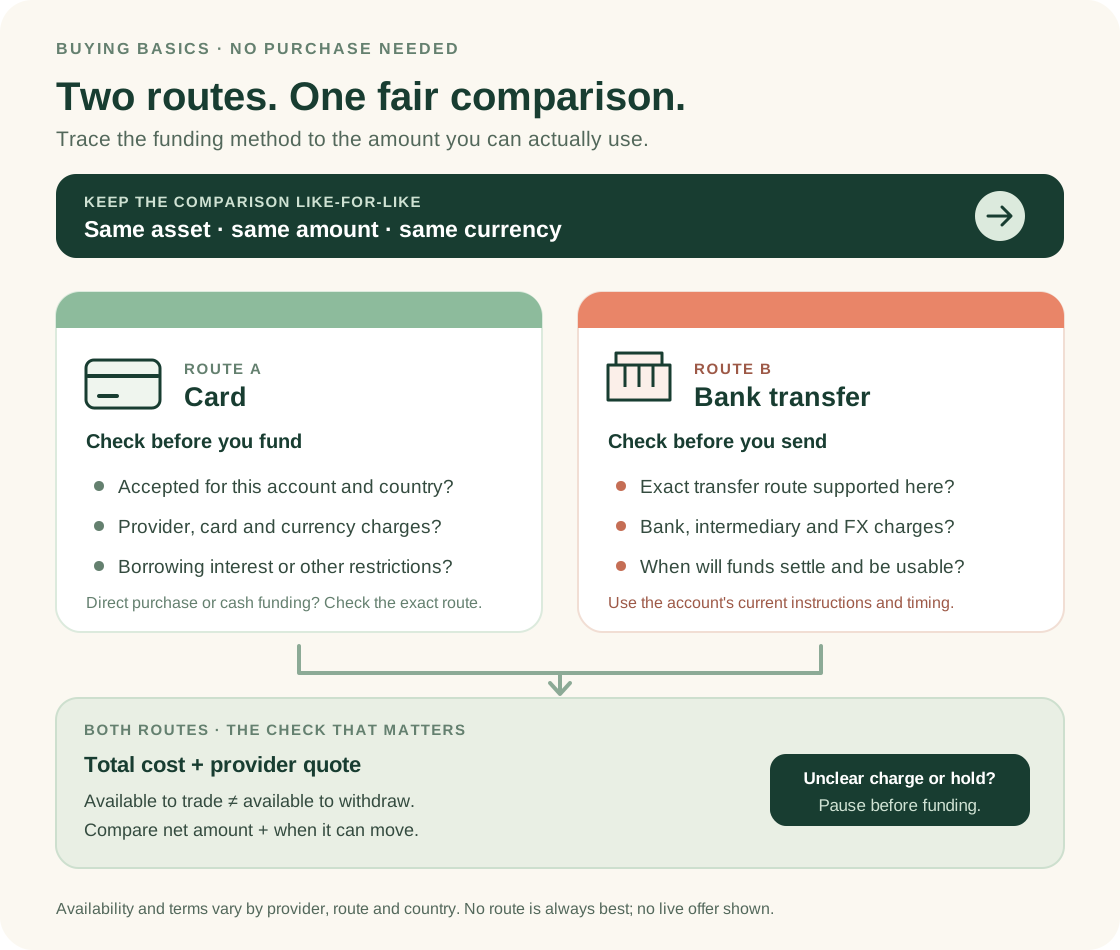
- Inspect the total cost, including explicit fees, any spread, and later withdrawal or cash-out costs.
- Decide whether you or a provider controls wallet keys, and understand recovery before funding anything.
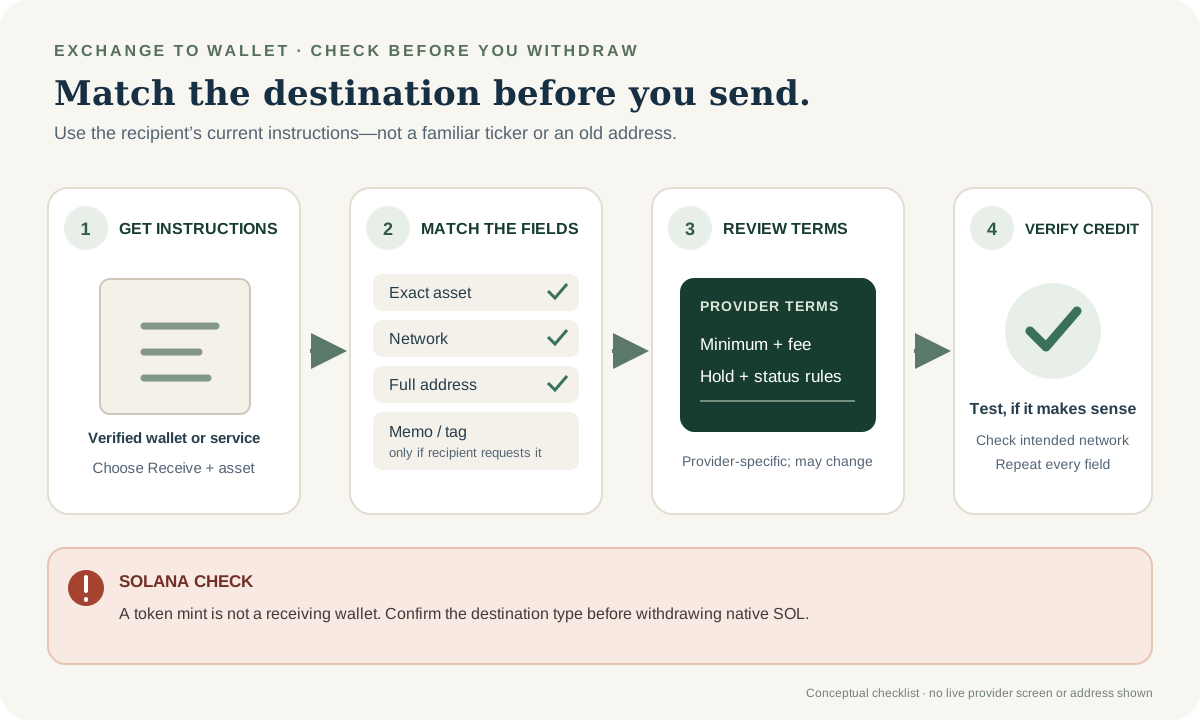
- If withdrawing, match the exact asset, supported network, full address, and any required memo or tag.
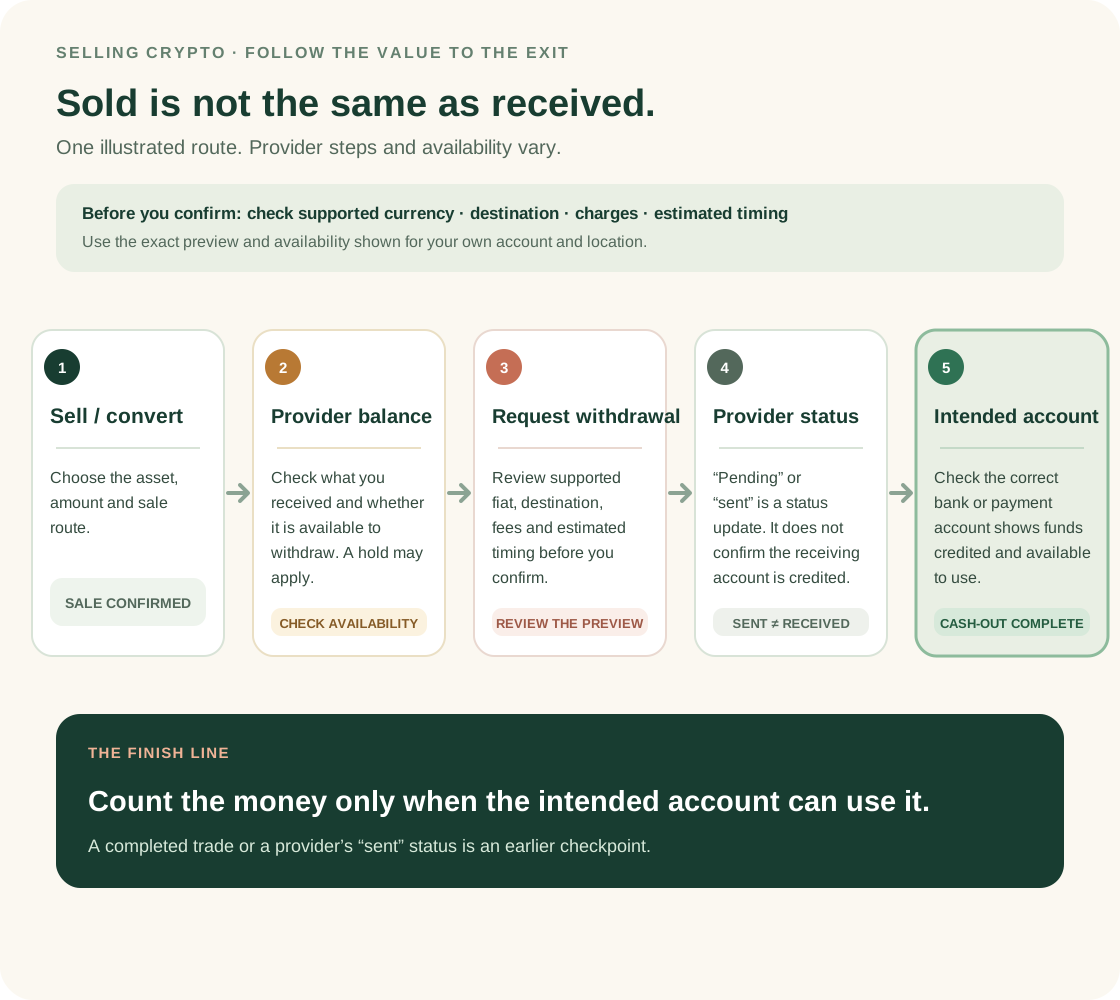
- Check both the network transaction and the receiving service's actual credit; neither proves the provider or asset is safe.
A fictional provider shows an attractive quote but does not clearly explain who controls the wallet keys or whether it supports the receiving network. Which checkpoint is still unresolved, and what could you do without depositing?
The short version
Start by deciding whether you are learning or making a financial decision. Do not put essential expenses at risk. Check that buying is allowed where you live and identify the exact legal entity behind a provider. If your local regulator lists firms for this activity, check the exact entity and what its permission covers: a listing is not a guarantee of safe custody or reimbursement. Reach the genuine service independently, understand the full quote and withdrawal terms, and secure account access before funding it. You can stop at any point.
Know what you are buying and where it will be held
Before confirming an order, know the exact asset, order type, total cost and custody destination. A balance inside a service and an asset withdrawn to a wallet are different arrangements. A successful purchase does not mean a withdrawal is supported on the network you want. Plan the complete route—including any later sale and cash withdrawal—before paying.
An illustrative case
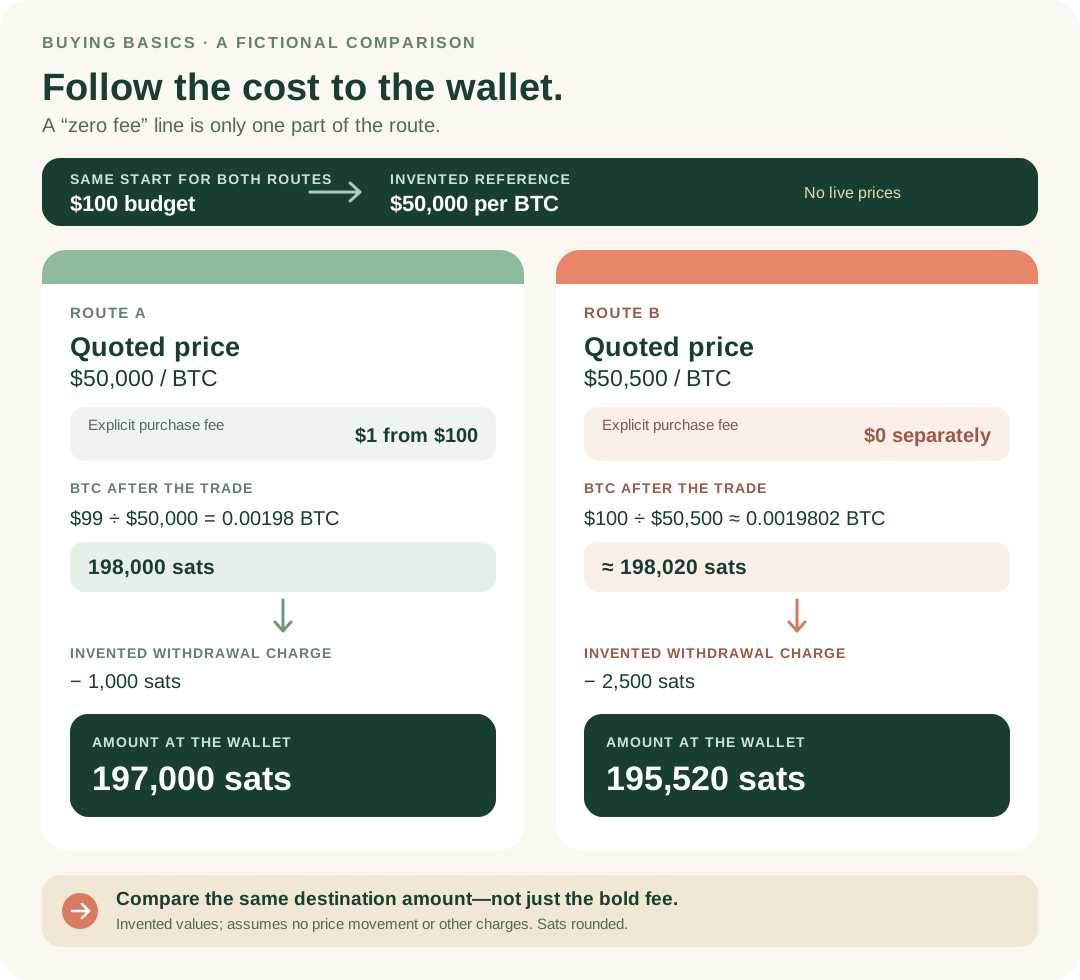
In a fictional purchase, a $100 payment includes a $2 service fee and an additional spread in the quoted price. The resulting asset could have a reference-market value below $98; a later $3 withdrawal charge would add another cost. These example amounts are not current prices or a provider quote. The point is to compare what you pay with what you receive, then include the cost of moving or cashing out.
A no-money review
- Find the provider’s legal entity and reach its official site using a source you found independently.
- Read the complete quote, custody terms and supported withdrawal route without depositing.
- Decide who controls the keys and how account or wallet recovery works. Never disclose a wallet recovery phrase or private key.
Where readers go wrong
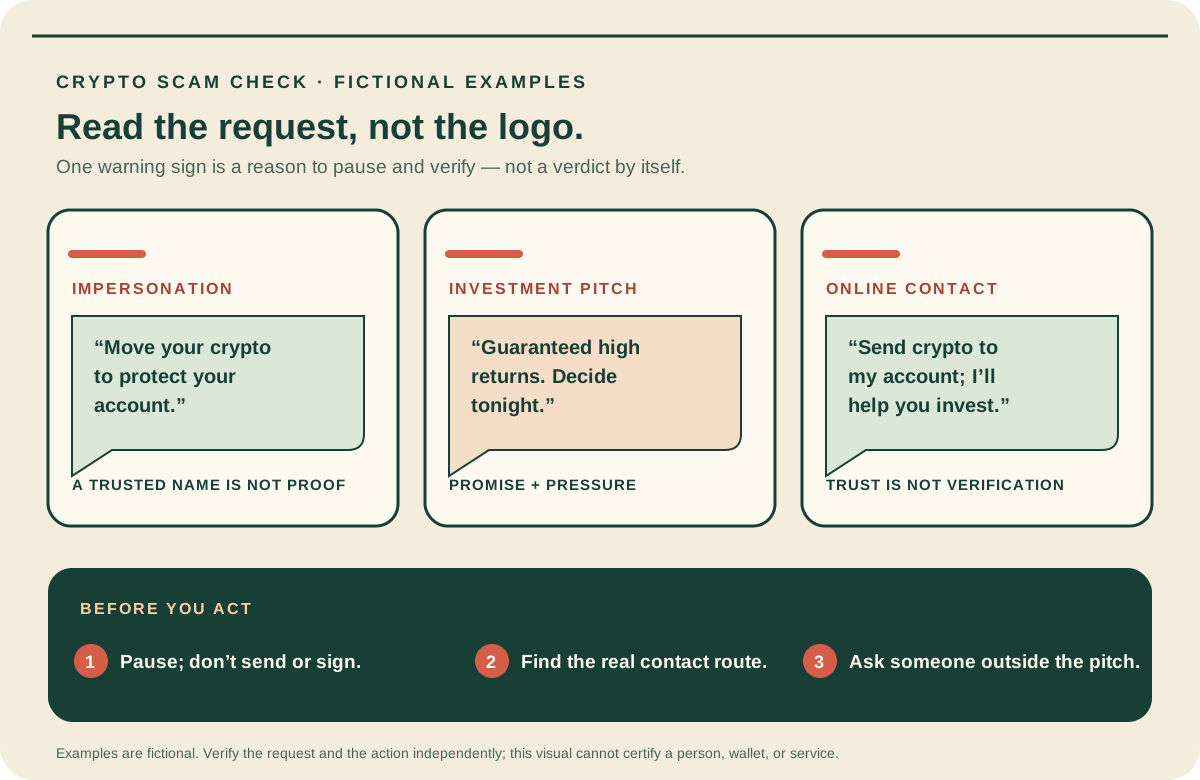
Do not let a referral bonus, deadline or influencer rush the process. Stop if someone promises guaranteed returns, asks you to buy or send crypto to “protect” money, or demands an extra payment to unlock an investment balance. The FTC’s consumer guidance on crypto scams describes these patterns. For a step-by-step check of the request and next action, see how to spot a crypto scam before sending money. A message that looks like it comes from a known company or authority can still be an impersonation.
The practical takeaway
No provider or checklist removes market, custody, operational or fraud risk. Availability, identity checks, insurance, consumer protections and tax treatment depend on your location, provider and asset. Check current local information. This guide is a learning aid—not an exchange endorsement, a legal determination or a recommendation about how much to buy. Choosing not to buy is a valid outcome.
A deliberate first-purchase sequence
1. Identify the service. Find the legal entity that would serve you, check whether it supports your location and the service you need, and navigate to its genuine site independently. A registration or licence applies only to its stated scope; it does not by itself prove that a provider is safe or that funds are insured.
2. Secure access and understand custody. Use strong account security and learn what recovery depends on. Decide whether a provider or you would control the wallet keys. The SEC staff’s custody bulletin explains that self-custody places key security on you, while a third-party custodian introduces provider risks. Never share a private key or recovery phrase.
3. Inspect the complete quote. Check the exact asset, order type, quote expiry, payment amount, explicit fees, spread and expected output. A market order may execute at multiple prices; a limit order may not fill. Include any funding, withdrawal or cash-out charges. These are questions to understand, not a suggested purchase amount.
4. Check the route before moving anything. If you may withdraw, confirm from the receiving service’s own instructions that it supports the exact asset and network. Match the full address and any required memo or tag; check minimums and fees. A small test can reveal some mistakes, but it cannot prove that a provider is honest or guarantee a later transfer.
5. Verify the result independently. Keep the receipt, check the transaction through the relevant service or network, and confirm that the receiving service actually credited the asset. A transaction appearing on a network and a provider credit are separate outcomes. Do not put recovery secrets in notes or accounting records.
If your route includes withdrawing crypto from an exchange to a wallet you control, use the field-by-field exchange-to-wallet checklist before sending. For the Bitcoin-specific route distinction, see how to buy bitcoin safely.
Conditions that should stop the process
Pause if the provider, asset, total cost, custody arrangement, network or recovery process is unclear. Stop if someone asks you to keep an offer secret, guarantees a return, requests your private key or recovery phrase, or demands an unexpected payment to release funds. You do not need proof of fraud to decide not to proceed.
A successful small transaction reduces only a limited set of uncertainties. It does not validate a platform’s solvency, an asset’s quality, a promoter’s honesty or the suitability of a purchase.
Check your understanding.
What should be clear before confirming a purchase?
A correct answer records local learning progress, not a qualification or proof of financial readiness.
Put this lesson in context
Compare the whole process, including custody and withdrawal costs, before choosing your next lesson.
Sources & context
- Investor.gov (SEC Office of Investor Education and Assistance) — Crypto Asset Custody Basics for Retail Investors — Investor Bulletin ↗Consulted 2026-10-10
- US Federal Trade Commission — Cryptocurrency and scams ↗Consulted 2026-10-09
Original educational content prepared for this project. Sources provide context, not endorsement or a guarantee that every statement remains current. Rules, product interfaces and availability can change.
Keep learning in Telegram.
Open this published guide in the learning bot. No account connection or wallet is needed.
Join the $STONKB community.
Follow project updates, share useful ideas and meet other builders. You do not need to buy $STONKB to join.
Take what you learned.
Leave the pressure behind.