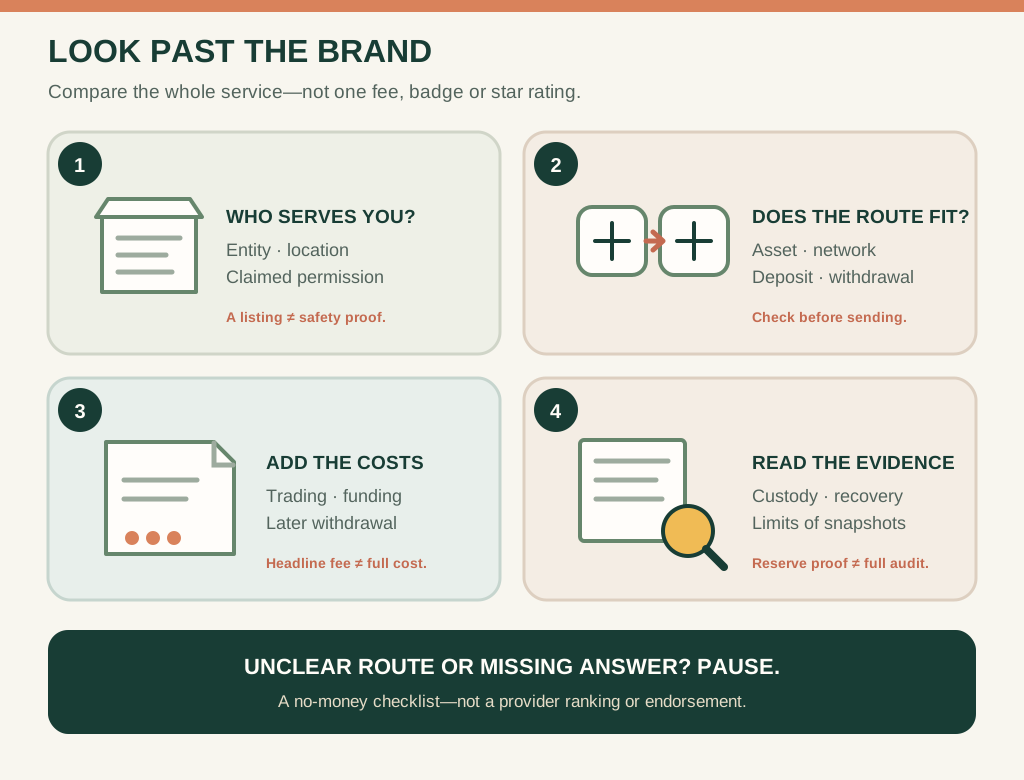
This guide is educational, not personalized financial, legal or security advice. A checklist reduces avoidable mistakes; it cannot make a transaction risk-free.
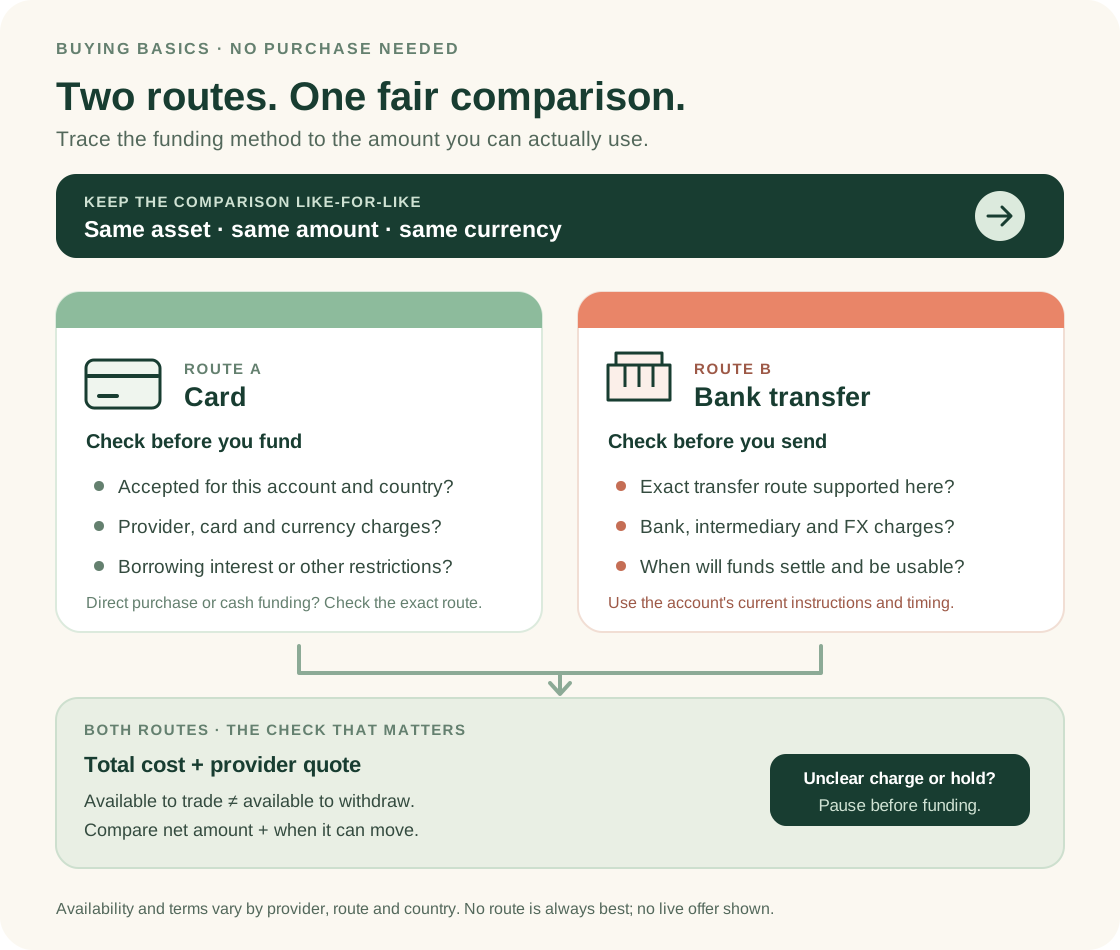
A comparison workflow, not a live offer. Accepted methods, fees, settlement and withdrawal availability vary by provider, payment route and country.
- Check whether the specific card or transfer route is available for your account and location.
- Add provider, payment-institution and currency-conversion charges; leave unclear amounts unknown.
- Compare the same asset, amount and currency, including the provider's quote and any separate trading charge.
- Check when the balance can be withdrawn to the intended destination; available to trade may differ from available to withdraw.
A fictional card route shows a $4 fee; a bank route shows $1, but its conversion charge and withdrawal timing are unclear. What can you compare now, and what must you verify before funding either route?
Follow both routes to the same endpoint
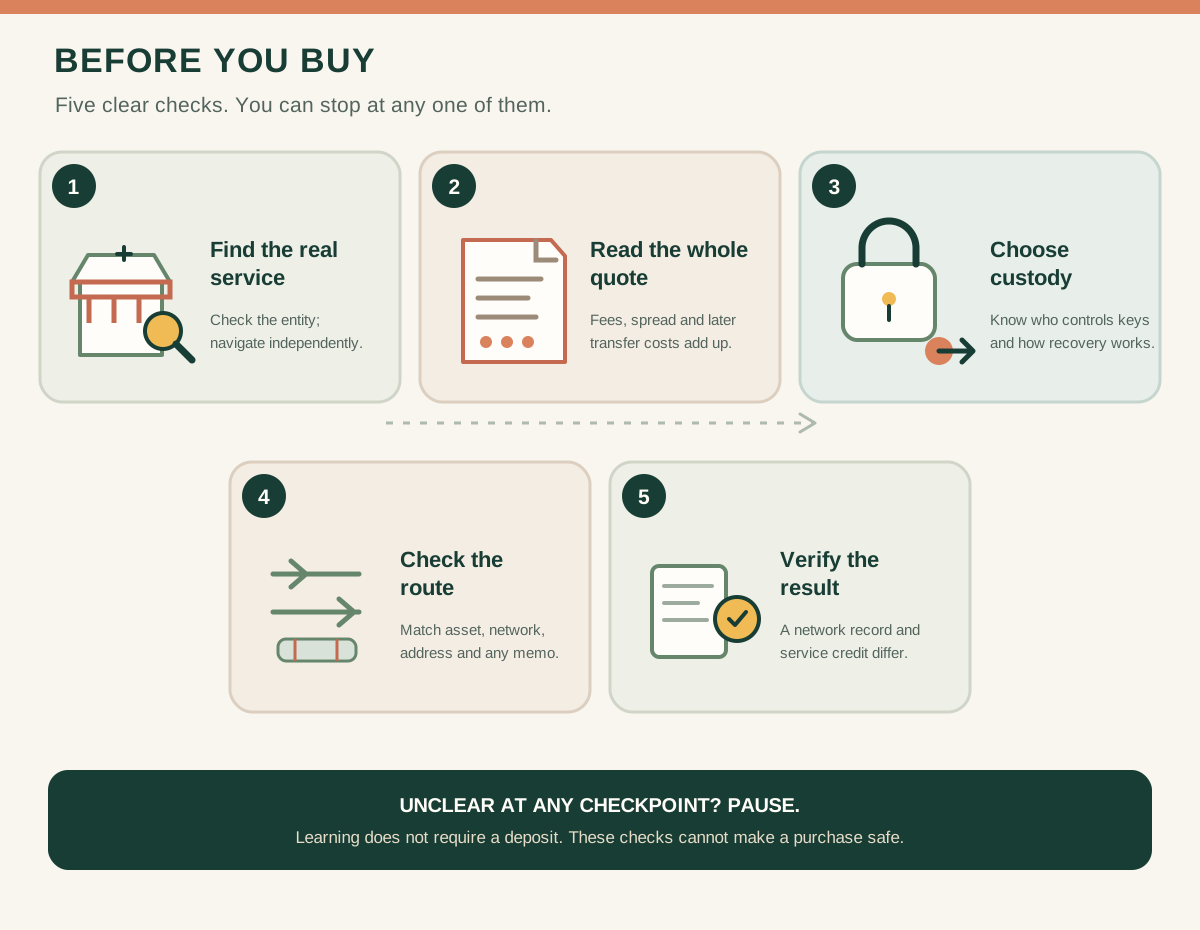
A card or bank transfer is only one leg of a crypto purchase. Compare the complete route: what you pay, the amount the provider quotes, when the purchase is usable, and whether you can withdraw to your intended destination. No method is always the cheapest, fastest or safest.
The label does not tell you the exact flow. A provider may offer a direct card purchase or ask you to add cash by bank transfer; accepted methods and what they can do vary by account and location. For example, Coinbase's APAC payment table lists different buy, deposit, withdrawal and settlement options across countries. That is one provider's current example, not a rule for every service. Check the instructions shown for your own account before sending money.
Compare each funding path
For a card route, check whether your issuer and provider allow the transaction, the provider's purchase charge, any card or currency-conversion fee, and whether borrowing would add interest. For a bank route, check the exact transfer instructions, bank or intermediary charges, currency conversion and expected settlement. Either route may have account-specific limits or restrictions. Costs and availability depend on the route, provider, payment institution, currency and location.
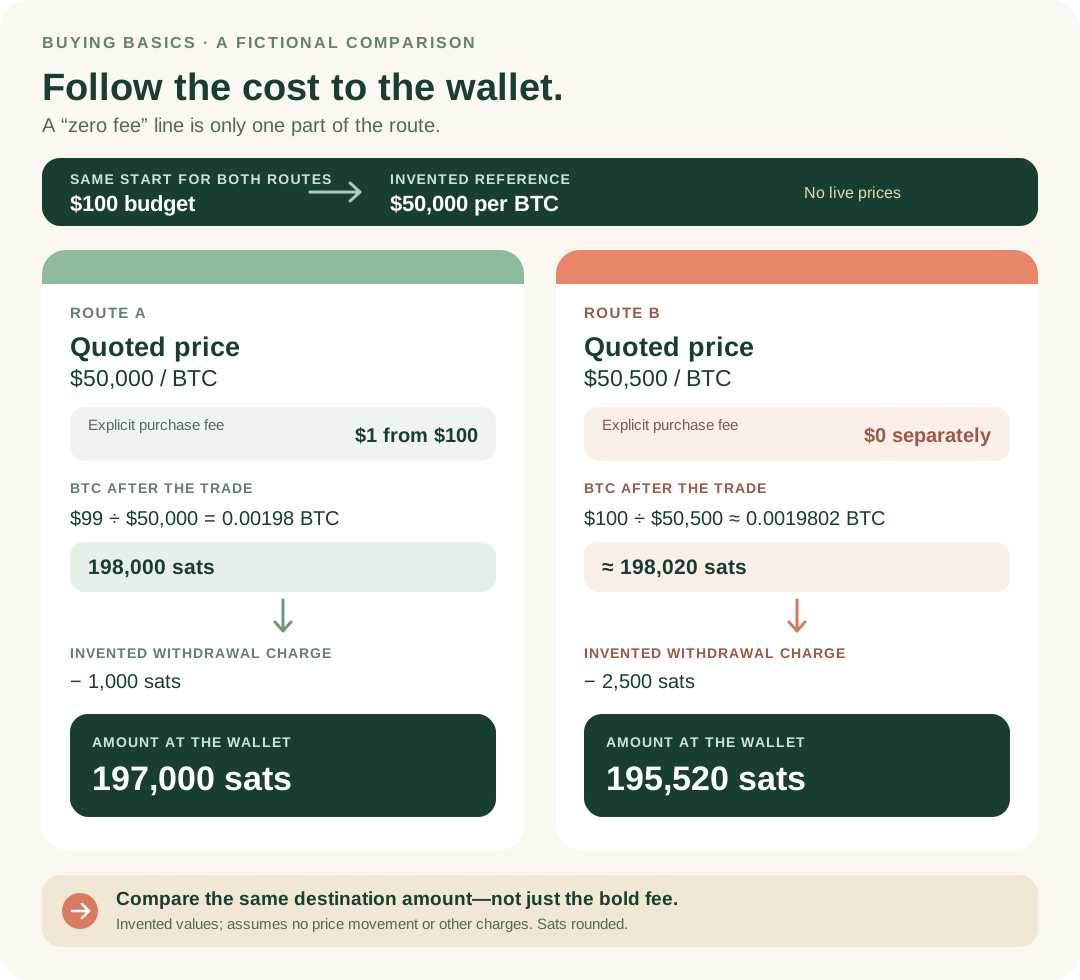
Then compare the same asset, amount and currency. Include the provider's quoted price and any separate trading charge; a low funding fee alone does not show how much crypto the order would buy. If your destination is a wallet, also check the withdrawal charge, supported network and when the purchased balance may actually be sent. “Available to trade” is not necessarily “available to withdraw.”
A fictional $100 example
Suppose one invented route lists a $4 card charge and another lists a $1 bank-transfer charge. If that second route separately incurs a made-up 3% currency-conversion charge on $100, that adds $3: its modeled payment charges total $4 before any trading or withdrawal costs. This arithmetic is illustrative, not a typical offer. It shows why the boldest line item is not the full comparison.
Know which payment you are making
Paying a provider by card to buy crypto is different from later sending crypto to another person or wallet. The U.S. FTC explains that cryptocurrency payments typically are not reversible and do not have the same legal protections as credit- or debit-card payments; that is not a promise that a card dispute will reverse a crypto transfer or guarantee a refund. Rules and issuer processes depend on jurisdiction and the exact transaction. Read the FTC's crypto payment guidance in its U.S. context, then check your own provider and payment-institution terms.
A no-money comparison
- Use the same asset, fiat amount, currency and intended destination for both routes.
- Record every provider, bank/card and currency-conversion charge; mark unclear costs as unknown.
- Check the quoted amount, settlement estimate, account restrictions and withdrawal availability separately.
- Read the payment institution's dispute process and the provider's refund, cancellation and withdrawal terms.
Do not borrow for a speculative purchase without understanding interest and the possibility of losing the money. Speed does not make an asset or provider safer. For how quoted prices and trading charges change the final amount, see crypto fees and spreads; for the wider first-purchase sequence, see how to buy crypto more safely. You can stop before funding. This guide is a comparison method, not an exchange endorsement or a recommendation to buy.
Check your understanding.
Before choosing a funding route, what should you compare?
A correct answer records local learning progress, not a qualification or proof of financial readiness.
Put this lesson in context
Compare the whole process, including custody and withdrawal costs, before choosing your next lesson.
Sources & context
- Coinbase Help — Add and verify a payment method - APAC ↗Consulted 2026-10-05
- US Federal Trade Commission — Cryptocurrency and scams ↗Consulted 2026-10-09
Original educational content prepared for this project. Sources provide context, not endorsement or a guarantee that every statement remains current. Rules, product interfaces and availability can change.
Keep learning in Telegram.
Open this published guide in the learning bot. No account connection or wallet is needed.
Join the $STONKB community.
Follow project updates, share useful ideas and meet other builders. You do not need to buy $STONKB to join.
Take what you learned.
Leave the pressure behind.