This guide is educational, not personalized financial, legal or security advice. A checklist reduces avoidable mistakes; it cannot make a transaction risk-free.
Read the report as a bounded piece of evidence
A reserve disclosure describes assets, and sometimes related liabilities, under a stated methodology and date. An attestation examines specified information against defined criteria. An audit can have a broader or different scope depending on the engagement. The labels are not interchangeable; read the actual report, named entities, period, assurance wording and limitations.
Reporting schedules also differ by issuer. Circle says it discloses USDC reserve holdings weekly and provides monthly third-party assurance; its transparency page describes the schedule and links the dated reports. Tether says it typically publishes quarterly reserve reports prepared by BDO Italia, while noting that it does not commit to a fixed update interval; see its reporting FAQ. These are issuer-described procedures, not proof about a particular asset or report. Check the dated document and its scope directly.
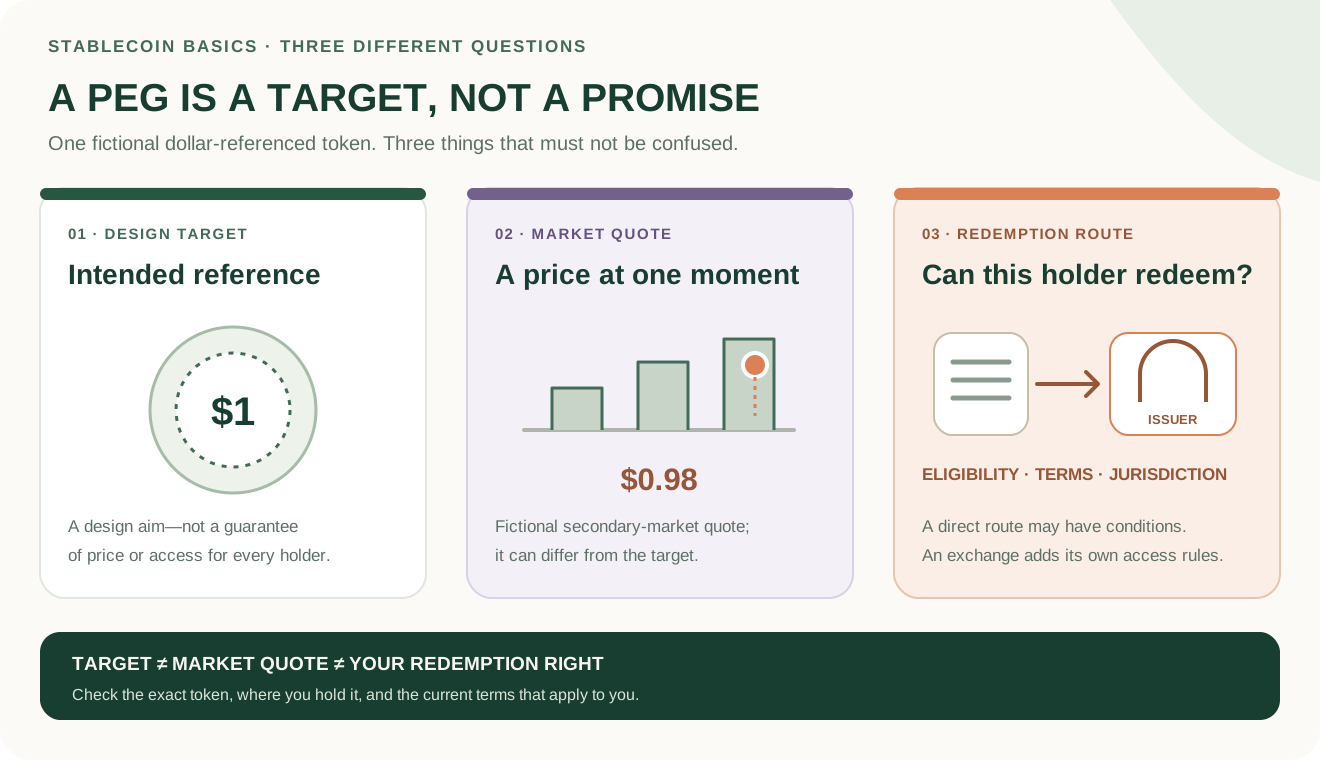
Then inspect composition, liquidity, concentration, custody and the relationship between disclosed reserves and tokens in circulation. A point-in-time observation does not guarantee that the same assets remain available later. It also does not tell every holder what legal redemption rights they have.
The inference that goes too far
A fictional issuer reports sufficient assets on a stated date. A holder concludes that every reserve asset can be sold instantly at face value, that every token holder can redeem directly and that the bank account has government deposit protection. Those conclusions may exceed the report. Settlement delays, market risk, eligibility, geography and platform custody still matter.
A closer check
Keep the report date beside every reserve conclusion. Ask what entity was examined, what liabilities or circulation figure were included, which assets were valued and what the assurance language excludes. A bounded report can be useful evidence without proving future solvency, instant liquidity or your personal redemption eligibility.
A careful reading routine
Record the report date, scope, issuer, reserve categories, circulation figure, assurance provider and any qualifications. Find the current redemption terms separately. Ask what the report does not test: future solvency, operational access, smart-contract risk, a particular exchange's balance or your personal ability to redeem. Compare the report's date with any decision you are making, and save a copy of the source used so you can identify what changed later. For the wider mechanism, read what is a stablecoin?.
Check your understanding.
What must accompany a reserve total?
A correct answer records local learning progress, not a qualification or proof of financial readiness.
Put this lesson in context
Separate a stablecoin label from the issuer, network and redemption terms behind it.
Sources & context
- Circle — USDC reserve transparency ↗Consulted 2026-10-07
- Tether — Reserve transparency ↗Consulted 2026-10-07
- Tether — How often does Tether provide its transparency information? ↗Consulted 2026-10-07
Original educational content prepared for this project. Sources provide context, not endorsement or a guarantee that every statement remains current. Rules, product interfaces and availability can change.
Keep learning in Telegram.
Open this published guide in the learning bot. No account connection or wallet is needed.
Join the $STONKB community.
Follow project updates, share useful ideas and meet other builders. You do not need to buy $STONKB to join.
Take what you learned.
Leave the pressure behind.