This guide is educational, not personalized financial, legal or security advice. A checklist reduces avoidable mistakes; it cannot make a transaction risk-free.
The dollar sign hides the legal and technical arrangement
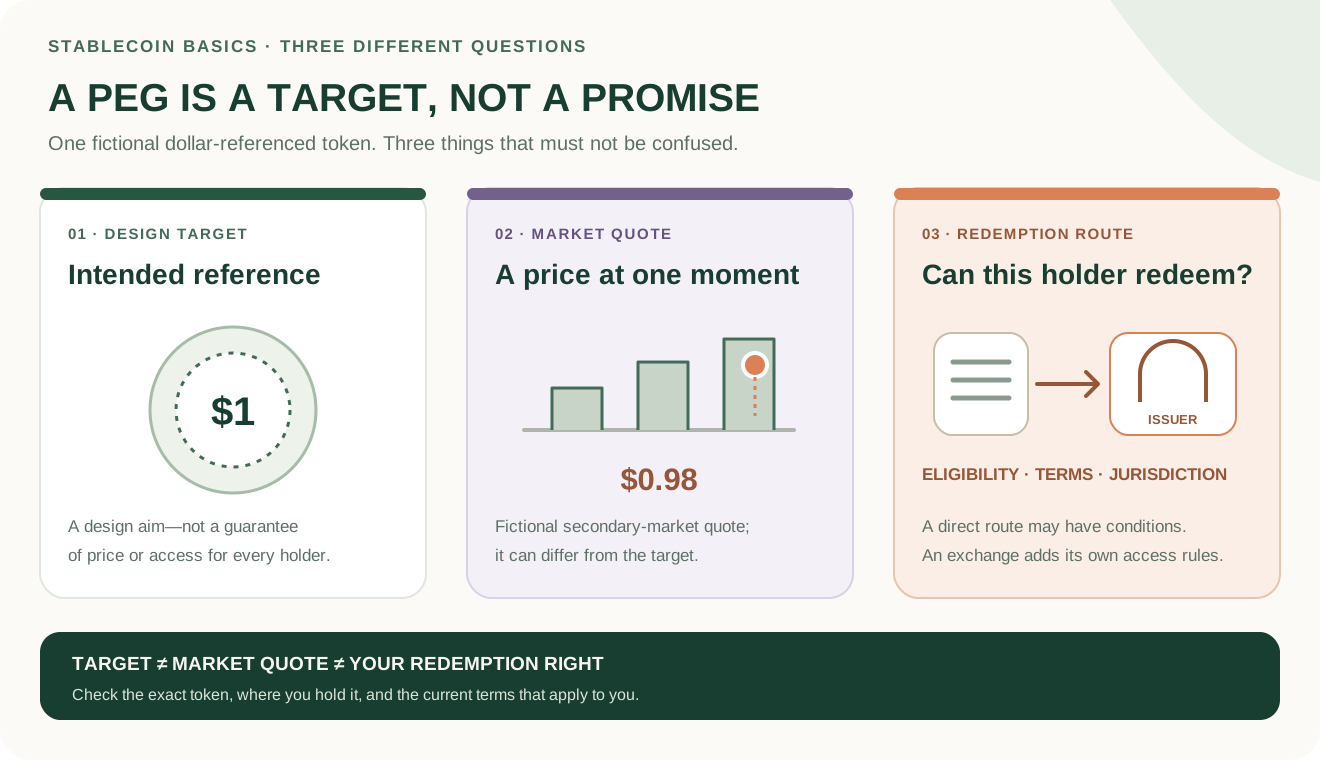
A bank balance, exchange balance and self-custodied stablecoin can each display $500, but they do not represent the same claim. Identify who owes or controls the value, how withdrawals work, what can pause access and which legal protections actually apply. Similar formatting is not evidence of equivalent rights.
Bank protection, where available, has jurisdiction-specific eligibility and limits. A stablecoin or platform does not inherit bank treatment merely because it references the dollar. Issuer terms, network behavior, exchange custody and wallet recovery each add a different risk layer. Banks also have operational constraints; the comparison should describe the task rather than turn into a slogan about replacing one system.
Three balances, three failure stories
One fictional $500 balance is a bank deposit, one is an exchange's internal credit and one is a token controlled by a wallet. The first may depend on bank access and applicable protection rules. The second depends on the platform's records, solvency and withdrawal policy. The third depends on the token's redemption or market route and the user's signing and recovery process. The number alone does not tell you which story applies.
A closer check
Match the balance to its job. For a bill due tomorrow, access during an outage matters; for a cross-border payment, the recipient's exit matters; for savings, the claim and protection matter. A dollar symbol does not answer those questions, so record the failure path before assigning the balance a role.
Match the balance to the job
For rent or a bill due tomorrow, ask whether the balance can be accessed during a provider outage, account review or network congestion. For a cross-border payment, ask whether the recipient has a reliable conversion route. For long-term savings, ask what claim, protection and recovery plan survives if the app disappears. A useful comparison starts with the job and then documents the failure path.
Before calling any balance an emergency fund, write its claim, access route, delay, counterparty and recovery failure. For the token layer, read what is a stablecoin?; for custody, read custody vs ownership.
Check your understanding.
What makes two dollar balances comparable?
A correct answer records local learning progress, not a qualification or proof of financial readiness.
Put this lesson in context
Separate a stablecoin label from the issuer, network and redemption terms behind it.
Sources & context
- ethereum.org — Stablecoin mechanisms ↗Consulted 2026-10-05
- Circle — USDC reserve transparency ↗Consulted 2026-10-07
- Tether — Reserve transparency ↗Consulted 2026-10-07
Original educational content prepared for this project. Sources provide context, not endorsement or a guarantee that every statement remains current. Rules, product interfaces and availability can change.
Keep learning in Telegram.
Open this published guide in the learning bot. No account connection or wallet is needed.
Join the $STONKB community.
Follow project updates, share useful ideas and meet other builders. You do not need to buy $STONKB to join.
Take what you learned.
Leave the pressure behind.