This guide is educational, not personalized financial, legal or security advice. A checklist reduces avoidable mistakes; it cannot make a transaction risk-free.
A self-custodied key does not override the token contract
Some token systems give an issuer or administrator powers such as freezing, blocking, pausing or upgrading contract behavior. The exact powers depend on the issuer, contract, network implementation and current terms. Holding the wallet keys may let you sign a transaction, but it does not guarantee that the token contract will accept or honor every movement.
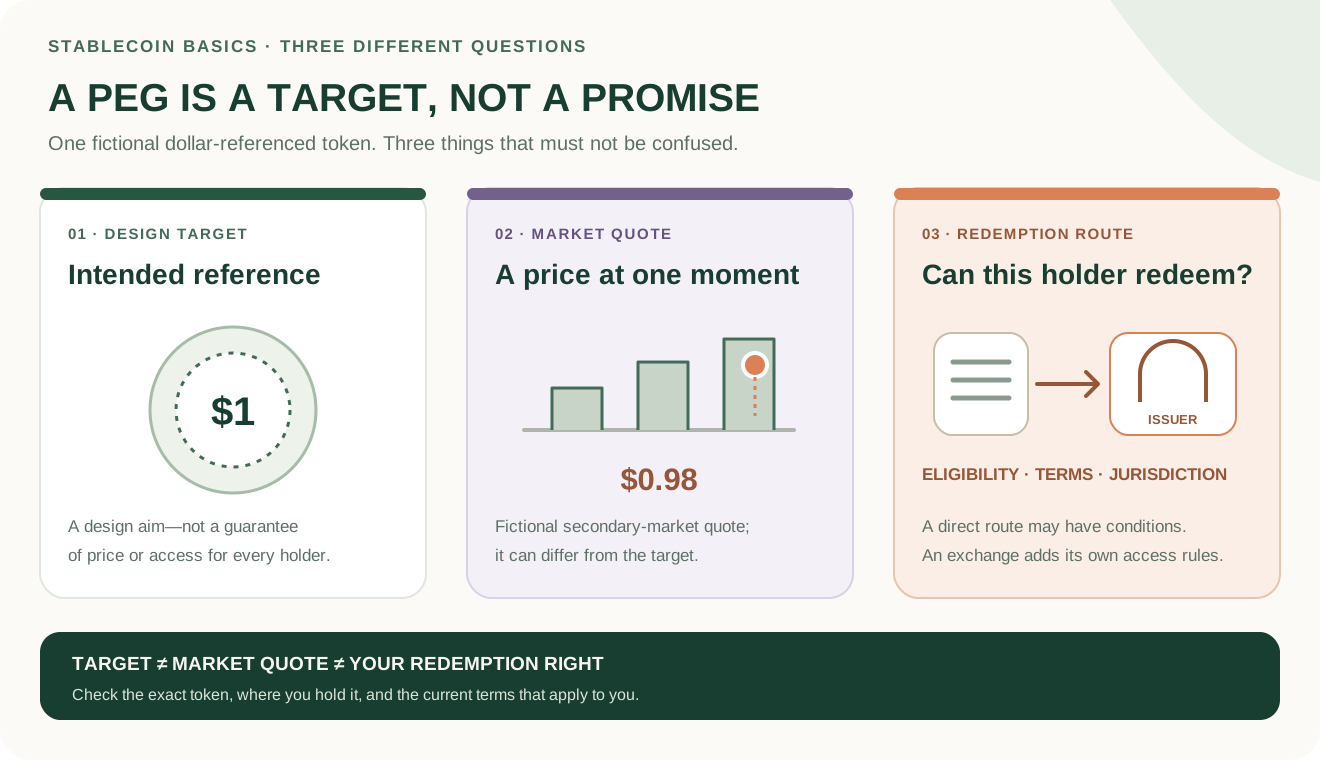
Keep three layers separate: wallet control, token control and platform control. You may control the wallet while an issuer restricts an address. An exchange may restrict your account independently. A redemption route may have another set of eligibility and compliance conditions.
A closer check
Administrative powers should be read at the token and network level. Check whether a freeze, pause, blacklist or upgrade can affect the exact token version you hold and who can invoke it. Self-custody protects the signing key; it does not cancel restrictions written into the asset's own rules.
A closer check
If a token is frozen, preserve the transaction error and current issuer documentation before seeking help. Do not attempt random contract calls or accept a recovery service that asks for credentials. The exact token version and administrative event matter.
A useful diagnostic
A fictional holder can open the wallet and sign normally, yet one token cannot move because the contract rejects that address. The wallet is not necessarily broken, and another asset in the same wallet may remain transferable. The correct next step is to read the current issuer and contract documentation through an independently verified route, not to expose a recovery phrase to “support.”
Record administrative powers, pause or upgrade controls, blacklist behavior, redemption terms and the official contact route. Ask what happens if the issuer, exchange or network becomes unavailable. Also check whether a restriction applies to one token version or to every network representation. Self-custody changes who holds the keys; it does not erase the asset's own rules. For the broader stablecoin model, read what is a stablecoin?.
Check your understanding.
Can issuer controls matter in a self-custodied wallet?
A correct answer records local learning progress, not a qualification or proof of financial readiness.
Put this lesson in context
Separate a stablecoin label from the issuer, network and redemption terms behind it.
Sources & context
- Circle — USDC reserve transparency ↗Consulted 2026-10-07
- Tether — Reserve transparency ↗Consulted 2026-10-07
- ethereum.org — Stablecoin mechanisms ↗Consulted 2026-10-05
Original educational content prepared for this project. Sources provide context, not endorsement or a guarantee that every statement remains current. Rules, product interfaces and availability can change.
Keep learning in Telegram.
Open this published guide in the learning bot. No account connection or wallet is needed.
Join the $STONKB community.
Follow project updates, share useful ideas and meet other builders. You do not need to buy $STONKB to join.
Take what you learned.
Leave the pressure behind.