This guide is educational, not personalized financial, legal or security advice. A checklist reduces avoidable mistakes; it cannot make a transaction risk-free.
Why copying a successful-looking wallet can go wrong: the short version
A wallet can look successful because of missing acquisition history, transfers from other accounts, favorable valuation assumptions or one unusual outcome. The observer may not see hedges, private deals or losses elsewhere. Even an accurately measured past return does not establish a repeatable strategy.
Scope and limitations
Copying adds execution delay and different costs. A position that was attractive at one entry price may be unsuitable by the time you notice it. Your capital, liquidity needs and ability to absorb loss differ from the unknown controller’s circumstances. Observation is more defensible than imitation without a thesis.
An illustrative case
A fictional wallet receives tokens before a public launch and later sells at a profit. A follower assumes the public buy price offered the same opportunity. It did not: the original acquisition terms, timing and risk exposure were different.
A no-money review
- Identify what the public record leaves unknown about acquisition and hedging.
- Estimate how your timing and fees would differ.
- Write an independent reason for a decision instead of treating another address as authority.
Where readers go wrong
Do not assume a wallet label such as smart money certifies skill, honesty or future performance.
A closer check
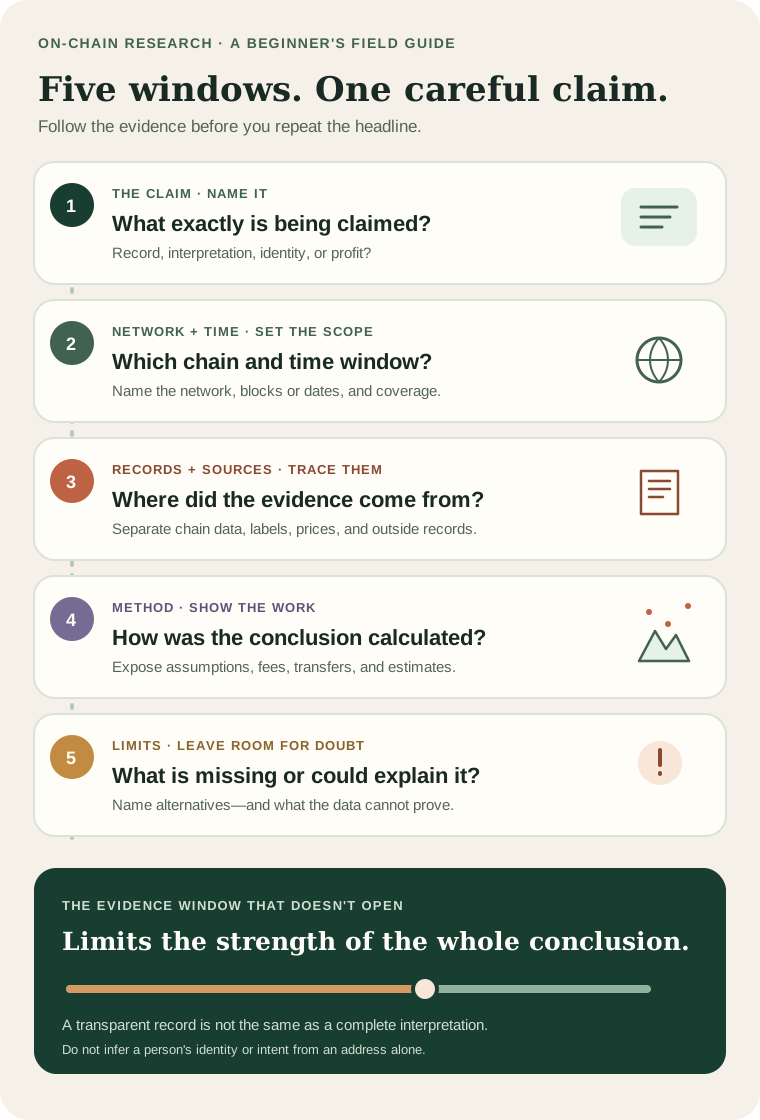
A visible wallet can show transactions without explaining the owner's plan, constraints or off-chain position. Copying a trade adds timing, fees, liquidity, tax and sizing differences. Treat a wallet observation as a research lead, not a signal to imitate, and define in advance what evidence would make you abandon the idea.
For a related next step, see onchain claim checklist.
The practical takeaway
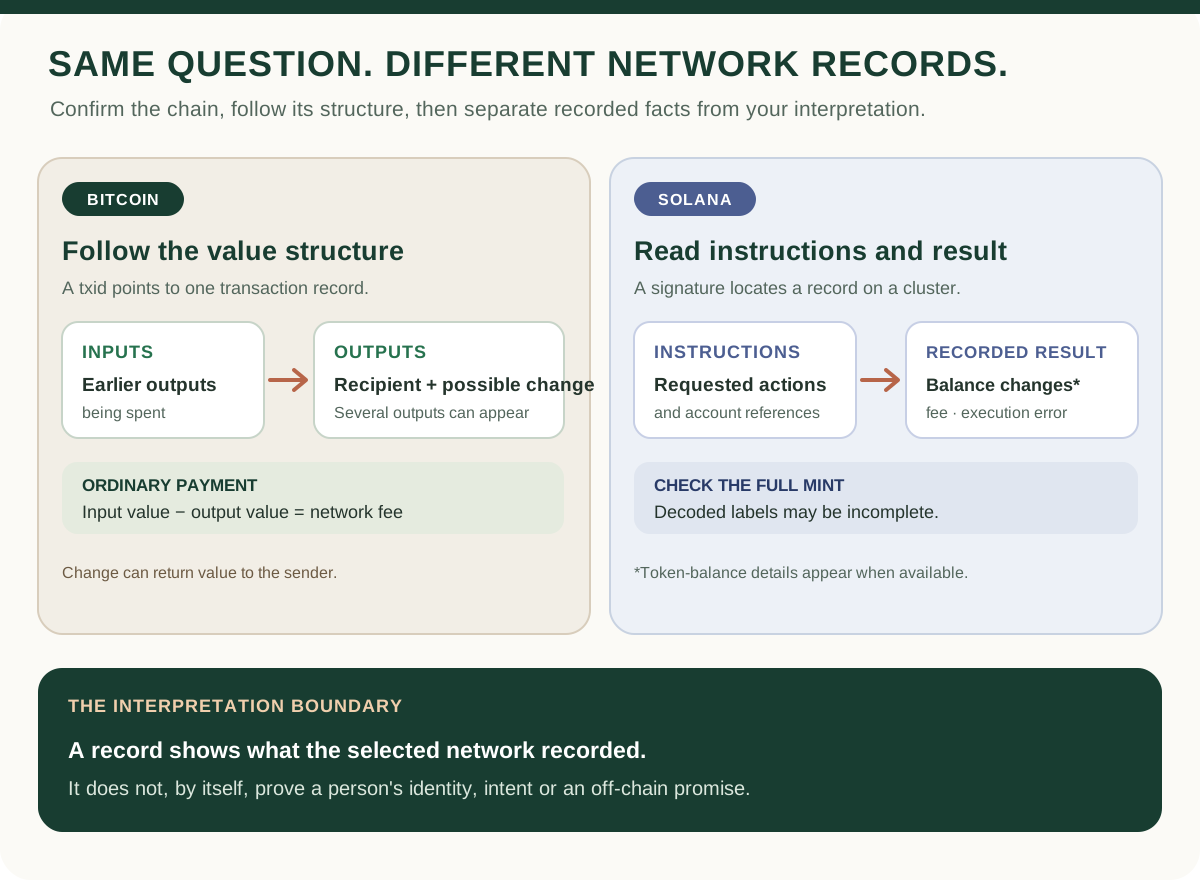
Public records show particular addresses and transactions, not the whole financial life or intent of a person. Labels, valuations and profit calculations add assumptions. Treat an observation as evidence with a boundary. Do not identify an individual, copy a trade or accuse someone of misconduct from one address alone.
Check your understanding.
Why might a follower’s result differ from the observed wallet?
A correct answer records local learning progress, not a qualification or proof of financial readiness.
Put this lesson in context
Start with an explorer record, then distinguish the recorded event from assumptions about a person or project.
Sources & context
- ethereum.org — Ethereum accounts ↗Consulted 2026-10-11
- Solana documentation — Transactions ↗Consulted 2026-10-11
- Bitcoin.org — Some things you need to know ↗Consulted 2026-10-11
Original educational content prepared for this project. Sources provide context, not endorsement or a guarantee that every statement remains current. Rules, product interfaces and availability can change.
Keep learning in Telegram.
Open this published guide in the learning bot. No account connection or wallet is needed.
Join the $STONKB community.
Follow project updates, share useful ideas and meet other builders. You do not need to buy $STONKB to join.
Take what you learned.
Leave the pressure behind.