This guide is educational, not personalized financial, legal or security advice. A checklist reduces avoidable mistakes; it cannot make a transaction risk-free.
Read-only wallet analysis: useful without connecting a wallet: the short version
A read-only tool can query public records associated with an address without controlling that address. It may show balances, transactions or derived analytics depending on its data coverage. Providing a public address is different from connecting a wallet or signing a request. The task does not inherently require spending authority.
Scope and limitations
Public-address analysis still has privacy implications. A query can link your browsing context to an address if the service logs it. The results also depend on indexing, labels and valuation assumptions. Read the tool’s privacy policy and explain what its data cannot see.
An illustrative case
A learner studies a public sample address to understand transfers. That exercise does not require their personal wallet or any signature. Using a sample also avoids needlessly linking their own financial activity to a new service while learning the interface.
A no-money review
- Practice with a public documented sample rather than your own holdings.
- Check that the workflow does not request a phrase, key or unexpected signature.
- Read data-source and privacy disclosures before interpreting results.
Where readers go wrong
Do not treat read-only as a claim that a website cannot collect browsing or query data. No spending access and no privacy risk are different statements.
A closer check
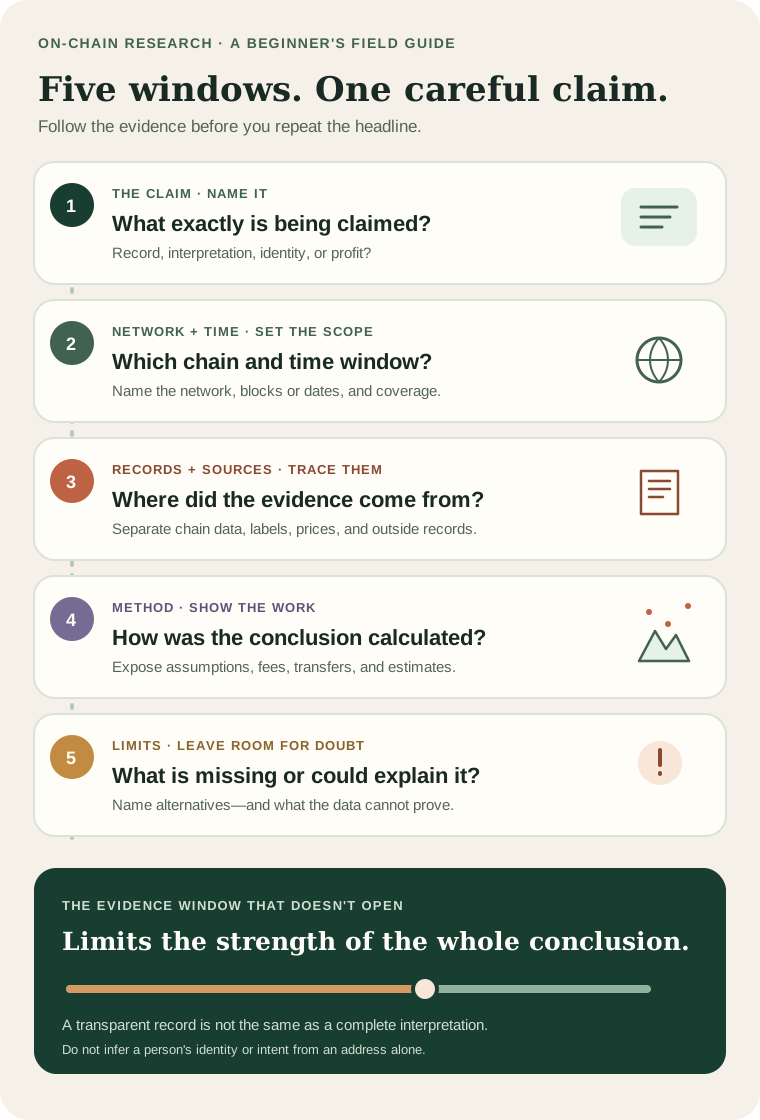
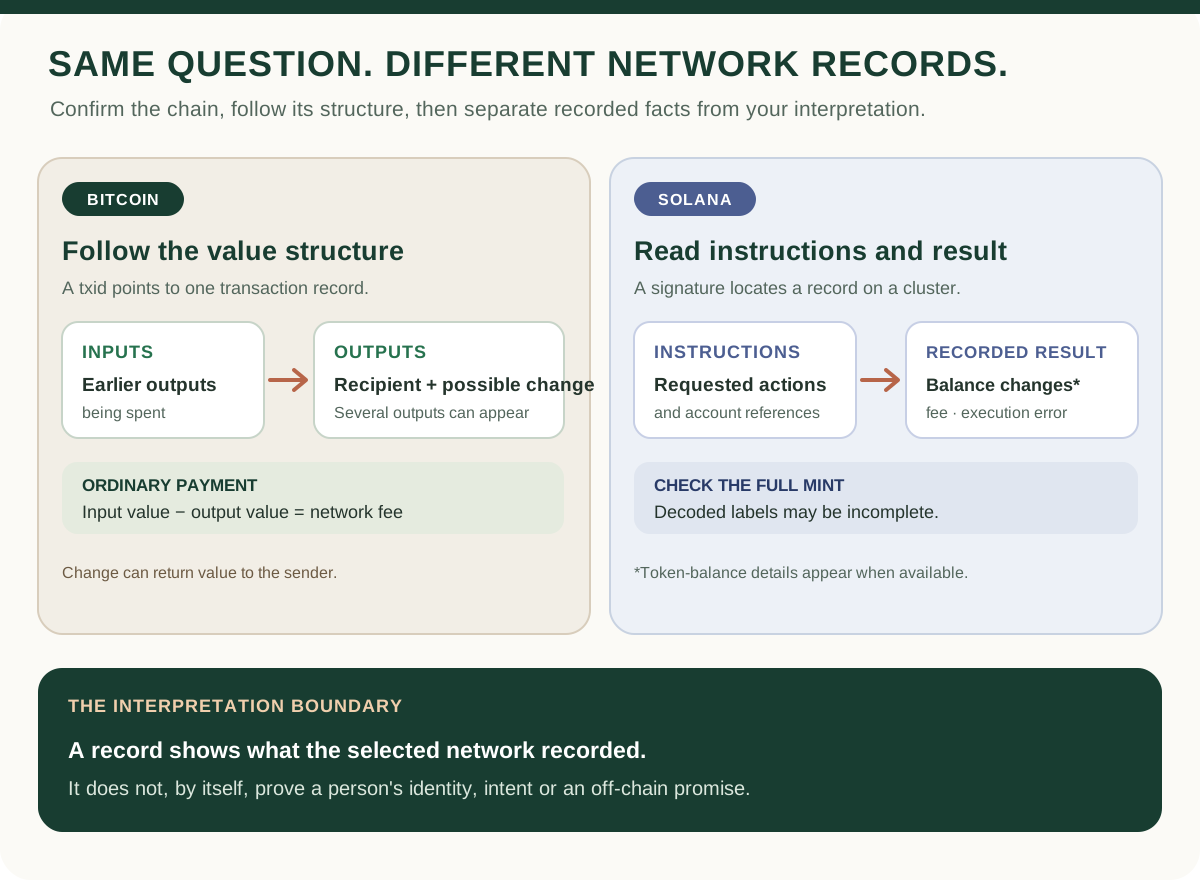
Read-only analysis reduces signing risk but does not make the data complete or the interpretation private. Confirm the network and address, avoid uploading sensitive labels and record the query date. Use the result to form questions; do not infer ownership, intent or future performance from an address alone.
For a related next step, see onchain claim checklist.
The practical takeaway
Public records show particular addresses and transactions, not the whole financial life or intent of a person. Labels, valuations and profit calculations add assumptions. Treat an observation as evidence with a boundary. Do not identify an individual, copy a trade or accuse someone of misconduct from one address alone.
Check your understanding.
What does a public-address lookup not inherently require?
A correct answer records local learning progress, not a qualification or proof of financial readiness.
Put this lesson in context
Start with an explorer record, then distinguish the recorded event from assumptions about a person or project.
Sources & context
- ethereum.org — Ethereum accounts ↗Consulted 2026-10-11
- Bitcoin.org — Some things you need to know ↗Consulted 2026-10-11
- StonkBuilder — StonkScope public entry page ↗Consulted 2026-09-23
Original educational content prepared for this project. Sources provide context, not endorsement or a guarantee that every statement remains current. Rules, product interfaces and availability can change.
Keep learning in Telegram.
Open this published guide in the learning bot. No account connection or wallet is needed.
Join the $STONKB community.
Follow project updates, share useful ideas and meet other builders. You do not need to buy $STONKB to join.
Take what you learned.
Leave the pressure behind.