This guide is educational, not personalized financial, legal or security advice. A checklist reduces avoidable mistakes; it cannot make a transaction risk-free.
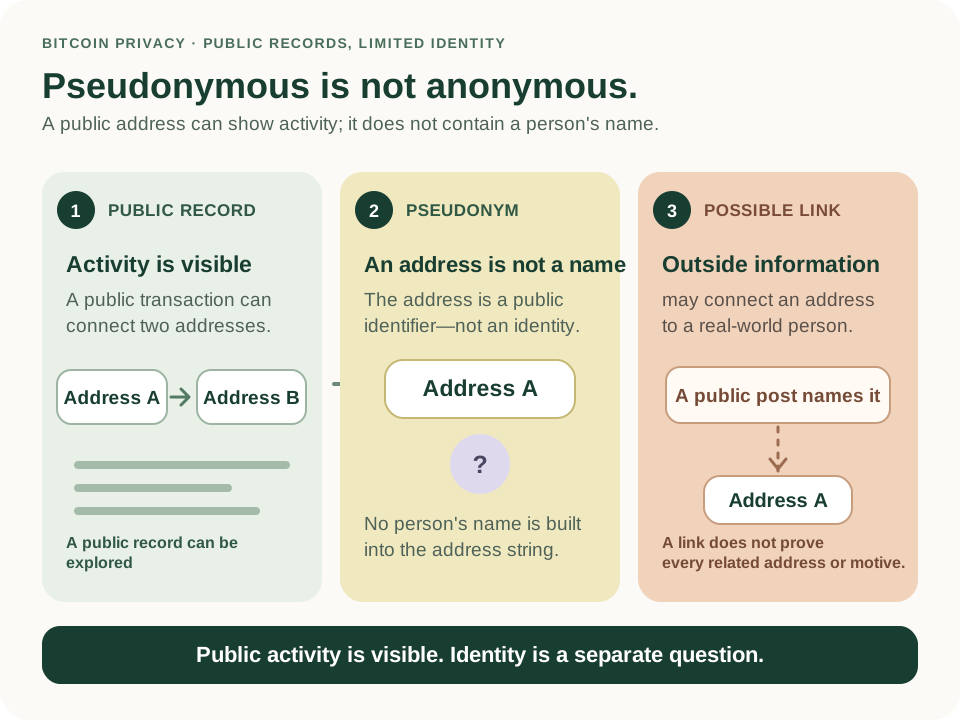
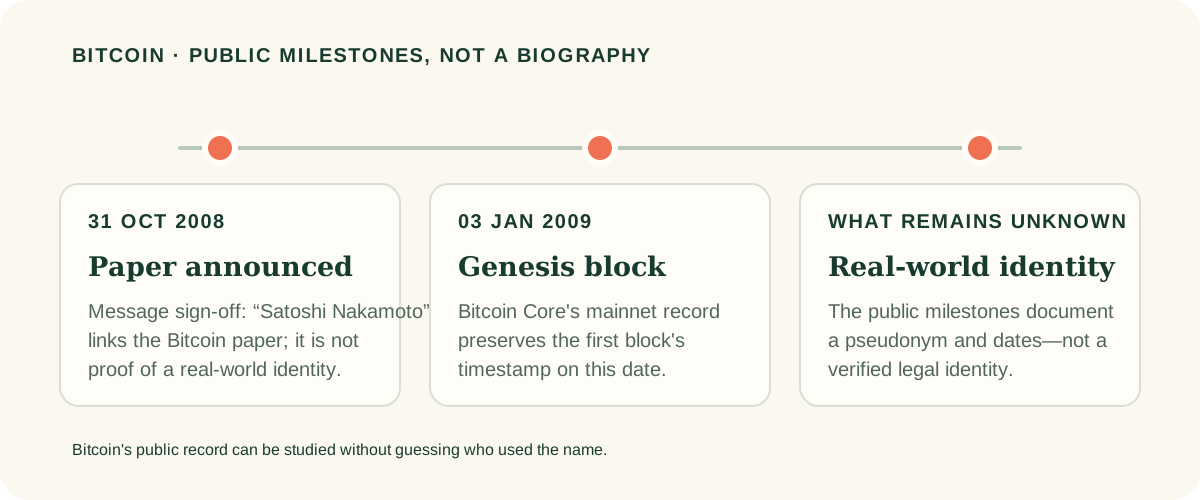
Bitcoin addresses are public pseudonyms; outside information can sometimes connect one to an identity. That link does not prove every related address or motive.
- Confirmed Bitcoin transactions and address-associated history can be inspected on the public record.
- An address is a public identifier, not a person's name.
- Outside information may connect an address to a person, but that link does not prove every related address or motive.
- Fresh receiving addresses and care with public sharing can reduce some direct links, but neither guarantees anonymity.
A public donation page posts one address. What can you infer about that address's public history, and what does the page not prove about other addresses or motives?
Short answer: Bitcoin is pseudonymous, not anonymous
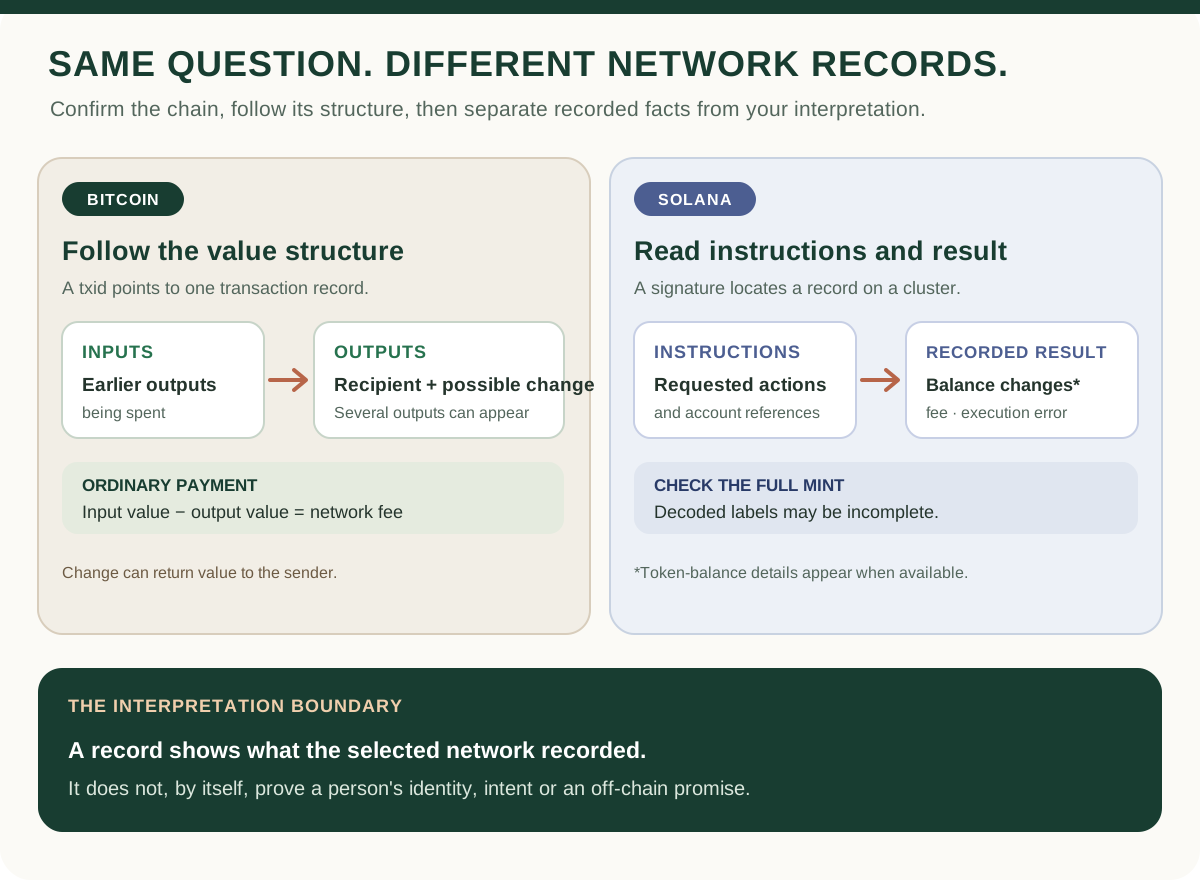
Bitcoin's blockchain makes confirmed transactions public, but it does not attach built-in account names. Transactions spend earlier outputs and create new outputs with spending conditions; wallet software and block explorers commonly display payment destinations as Bitcoin addresses. Read Bitcoin.org's privacy guide for the public-history and address-reuse limits, and the Bitcoin Developer Guide's transaction chapter for how inputs and outputs work. An address is a pseudonym: it can be inspected, but it is not itself a person's identity.
What the public record can show
A block explorer can display confirmed transactions and value movements associated with an address. Analysts may use transaction patterns as heuristics. For example, a common-input heuristic often assumes the inputs to one transaction share control—but that is not guaranteed. BIP 78's Payjoin specification describes a collaborative transaction in which the receiver may add their own inputs, which can defeat that assumption. A pattern is a clue, not proof of shared ownership or a person's identity. The record does not explain why a payment happened, what was exchanged off-chain, or who controlled an address.
How an address may become identifiable
A separate clue can connect an address to a person—for example, when someone publishes a receiving address beside their name, or a service keeps account records tied to deposits or withdrawals. Bitcoin.org notes that people often disclose identity to receive goods or services; a service's records may provide that outside link. It does not automatically identify every address the person may use, prove who controlled an address at a particular moment, or reveal anyone's motive.
Keep the observed record, the outside clue, and the conclusion separate. Address clustering and transaction-pattern analysis are inferences whose reliability depends on context; collaborative transactions are one reason not to treat a grouping as a verified identity.
Privacy has limits—and small steps are not guarantees
If a wallet supports it, using a fresh receiving address can reduce direct reuse of that address in public history. It does not hide every connection in a payment graph or erase information already shared. Avoid posting an address publicly when you do not want it associated with your identity. Neither habit makes Bitcoin activity anonymous: payment patterns, wallet behavior, service records, and information shared elsewhere can still matter.
You can learn with public examples without connecting a wallet. Never enter a private key or recovery phrase into an explorer, lesson, or support chat.
Practise with a public clue
Imagine a community page publishes a Bitcoin address for donations. The page has linked that address to its own public identity, and anyone can inspect confirmed history for it. That alone does not prove who controls other addresses, what the donations paid for, or why a later transaction occurred.
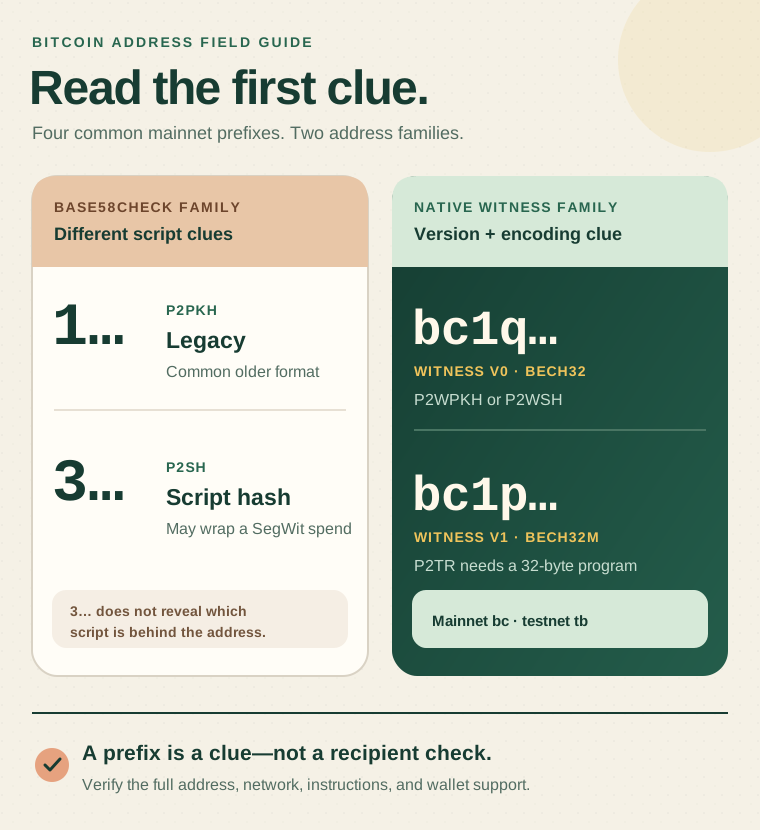
For transaction evidence, see how to read a transaction in an explorer. For cautious interpretation of address labels, continue to wallet labels and attribution; for address reuse and formats, see Bitcoin address formats.
Check your understanding.
A public page links one Bitcoin address to a name. What does that establish by itself?
A correct answer records local learning progress, not a qualification or proof of financial readiness.
Put this lesson in context
Begin with the Bitcoin network, then follow the guides on wallets, fees and confirmation.
Sources & context
- Bitcoin.org — Protect your privacy ↗Consulted 2026-10-10
- Bitcoin Developer Guide — Transactions ↗Consulted 2026-10-11
- Bitcoin Improvement Proposals — BIP 78: Payjoin ↗Consulted 2026-10-10
Original educational content prepared for this project. Sources provide context, not endorsement or a guarantee that every statement remains current. Rules, product interfaces and availability can change.
Keep learning in Telegram.
Open this published guide in the learning bot. No account connection or wallet is needed.
Join the $STONKB community.
Follow project updates, share useful ideas and meet other builders. You do not need to buy $STONKB to join.
Take what you learned.
Leave the pressure behind.