This guide is educational, not personalized financial, legal or security advice. A checklist reduces avoidable mistakes; it cannot make a transaction risk-free.
Wallet labels and attribution: useful clues, uncertain identities: the short version
An explorer or analytics service may label an address as an exchange, protocol or other entity based on its own evidence. Labels can help orientation, but the method and confidence vary. An address may be shared, custodial, reassigned in an operational sense or linked to several activities.
Scope and limitations
Do not equate an address with one identifiable human or infer intent from a single transfer. A movement to an exchange does not prove an immediate sale; it might be custody management or another operation. Public information still deserves careful interpretation and privacy awareness.
An illustrative case
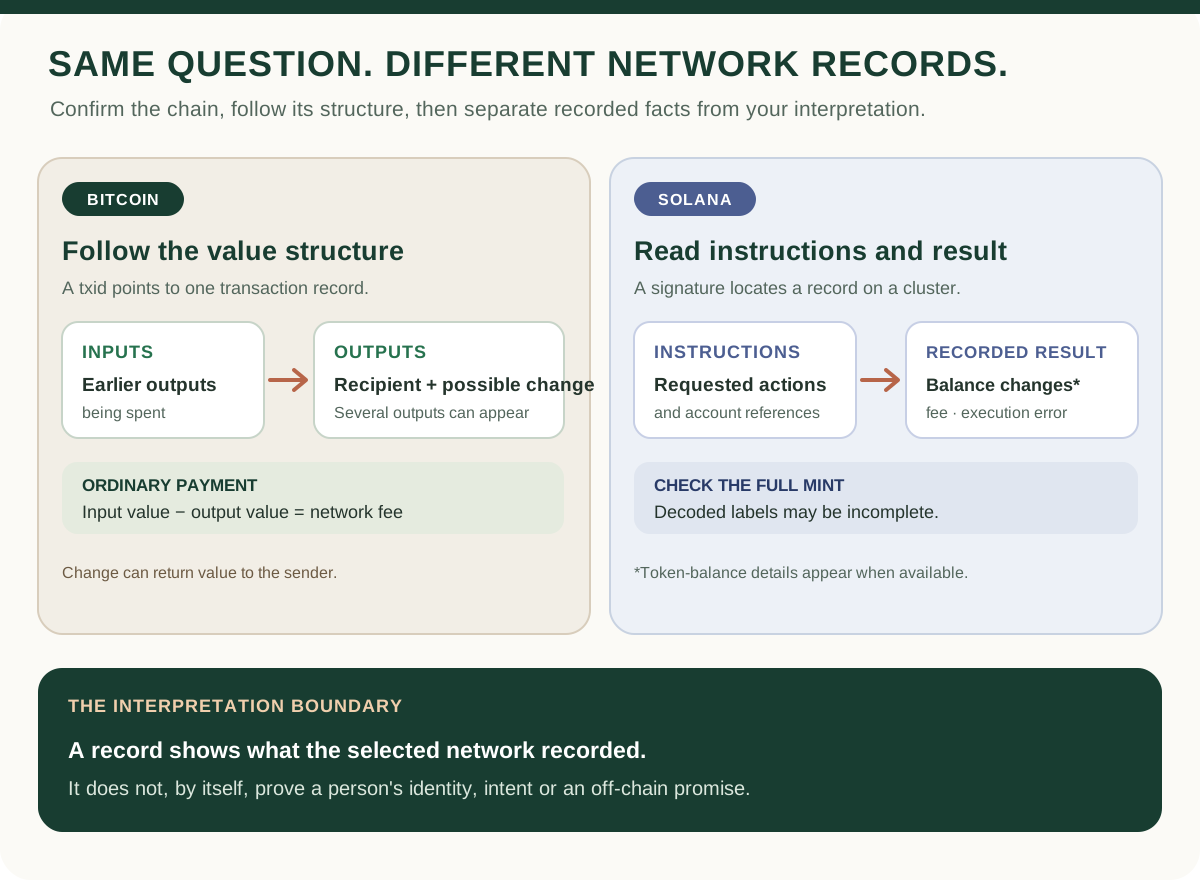
A large address sends tokens to a labeled exchange wallet. A social post calls it a whale dumping. The observed fact is the transfer. Whether a trade followed, who controlled it and why it happened remain separate questions unless more evidence is available.
A no-money review
- Write the label source and any stated confidence or methodology.
- Describe the raw transfer before adding a narrative.
- List at least two alternative explanations consistent with the same record.
Where readers go wrong
Do not accuse an individual of misconduct based only on an address label or a correlation in timing.
A closer check
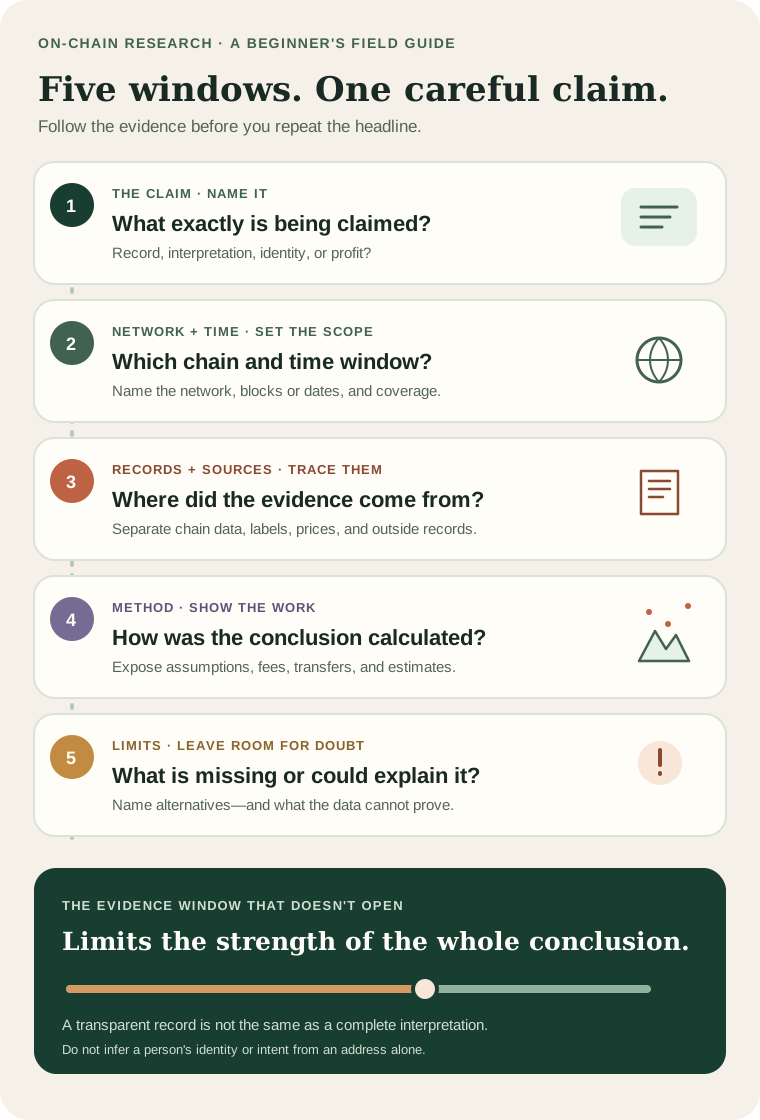
Labels are hypotheses supported by evidence, not identity certificates. Check the source, timestamp and confidence of every label, then separate an exchange, contract, treasury and individual-wallet assumption. Do not publish a person's identity or accuse them of misconduct from a heuristic match or a single transfer.
For a related next step, see onchain claim checklist.
The practical takeaway
Public records show particular addresses and transactions, not the whole financial life or intent of a person. Labels, valuations and profit calculations add assumptions. Treat an observation as evidence with a boundary. Do not identify an individual, copy a trade or accuse someone of misconduct from one address alone.
Check your understanding.
What does an exchange-bound transfer prove on its own?
A correct answer records local learning progress, not a qualification or proof of financial readiness.
Put this lesson in context
Start with an explorer record, then distinguish the recorded event from assumptions about a person or project.
Sources & context
- ethereum.org — Ethereum accounts ↗Consulted 2026-10-11
- Solana documentation — Transactions ↗Consulted 2026-10-11
- Bitcoin.org — Some things you need to know ↗Consulted 2026-10-11
Original educational content prepared for this project. Sources provide context, not endorsement or a guarantee that every statement remains current. Rules, product interfaces and availability can change.
Keep learning in Telegram.
Open this published guide in the learning bot. No account connection or wallet is needed.
Join the $STONKB community.
Follow project updates, share useful ideas and meet other builders. You do not need to buy $STONKB to join.
Take what you learned.
Leave the pressure behind.