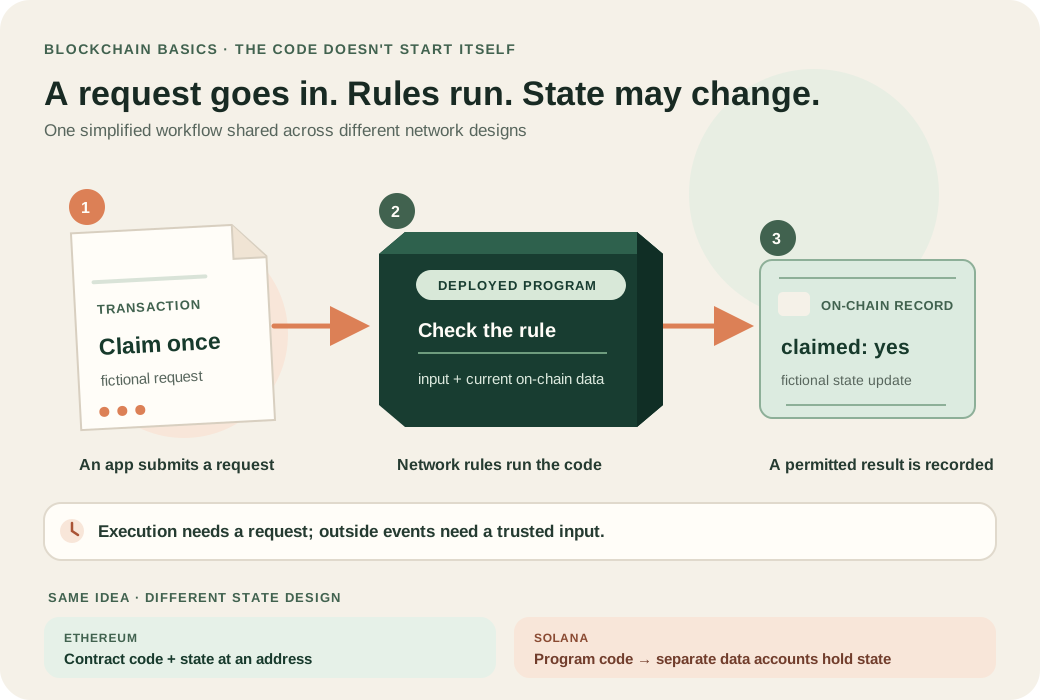
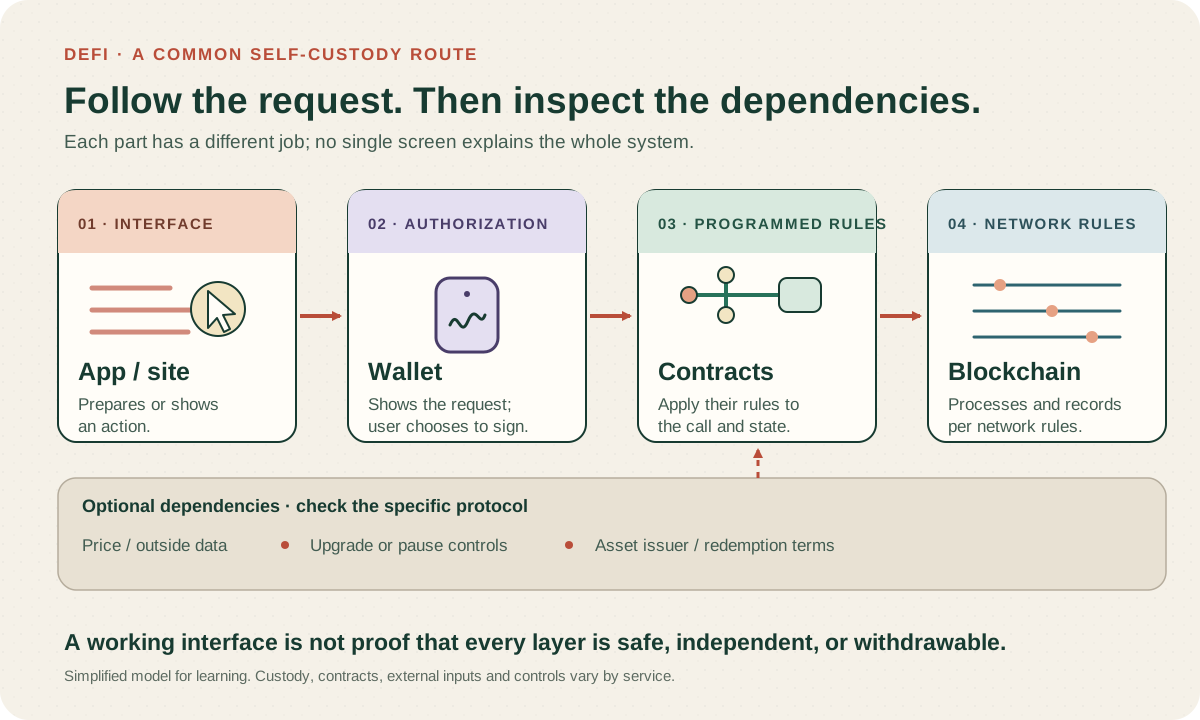
This guide is educational, not personalized financial, legal or security advice. A checklist reduces avoidable mistakes; it cannot make a transaction risk-free.
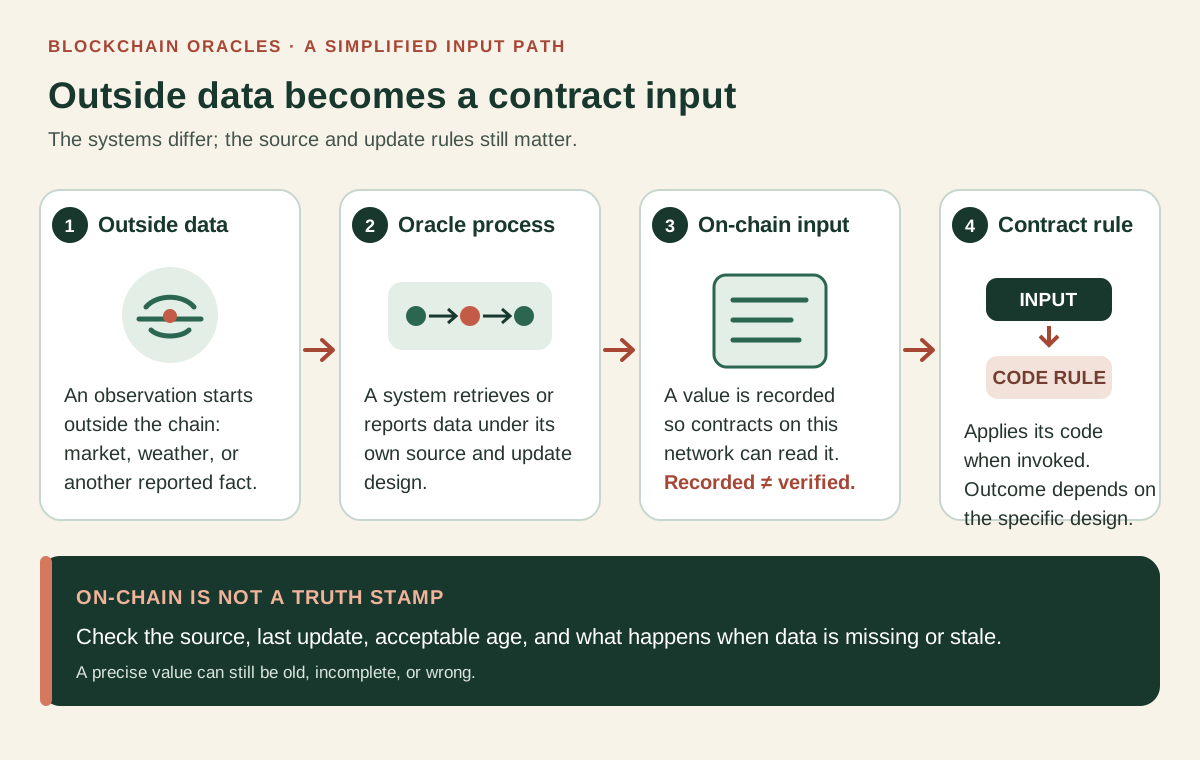
One simplified input-oracle path; architectures and source rules vary. A recorded value can still be inaccurate, stale, or unavailable.
- An outside source provides an observation such as a market value or weather report.
- An oracle process retrieves, selects, aggregates, or reports information under its own design; not every system uses the same sources or steps.
- A value becomes readable to contracts on a blockchain, but on-chain availability does not prove the external fact was true.
- Contract code applies its own rule to the input when invoked; the outcome depends on that code and its execution path.
A lending contract can read a price feed, but the feed’s last update is older than the application allows. What should be checked before treating the value as usable?
What is a blockchain oracle?
A blockchain oracle is a system that makes information from outside a blockchain available to a contract that needs it. A market observation or weather report may begin outside the chain; an oracle process can retrieve or relay data and make a result readable on-chain. The contract can then use that input when its code runs. A value being recorded on-chain does not prove that the outside fact was correct.
This guide focuses on input oracles—outside information flowing into contracts. Oracle designs vary: they may use one or several sources, different trust models, and either ongoing data feeds or request-and-response flows. The diagram is one simplified path, not a universal architecture.
Why can’t a contract read any website it wants?
On a replicated blockchain, participating nodes need to reach the same result from the same transaction and network state. If a contract directly asked a changing website for a value, different nodes might receive different answers. Ethereum’s oracle documentation explains this constraint and describes oracle systems that bring outside data on-chain; its smart-contract documentation likewise explains why contracts cannot directly retrieve arbitrary off-chain data. The exact implementation differs across networks and oracle services.
Follow the data, step by step
1. Outside source: A data provider or other source publishes an observation. The source may have limited market coverage or its own errors. 2. Oracle process: A system retrieves, selects, aggregates, or reports data according to its design. Some use multiple sources or reporters; others do not. 3. On-chain input: A transaction or feed update makes a value available to contracts on a network. This proves the value was recorded under network rules—not that it reflects every relevant source or the real-world truth. 4. Contract rule: A contract reads the input and applies its own code. For example, a lending protocol may use a price input in a collateral rule. Whether an action follows depends on that contract’s logic and the way it is invoked.
For the general contract model, see what a smart contract is. For one consequence of price inputs, see collateral and liquidation.
What can go wrong?
Data can be inaccurate, delayed, unavailable, or unrepresentative of the market or event a contract cares about. A precise number can still be stale. An oracle does not remove the need to ask who supplies the data, how updates are produced, and what the contract does when information is missing or too old.
For one provider-specific example, Chainlink’s Data Feeds documentation says feeds can update when a configured deviation threshold is crossed or a heartbeat interval passes. Those settings vary by feed; the documentation says feeds are not continuous streaming data and advises applications to check the latest update time. This is one implementation, not a rule for every oracle.
A no-wallet review
Before relying on an oracle-dependent application, look up the specific documentation and ask: What source and market does this feed represent? Who can report or change it? When was it last updated, and how old is too old for this use? What happens if data is delayed or unavailable? For a broader distinction between an on-chain record and outside evidence, read what a blockchain record can prove.
You can learn this workflow without connecting a wallet, depositing funds, granting an approval, or using leverage.
Check your understanding.
A contract reads a price value posted by an oracle. What can you safely conclude?
A correct answer records local learning progress, not a qualification or proof of financial readiness.
Put this lesson in context
Learn the underlying mechanism before comparing an application or a quoted return.
Sources & context
- ethereum.org — Oracles ↗Consulted 2026-10-09
- ethereum.org — Introduction to smart contracts ↗Consulted 2026-10-11
- Chainlink Documentation — What are Chainlink Data Feeds? ↗Consulted 2026-10-09
Original educational content prepared for this project. Sources provide context, not endorsement or a guarantee that every statement remains current. Rules, product interfaces and availability can change.
Keep learning in Telegram.
Open this published guide in the learning bot. No account connection or wallet is needed.
Join the $STONKB community.
Follow project updates, share useful ideas and meet other builders. You do not need to buy $STONKB to join.
Take what you learned.
Leave the pressure behind.