This guide is educational, not personalized financial, legal or security advice. A checklist reduces avoidable mistakes; it cannot make a transaction risk-free.
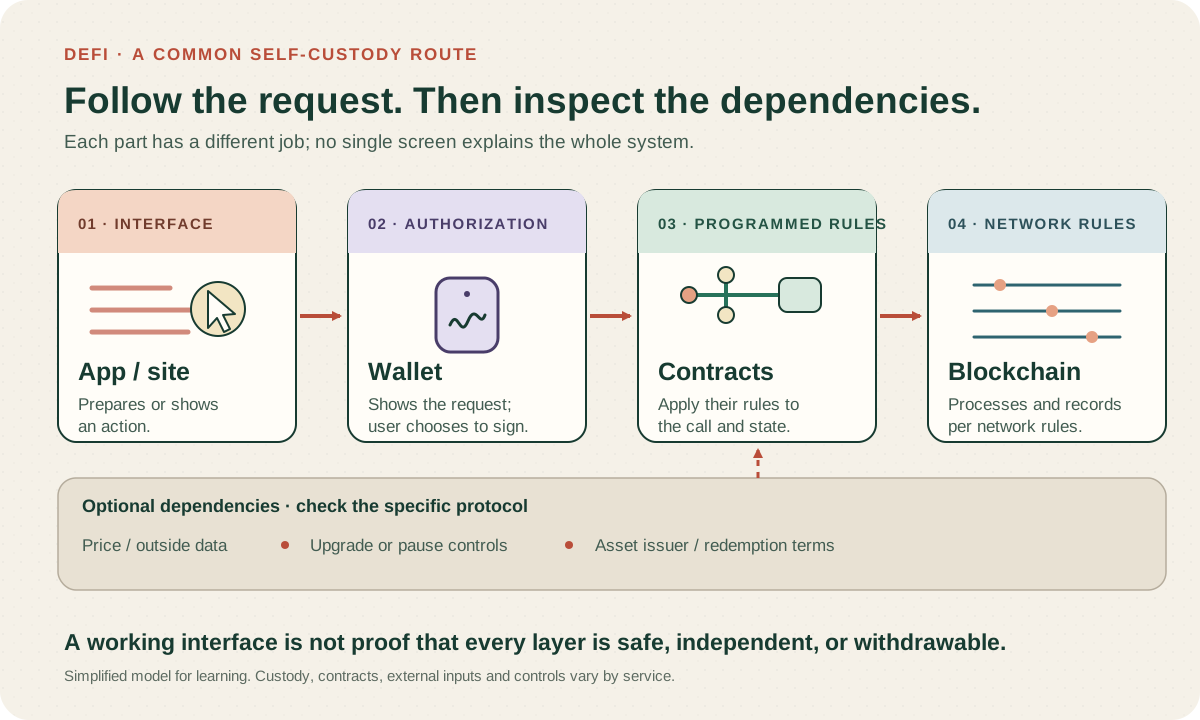
One simplified self-custody route. Interface, wallet, contracts and network are distinct; outside data, governance and asset controls depend on the specific service.
- An application interface prepares or displays an action; it is not the blockchain network or the contract itself.
- In a common self-custody route, a wallet presents a transaction for the user to review and authorize. Custody and signing arrangements vary.
- A called smart contract applies its programmed rules to the transaction and available state. Some protocols also rely on outside data or upgrade controls.
- The blockchain network processes and records changes under its rules. A record does not prove every off-chain claim about an asset or service.
For a lending example, name who runs the interface, which wallet or provider authorizes the request, what contract and network are involved, and which outside data or issuer controls might matter. No deposit is needed.
What is DeFi?
Decentralized finance (DeFi) is a broad term for financial services built with blockchain-based assets and software. A DeFi service may combine an application interface, a wallet or provider, on-chain contracts, a blockchain network and one or more assets. These are different parts with different operators and controls. The word “decentralized” does not mean every part has no operator, administrator or risk.
ethereum.org’s DeFi overview offers a useful Ethereum-specific map: blockchain, assets, protocols and applications. It is a starting model, not a rule that every DeFi service has the same architecture.
Follow one common request
In a common self-custody route, a person starts an action in an interface. The connected wallet shows a transaction request; the person decides whether to authorize it. A smart contract is code and data deployed at an address on a blockchain. If called, it applies its programmed rules to the transaction and the state it can access. The network processes the transaction under its rules and records resulting changes.
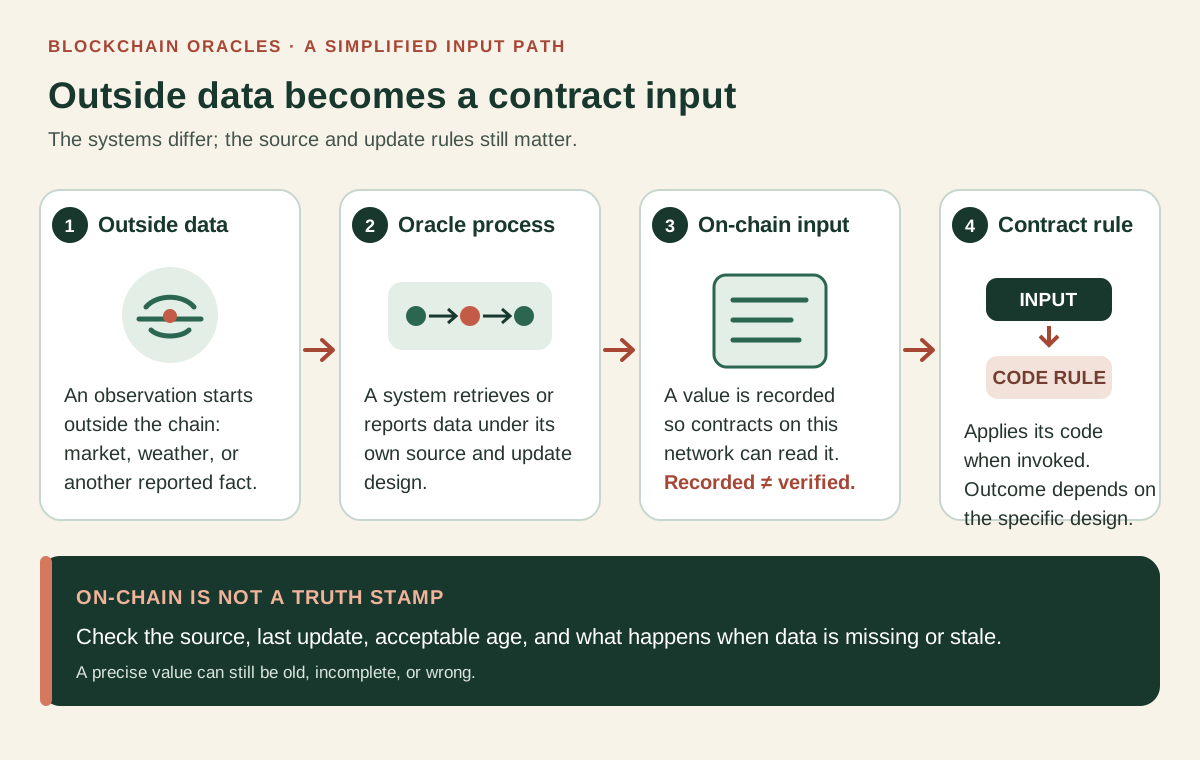
That path is simplified. Some services use custodians, relayers, multiple contracts, or other arrangements. A familiar website is not the contract itself, a wallet connection is not a safety check, and a successful on-chain transaction does not prove an off-chain claim about an asset or service. Ethereum’s smart-contract explanation describes contracts as code and state; its security guidance explains why contracts that rely on outside data—such as a price feed—also depend on how that data is produced and delivered.
One example: a lending protocol
The details depend on the protocol. Aave’s Aave V3 guide describes one lending design built from smart contracts: users can supply supported assets, use eligible assets as collateral and borrow, while a position can face liquidation if its collateral no longer meets the protocol’s conditions. Its access guide also lists more than one way to interact with the protocol. This is an example, not a description of every DeFi app; supported assets, networks, parameters and interfaces can change.
What to check without depositing
Map the parts before considering any action: who operates the interface; who controls the wallet keys; which contract and network receive the request; whether the code can be upgraded or paused; whether an external price source or asset issuer affects the outcome; and what conditions govern withdrawal or liquidation. Check those claims in the relevant protocol’s current documentation. An audit or a visible balance is not insurance, and this guide does not recommend a protocol, deposit, token approval or use of leverage.
You can learn without connecting a wallet or sending funds. Continue with smart-contract risks, oracles and external data, and token approvals to examine specific dependencies.
Check your understanding.
In a common self-custody DeFi route, what does the interface do?
A correct answer records local learning progress, not a qualification or proof of financial readiness.
Put this lesson in context
Learn the underlying mechanism before comparing an application or a quoted return.
Sources & context
- ethereum.org — Decentralized finance ↗Consulted 2026-10-05
- ethereum.org — Introduction to smart contracts ↗Consulted 2026-10-11
- ethereum.org — Smart contract security ↗Consulted 2026-10-05
- Aave — Introduction to Aave V3 ↗Consulted 2026-10-05
- Aave — Accessing Aave ↗Consulted 2026-10-05
Original educational content prepared for this project. Sources provide context, not endorsement or a guarantee that every statement remains current. Rules, product interfaces and availability can change.
Keep learning in Telegram.
Open this published guide in the learning bot. No account connection or wallet is needed.
Join the $STONKB community.
Follow project updates, share useful ideas and meet other builders. You do not need to buy $STONKB to join.
Take what you learned.
Leave the pressure behind.