This guide is educational, not personalized financial, legal or security advice. A checklist reduces avoidable mistakes; it cannot make a transaction risk-free.
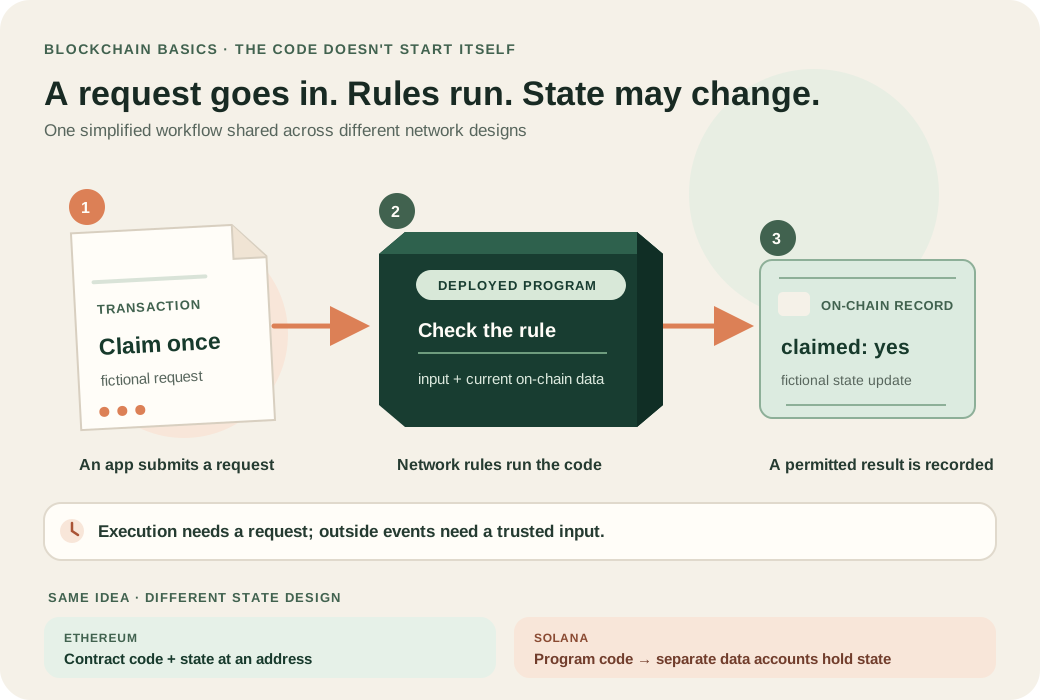
A simplified shared idea, not an exact execution trace: an explicit request invokes code, and network rules determine any on-chain state change. Ethereum and Solana store program code and mutable state differently.
- A person or application submits a transaction that calls a deployed contract or program; the code does not start itself like a timer.
- The network runs the requested function or instruction against its rules and supplied inputs.
- If the operation succeeds, it may update on-chain state; the public record cannot prove an outside event by itself.
- Storage and upgrade controls vary by network and deployment, so check the specific contract or program.
A fictional claim program marks an address as claimed after checking its on-chain record. What can it check itself, and what outside fact would need a trusted input?
The short answer
A smart contract is software deployed to a blockchain. A transaction can ask it to run a function or instruction; the network applies its rules to the supplied request and current on-chain data. If the operation succeeds, it may change the network's recorded state. The program does not wake itself up like a timer, and the phrase does not automatically mean a legally enforceable contract.
The visual gives the basic workflow: request → rules run → possible state change. The example is fictional and does not require a wallet, connection, signature, or purchase.
From a request to a recorded change
Imagine a fictional digital membership register. An application prepares a request to mark one address as having claimed a badge. A deployed program checks its written rules and the available on-chain record. If the request meets those conditions, execution can update that record; if it does not, the rule may reject the requested change. The code checks the data it receives—not whether a person really attended an event or whether an organization kept an off-chain promise.
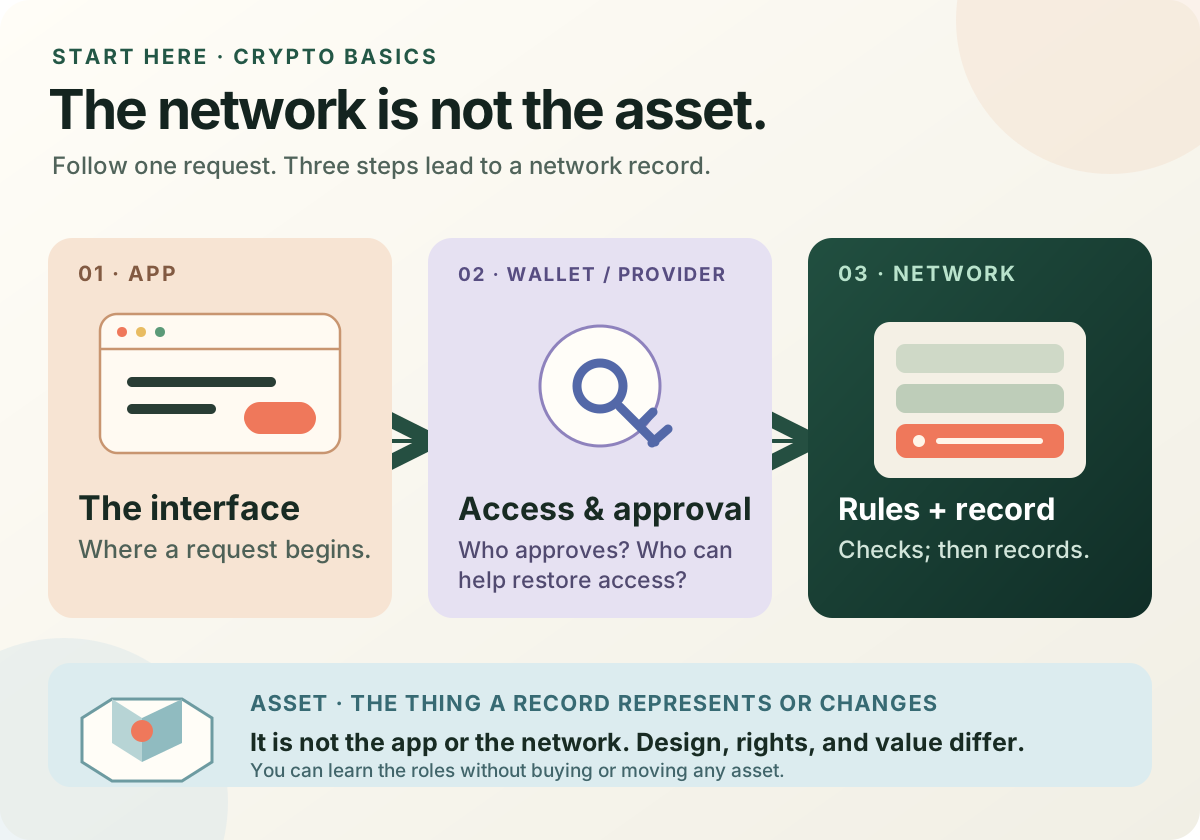
A website or app is often the interface people see, but it is not the contract itself. On Ethereum, writing to a contract normally means sending a transaction that calls it; reads that do not change state can be queried without a state-changing transaction. Network fees and transaction details depend on the specific chain and route.
Ethereum contracts and Solana programs
The broad idea is similar across networks, but the implementation is not identical. Ethereum describes a smart contract as code and data (state) at an Ethereum address. User accounts can submit transactions that execute its functions.
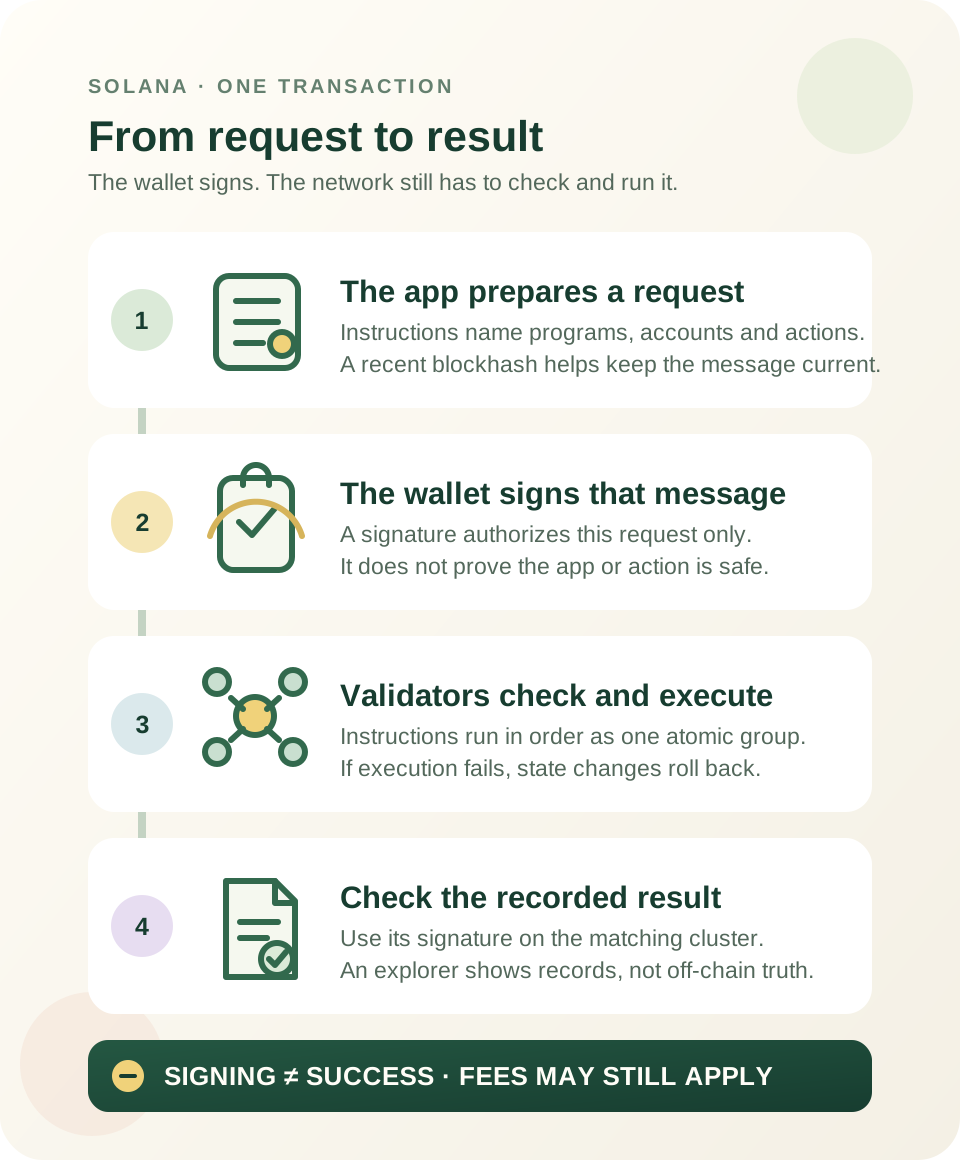
Solana documentation calls these pieces programs: executable program code is stored in an account, while mutable state lives in separate data accounts passed into instructions. A transaction can contain instructions that invoke programs. So “smart contract” is a useful general phrase, while “Solana program” is the network's more specific term. For Solana's wider request-to-result path, see how Solana transactions work.
What the code cannot know by itself
A blockchain program cannot independently observe every event in the physical world. If it needs an outside fact—such as a delivery, weather reading, or market price—another party or data service must supply information. That input introduces its own trust and failure questions. A blockchain record can show that the network processed the supplied data under its rules; it cannot, on its own, prove the outside fact was true.
Nor does deploying code mean the system can never change. Ethereum contracts may be designed with upgrade patterns, and Solana programs can have upgrade authorities depending on how they were deployed. The exact controls vary. For a particular app, check its code, data, upgrade powers, and dependencies rather than relying on a generic claim that “smart contracts are immutable.”
Code is not a safety guarantee
Code can contain bugs, use unexpected inputs, or give administrators powers that are easy to miss. An app can also present a request unclearly. A successful transaction means the network processed a particular request under its rules; it does not certify that the app is honest, the result is what you intended, or an off-chain promise was fulfilled. For a practical next step, read how to assess a smart-contract audit.
To place contracts in the bigger picture, continue with how blockchain works or what decentralized finance is. Learning the workflow needs no wallet connection or asset purchase.
Check your understanding.
What usually causes a deployed smart contract or Solana program to run?
A correct answer records local learning progress, not a qualification or proof of financial readiness.
Put this lesson in context
Start with how the technology works, then separate assets, accounts and wallet control.
Sources & context
- ethereum.org — Introduction to smart contracts ↗Consulted 2026-10-11
- ethereum.org — Interacting with smart contracts ↗Consulted 2026-09-30
- ethereum.org — Upgrading smart contracts ↗Consulted 2026-09-30
- Solana documentation — Programs ↗Consulted 2026-09-30
Original educational content prepared for this project. Sources provide context, not endorsement or a guarantee that every statement remains current. Rules, product interfaces and availability can change.
Keep learning in Telegram.
Open this published guide in the learning bot. No account connection or wallet is needed.
Join the $STONKB community.
Follow project updates, share useful ideas and meet other builders. You do not need to buy $STONKB to join.
Take what you learned.
Leave the pressure behind.