This guide is educational, not personalized financial, legal or security advice. A checklist reduces avoidable mistakes; it cannot make a transaction risk-free.
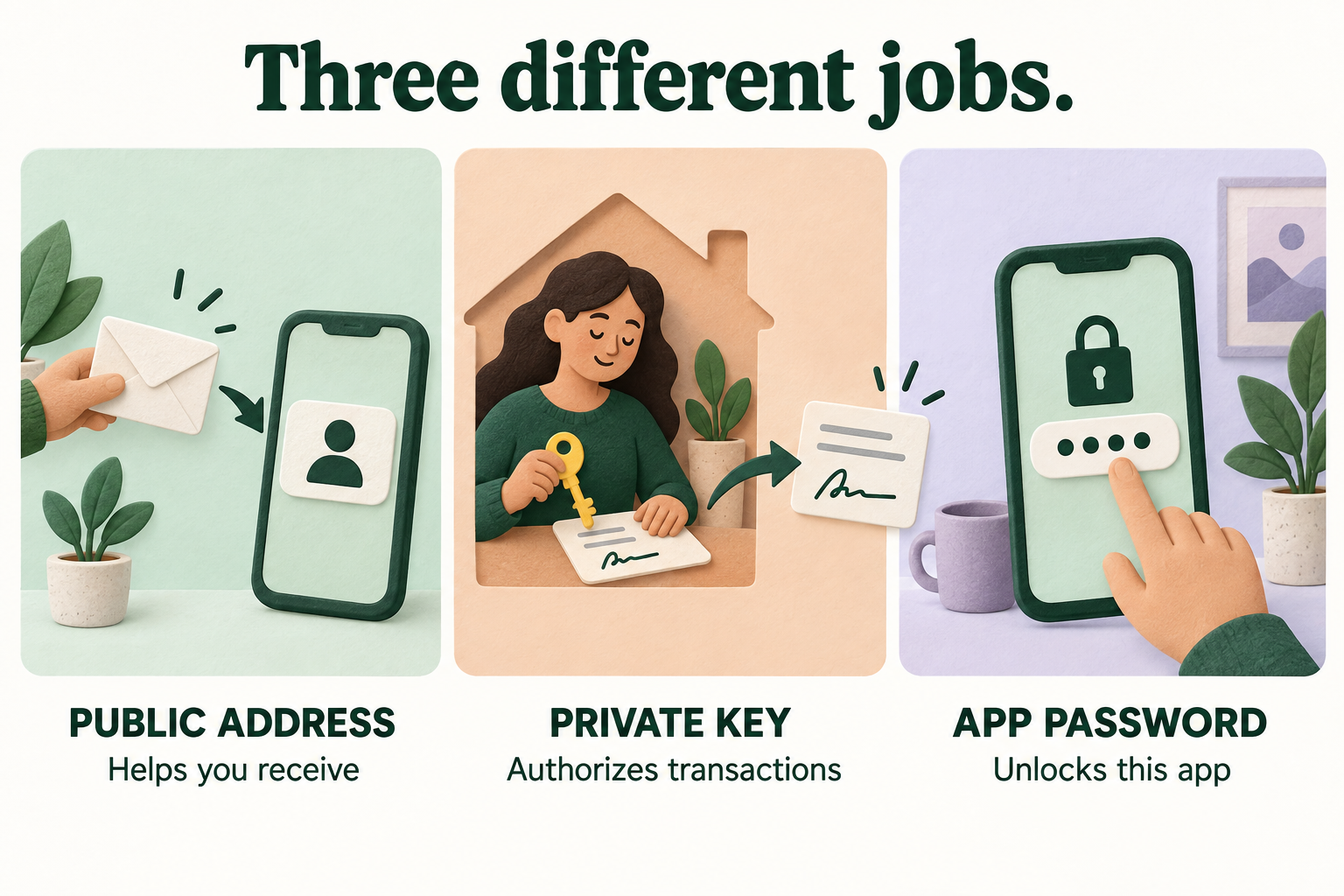
A public address can be shared for receiving. A private key authorizes. A password may protect a local device or wallet application.
- Address: a destination others may need to see.
- Private key: secret signing material that must stay secret.
- Password: a local access layer, not a replacement for key backup.
- Before acting, identify which one a request is asking for.
If a message asks for your recovery phrase or private key, which part of the picture tells you to stop?
The idea in plain English
A public address identifies a destination or account on a network. A private key authorizes actions for the corresponding account. A wallet password often protects a local installation, while an exchange password protects a provider account. They are not substitutes for one another.
The distinction that matters
Sharing an address does not usually authorize spending, but it can expose transaction history and link financial activity to your identity. Sharing signing material is much more serious. Read-only tools should not need private keys. Some modern account models have additional controls, so do not generalize one wallet’s recovery behavior to every wallet.
A practical example
A friend needs to pay you. They need the supported asset, network, receiving address and possibly a memo—not your recovery phrase. A website that asks for the phrase to “verify” receipt is requesting far more authority than the payment task requires.
Try this without moving money
- Label sample data as public destination, signing secret or login credential.
- Explain the privacy cost of publicly posting an address.
- Check that any read-only workflow avoids signatures and private material.
A mistake to avoid
Do not think “public” means consequence-free. An address can reveal balances and relationships even when it cannot move funds.
Before you act
This learning site never needs a recovery phrase, private key, password, one-time code or wallet connection. Work from your wallet maker’s independently verified documentation, since recovery methods differ. A strong setup must address both unauthorized access and accidental loss; solving one while ignoring the other is not enough.
Check your understanding.
What does a payer ordinarily need?
A correct answer records local learning progress, not a qualification or proof of financial readiness.
Sources & context
- ethereum.org — Ethereum accounts ↗Consulted 2026-09-23
- ethereum.org — Ethereum wallets ↗Consulted 2026-09-23
- ethereum.org — Security and scam prevention ↗Consulted 2026-09-23
Original educational content prepared for this project. Sources provide context, not endorsement or a guarantee that every statement remains current. Rules, product interfaces and availability can change.
Take what you learned.
Leave the pressure behind.