This guide is educational, not personalized financial, legal or security advice. A checklist reduces avoidable mistakes; it cannot make a transaction risk-free.
Wallet balance is not portfolio profit: the short version
A wallet balance is a quantity of assets at a point in time. Profit requires a defined comparison with costs, deposits, withdrawals and valuation rules. Receiving tokens can increase a balance without creating trading profit. Moving assets between your own wallets can make one balance fall without an economic loss.
Scope and limitations
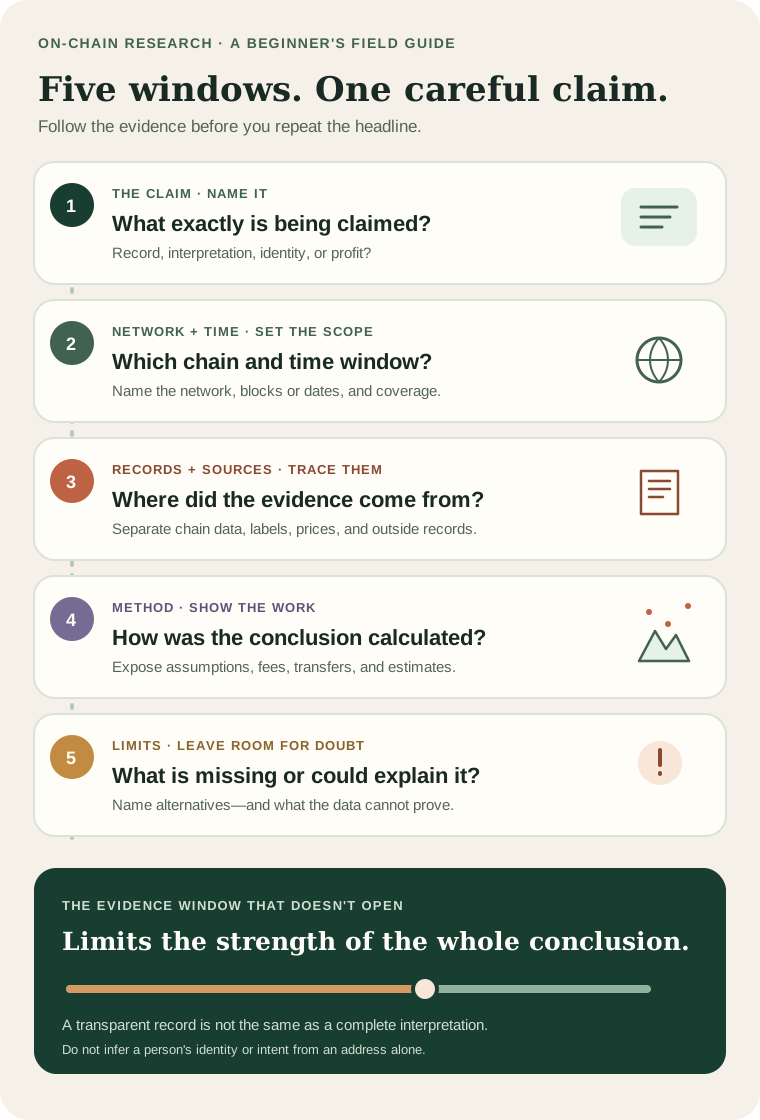
Analytics tools often reconstruct performance from incomplete public data. They may not know an acquisition price, off-chain trade, private transfer or whether two addresses belong to the same person. Read the methodology and distinguish realized outcomes from mark-to-market estimates.
An illustrative case
A fictional wallet receives $500 worth of tokens and later shows $600. The apparent $100 increase might involve a price change, another deposit or an incomplete starting value. Without the cash-flow history, the screen alone cannot determine a return rate.
A no-money review
- Separate balances, cash flows and price changes in a paper example.
- Identify which acquisition records an analytics tool cannot see.
- Compare estimates with your own transaction records before using them for decisions.
Where readers go wrong
Do not present a read-only wallet report as a complete accounting or tax statement. Missing context can materially alter the result.
A closer check
A balance is a snapshot of units or estimated value. Profit requires a cost basis, realized proceeds, fees, transfers, timing and a valuation method that may not be visible on-chain. State which pieces are known and which are inferred. A large balance can coexist with losses, illiquidity or obligations elsewhere.
For a related next step, see onchain claim checklist.
The practical takeaway
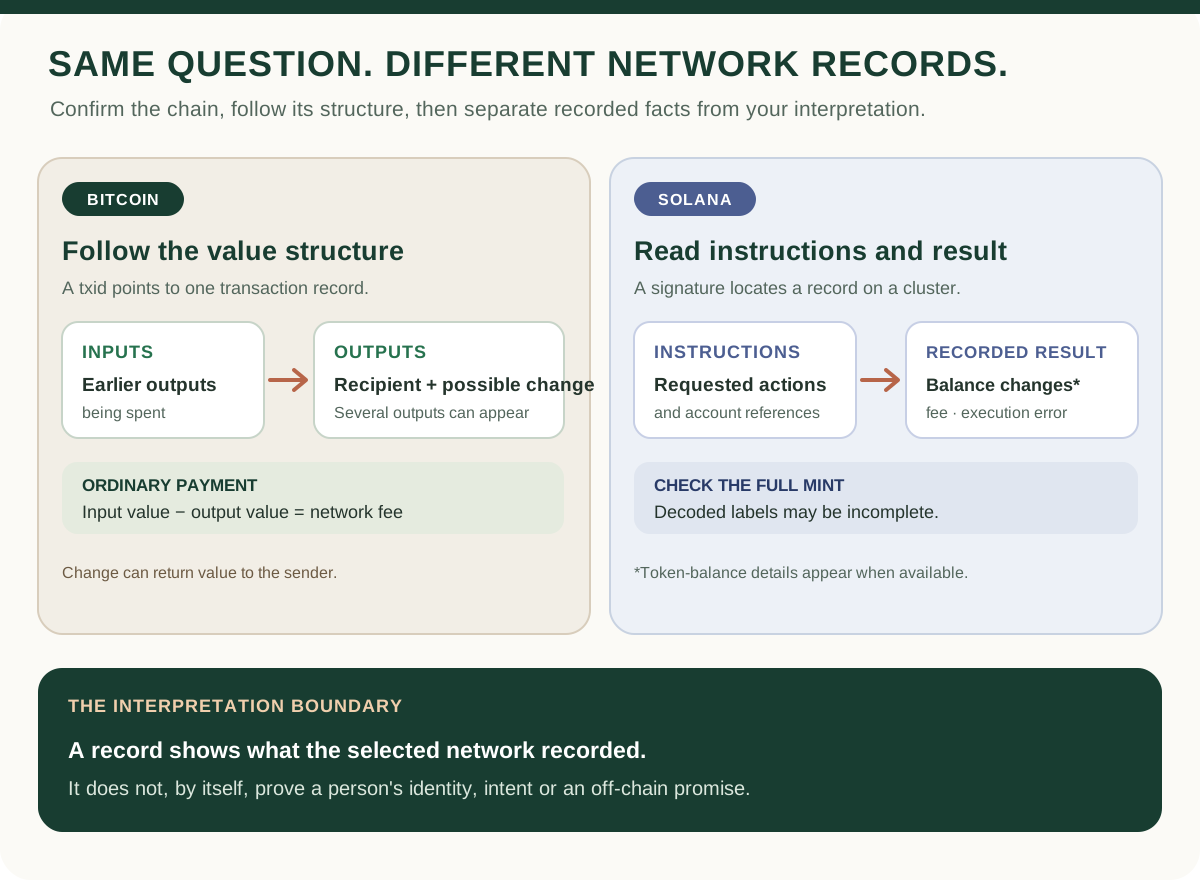
Public records show particular addresses and transactions, not the whole financial life or intent of a person. Labels, valuations and profit calculations add assumptions. Treat an observation as evidence with a boundary. Do not identify an individual, copy a trade or accuse someone of misconduct from one address alone.
Check your understanding.
Does a larger wallet balance prove trading profit?
A correct answer records local learning progress, not a qualification or proof of financial readiness.
Put this lesson in context
Start with an explorer record, then distinguish the recorded event from assumptions about a person or project.
Sources & context
- ethereum.org — Ethereum accounts ↗Consulted 2026-10-11
- Solana documentation — Transactions ↗Consulted 2026-10-11
- Bitcoin.org — Some things you need to know ↗Consulted 2026-10-11
Original educational content prepared for this project. Sources provide context, not endorsement or a guarantee that every statement remains current. Rules, product interfaces and availability can change.
Keep learning in Telegram.
Open this published guide in the learning bot. No account connection or wallet is needed.
Join the $STONKB community.
Follow project updates, share useful ideas and meet other builders. You do not need to buy $STONKB to join.
Take what you learned.
Leave the pressure behind.