This guide is educational, not personalized financial, legal or security advice. A checklist reduces avoidable mistakes; it cannot make a transaction risk-free.
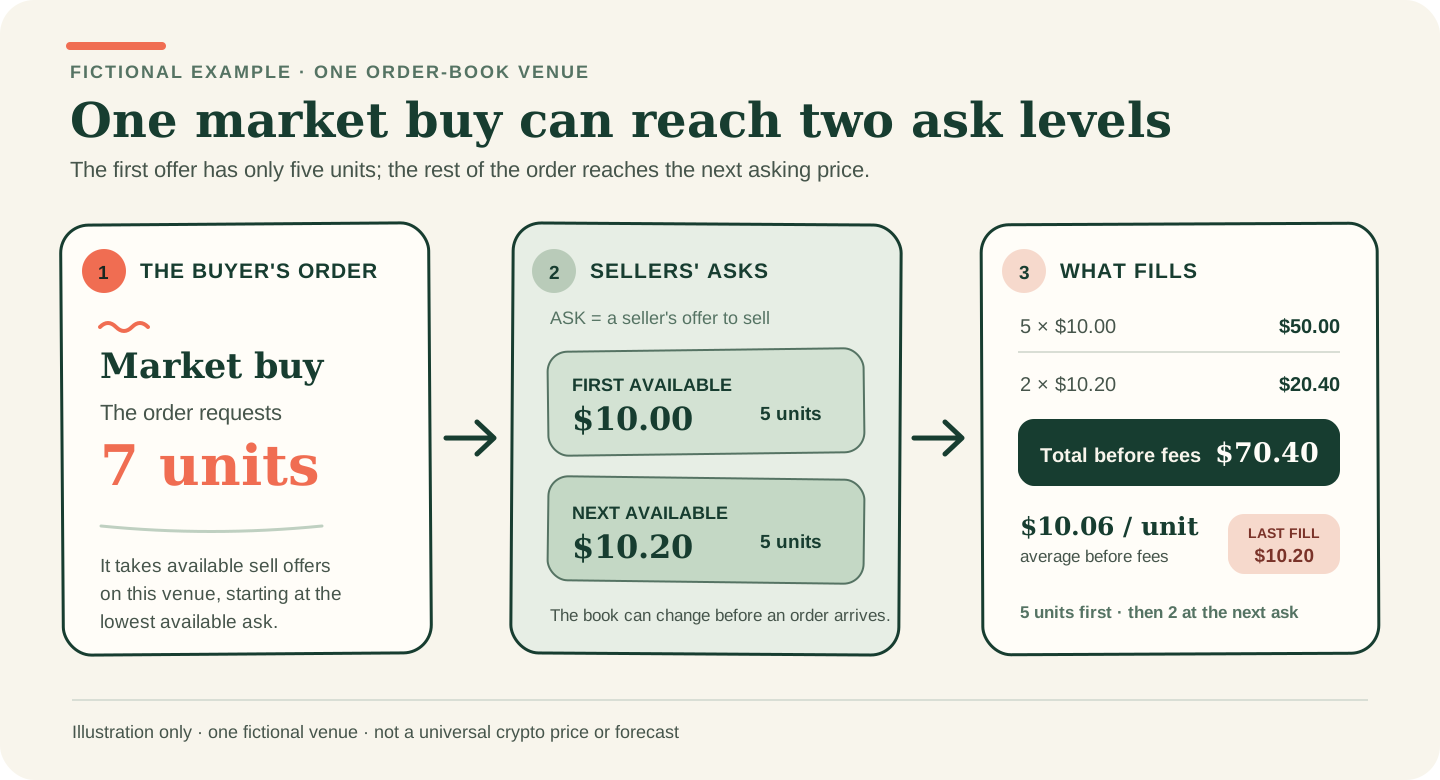
One fictional order-book venue: a market buy uses the available $10.00 ask, then reaches the $10.20 ask. The average is $10.06 before fees; this is not a universal crypto price or forecast.
- Five units are offered for sale at $10.00; five more are offered at $10.20.
- A market buy for seven takes five at $10.00, then two at $10.20.
- The fictional total is $70.40 before fees, or about $10.06 per unit on average.
- This single venue example is not a universal crypto price, future direction, or guaranteed fill.
If only three of the five units at $10.00 remained when the seven-unit buy arrived, how many units would need to reach the $10.20 ask, assuming enough units remained there?
The short answer
Every completed trade has a buyer and a seller, so “more buyers than sellers” is shorthand—not a headcount. On an order-book venue, the last traded price changes when a trade matches at a different available price; posted bids and asks can also change before a trade occurs. New information or changing expectations may influence those orders, but a chart alone cannot prove why a move happened. This guide uses one fictional order-book example; other venues can use different pricing mechanisms.
How one order can reach two prices
The visual uses a fictional book with five units offered at $10.00 and five at $10.20. A market buy for seven units takes the five available at $10.00, then gets its remaining two at $10.20. Before fees, that is $70.40 total and about $10.06 per unit on average; the last two units fill at $10.20. The example shows one order on one venue, not a universal crypto price or a forecast. Offers can change before an order arrives, and a different venue may have a different book.
A market order prioritizes execution against available orders, so its final fill can differ from the last trade or the first ask. A limit order sets a price boundary but may not fill. For the order-type comparison, see market orders vs limit orders; for trade size, pool depth and possible exit proceeds, see liquidity and price impact.
Information, leverage, and volatility
News, broad market moves, or revised expectations about an asset's demand or supply can change the orders people are willing to place. In margined futures, leverage magnifies gains and losses; a position moving against its holder may require more margin or be closed under the contract's rules. That is a derivatives-specific mechanism, not a description of every spot market. The CFTC risk advisory explains this futures risk.
Volatility describes the scale of price fluctuations over a chosen period; it does not indicate which way the next move will go. A fall does not create a rule that prices must rebound. For the separate arithmetic of losses and recovery, see drawdown risk.
Check a price story
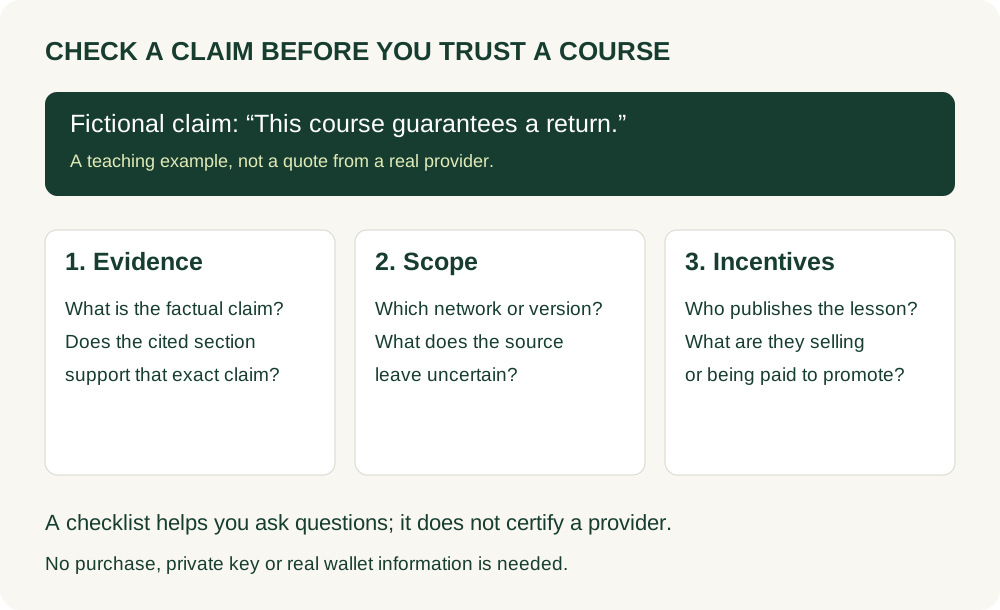
Before accepting a confident explanation, note the asset pair, venue, and time window. Separate what the chart or trade record shows from a proposed cause, then ask what other evidence would support that cause. A schedule such as a Bitcoin halving explains a protocol rule, not a guaranteed market reaction; see the Bitcoin halving guide. Learning these mechanics does not require a wallet, a trade, or leverage.
Check your understanding.
In the fictional order-book example, why can the last units of a seven-unit market buy fill at $10.20 when the first ask was $10.00?
A correct answer records local learning progress, not a qualification or proof of financial readiness.
Put this lesson in context
Start with how the technology works, then separate assets, accounts and wallet control.
Sources & context
- Coinbase — What is an order book? ↗Consulted 2026-10-02
- Coinbase Help — Liquidity ↗Consulted 2026-10-05
- U.S. Commodity Futures Trading Commission — Customer Advisory: Understand the Risks of Virtual Currency Trading ↗Consulted 2026-10-02
Original educational content prepared for this project. Sources provide context, not endorsement or a guarantee that every statement remains current. Rules, product interfaces and availability can change.
Keep learning in Telegram.
Open this published guide in the learning bot. No account connection or wallet is needed.
Join the $STONKB community.
Follow project updates, share useful ideas and meet other builders. You do not need to buy $STONKB to join.
Take what you learned.
Leave the pressure behind.