This guide is educational, not personalized financial, legal or security advice. A checklist reduces avoidable mistakes; it cannot make a transaction risk-free.
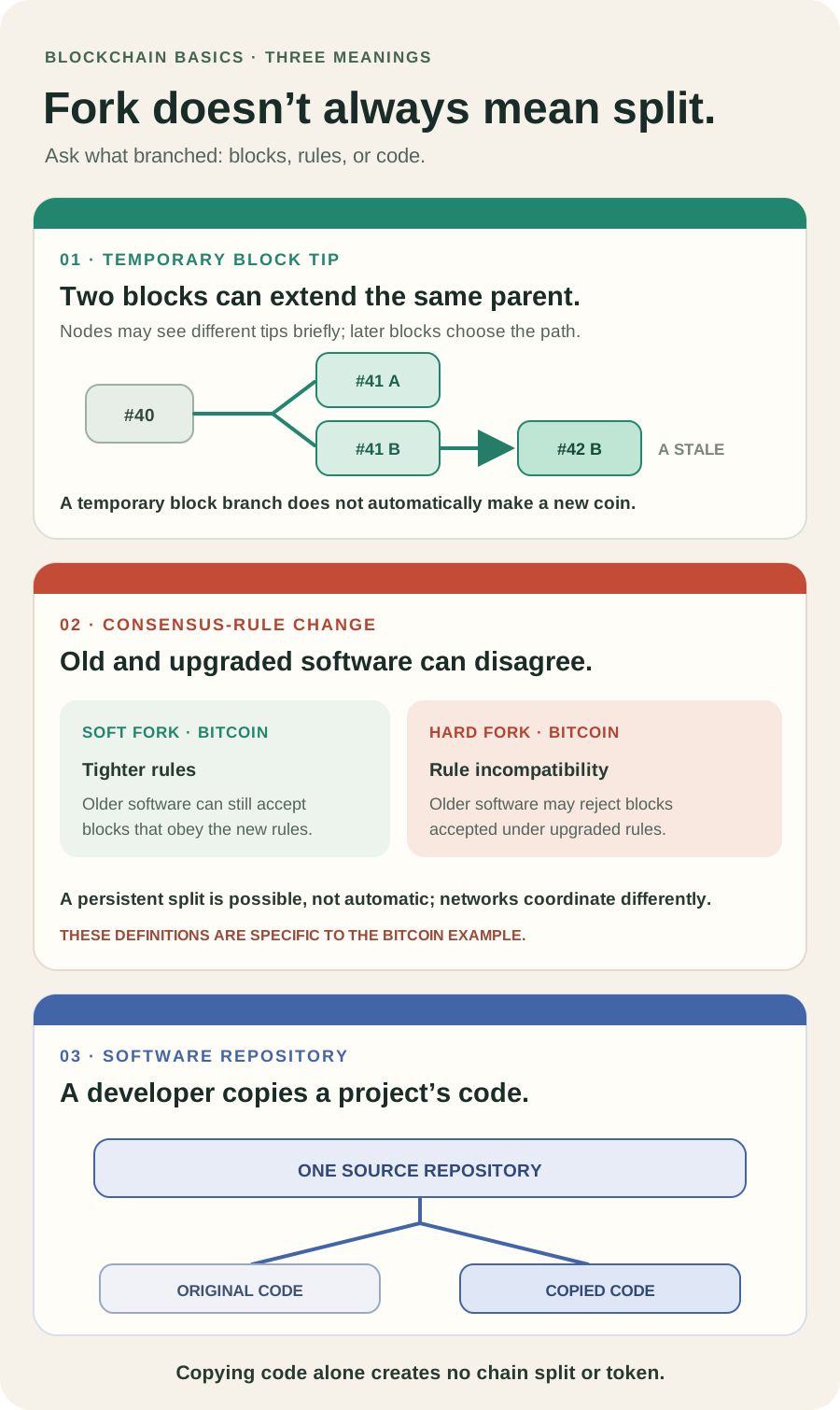
Three meanings share the word fork, but not the same consequences. Protocol definitions and fork choice are network-specific.
- Two blocks can briefly compete to extend the same Bitcoin history; a later block can make one stale.
- A soft or hard fork describes a consensus-rule change in Bitcoin terminology; compatibility differs, and a persistent split is not automatic.
- A source-code repository can be copied without changing any running blockchain or issuing a token.
A post says a developer forked a crypto repository and promises you a new coin. Identify which kind of fork occurred and what evidence is still missing.
The short answer: ask what is branching
A blockchain fork is a branch—but people use the word for different things. Two competing blocks can briefly extend the same history. A protocol upgrade can change which blocks software accepts. A developer can also fork a code repository without changing any blockchain. These are related by the idea of a branch, not by having the same consequences.
The visual separates those three meanings. Before acting on a claim about a ‘fork,’ ask which one is meant and which network is involved.
1. A temporary fork: two candidate blocks
In Bitcoin, two blocks can have the same height when miners find them close together. Different nodes may hear about different blocks first, so they temporarily see different chain tips. If a later block extends one branch, the network’s rules determine which history a node follows; the other block may become stale. This is a normal possibility in block propagation, not automatically a planned upgrade or a new coin.
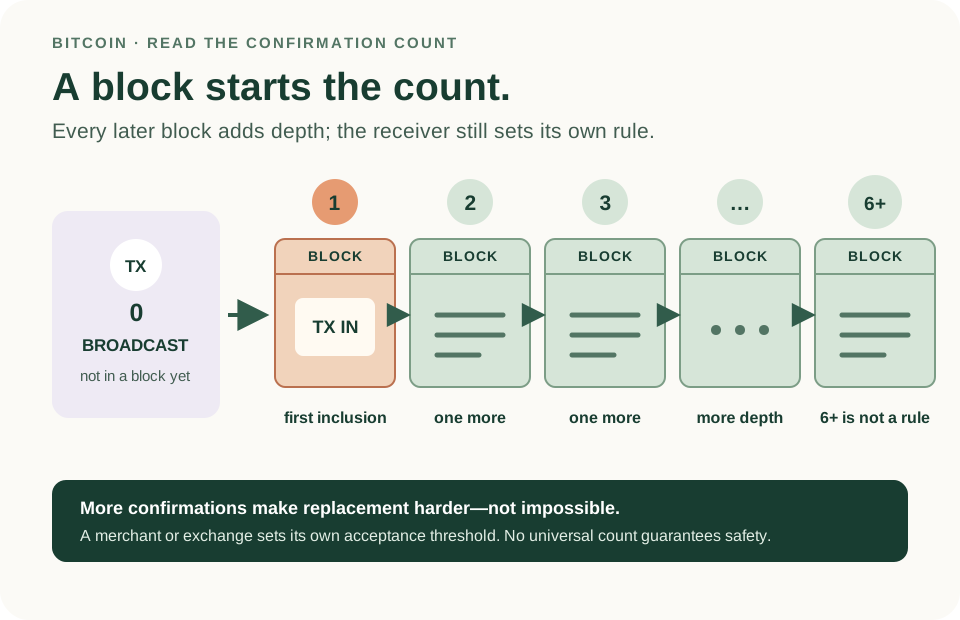
That is one reason a transaction’s confirmation count is not an unchangeable timer. If the block containing it is no longer in the history a node follows, the transaction may need to be considered again under that network’s rules. See Bitcoin confirmations explained for what the count means. This is a Bitcoin example; other networks use their own fork-choice and finality designs.
2. A rule change: soft fork or hard fork
A protocol fork concerns the rules that nodes enforce—not just two blocks arriving at once. In Bitcoin’s terminology, a soft fork makes some previously valid blocks or transactions invalid under tighter rules. Because blocks that satisfy the new restrictions can still be accepted by older software, it is backward-compatible in that specific sense. A hard fork changes consensus rules so older software may reject blocks accepted by upgraded software.
A rules change and a lasting chain split are not identical. A hard-fork change can create the possibility of two histories, but a persistent split depends on participants continuing to build and use both. The Bitcoin Developer Guide describes these outcomes in Bitcoin’s proof-of-work context; do not assume every network coordinates upgrades in the same way. For the roles of nodes and rule checks, read what is a blockchain node?.
3. A software fork: copied code
On GitHub, a repository fork creates a separate copy of a project's source code that can be changed without affecting the upstream project; see GitHub's guide to forking a repository. That repository action alone does not create a blockchain, move assets, or issue a token. A code fork could be used as a starting point for software that follows different network rules, but whether participants run it and a distinct chain persists is a separate question.
A three-question fork check
1. What branched? Competing blocks, consensus rules, or a source-code project? 2. Which network and software version? The word ‘fork’ is not a universal operating manual. 3. Did a new history actually persist? A temporary branch or a code copy alone does not establish a separate active network or a new asset.
No fork label by itself predicts a token’s value, gives you a claim to an asset, or tells you what a wallet will display. Verify the exact network and source before responding to an airdrop or upgrade message. Continue with how a blockchain works or compare proof of work and proof of stake.
Check your understanding.
A developer copies a blockchain project's source code into a separate repository. What has that action proved by itself?
A correct answer records local learning progress, not a qualification or proof of financial readiness.
Put this lesson in context
Start with how the technology works, then separate assets, accounts and wallet control.
Sources & context
- Bitcoin Developer Guide — Block Chain: temporary and rule-change forks ↗Consulted 2026-10-07
- Bitcoin Developer Guide — Glossary: Fork, hard fork, soft fork, and stale block ↗Consulted 2026-10-07
- Bitcoin Improvement Proposals — BIP 9: Version bits with timeout and delay ↗Consulted 2026-10-07
- GitHub Docs — Fork a repository ↗Consulted 2026-10-07
Original educational content prepared for this project. Sources provide context, not endorsement or a guarantee that every statement remains current. Rules, product interfaces and availability can change.
Keep learning in Telegram.
Open this published guide in the learning bot. No account connection or wallet is needed.
Join the $STONKB community.
Follow project updates, share useful ideas and meet other builders. You do not need to buy $STONKB to join.
Take what you learned.
Leave the pressure behind.