This guide is educational, not personalized financial, legal or security advice. A checklist reduces avoidable mistakes; it cannot make a transaction risk-free.
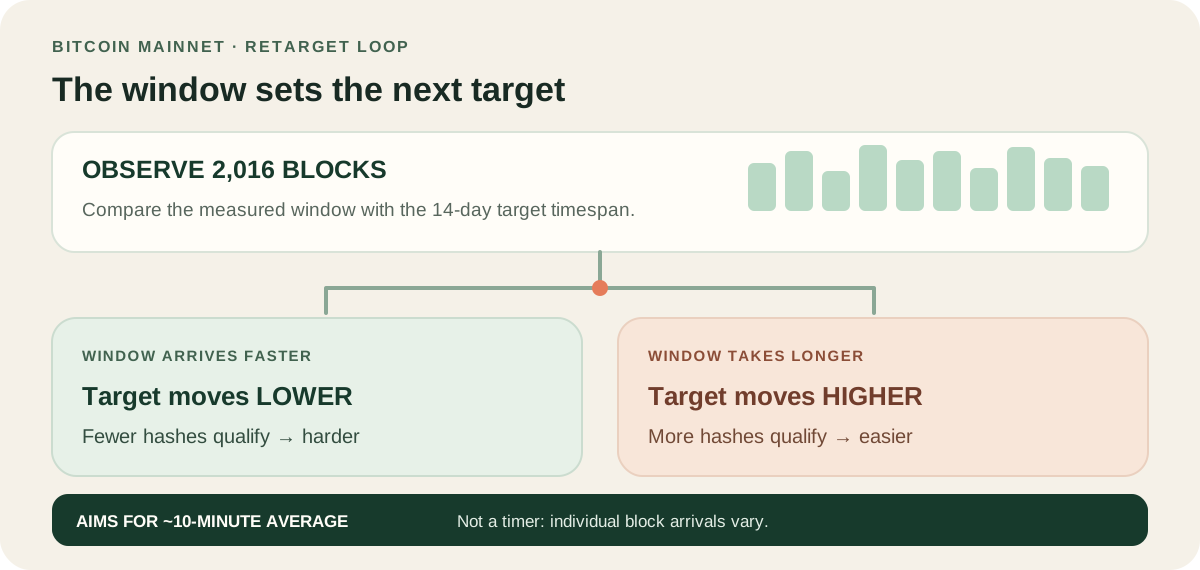
A simplified Bitcoin mainnet retarget: faster windows lower the target; slower windows raise it. Block arrivals remain variable, and other networks may use different rules.
- Bitcoin Core mainnet targets 2,016 blocks per retarget window and a 14-day timespan.
- If the window arrives faster than its target, the next proof-of-work target moves lower and qualifying hashes become harder to find.
- If the window takes longer, the target moves higher and qualifying hashes become easier to find.
- The rule aims toward a long-run average near ten minutes; it does not schedule or guarantee each block.
A fictional retarget window takes longer than 14 days. Which direction does the target move, and does that promise when the next block arrives?
The short answer: Bitcoin retargets after a block window
Bitcoin mainnet adjusts its proof-of-work target at retarget boundaries, every 2,016 blocks. Bitcoin Core v31.1 sets a target spacing of 10 minutes and a target timespan of 14 days; 2,016 × 10 minutes equals two weeks. The network compares how quickly the recent window arrived with that target period, then changes how hard it is for a block hash to qualify.
This is a target average, not a block-by-block clock. Individual blocks can arrive much sooner or later than ten minutes. A retarget does not promise that the next block—or every future block—will arrive on schedule.
What changes when blocks arrive faster or slower?
A block header's proof-of-work hash must be at or below a target. A lower target is harder to hit because fewer possible hashes qualify; a higher target is easier. Bitcoin Core measures the elapsed time for the retarget window and scales the target toward the 14-day timespan.
- If the window arrives faster than its target, the next target moves lower: mining becomes harder.
- If the window takes longer than its target, the next target moves higher: mining becomes easier.
- If it is close to the target, the adjustment is correspondingly smaller.
For an intentionally simplified example, imagine the observed window takes 10 days instead of 14. The target moves down, making qualifying hashes less common in the next period. If a window takes 18 days, the target moves up. These are fictional elapsed times used to explain direction—not current network measurements or a forecast. Bitcoin Core also limits the measured adjustment at each retarget, so one window cannot produce an unlimited jump.
When does the rule run?
The regular mainnet retarget happens at the boundary between 2,016-block periods, not whenever miners add more machines or whenever one slow block appears. Between regular boundaries, the mainnet proof-of-work target normally stays the same. Bitcoin Core has separate special rules for some test networks, so this article describes Bitcoin mainnet rather than every Bitcoin-like chain.
Difficulty, mining and halvings are different ideas
Difficulty adjustment changes the proof-of-work target; it does not change the subsidy paid by a block. Bitcoin's subsidy follows a separate block-height schedule. Read Bitcoin halving explained for that issuance rule.
Mining software searches for a qualifying hash and proposes a block, while full nodes independently check the block against the rules they follow. A retarget does not replace those checks or tell you whether a mining business will make money. See what Bitcoin mining does for the search-and-validation distinction and what a Bitcoin confirmation means for how later blocks build on transaction history.
Read the visual without treating it as a countdown
Start with the 2,016-block window. Then follow the two branches: faster-than-target blocks lower the target; slower-than-target blocks raise it. Both directions aim toward a long-run average near ten minutes, but block arrivals remain variable. You can follow this rule without a wallet, miner, or payment.
Check your understanding.
If a Bitcoin mainnet retarget window takes longer than its target timespan, what direction does the proof-of-work target move?
A correct answer records local learning progress, not a qualification or proof of financial readiness.
Put this lesson in context
Begin with the Bitcoin network, then follow the guides on wallets, fees and confirmation.
Sources & context
- Bitcoin Core — Proof-of-work target adjustment logic (v31.1) ↗Consulted 2026-10-09
- Bitcoin Core — Mainnet proof-of-work target parameters (v31.1) ↗Consulted 2026-10-09
- Bitcoin Core — Bitcoin Core Releases ↗Consulted 2026-10-11
- Bitcoin Developer Guide — Mining ↗Consulted 2026-10-11
Original educational content prepared for this project. Sources provide context, not endorsement or a guarantee that every statement remains current. Rules, product interfaces and availability can change.
Keep learning in Telegram.
Open this published guide in the learning bot. No account connection or wallet is needed.
Join the $STONKB community.
Follow project updates, share useful ideas and meet other builders. You do not need to buy $STONKB to join.
Take what you learned.
Leave the pressure behind.