This guide is educational, not personalized financial, legal or security advice. A checklist reduces avoidable mistakes; it cannot make a transaction risk-free.
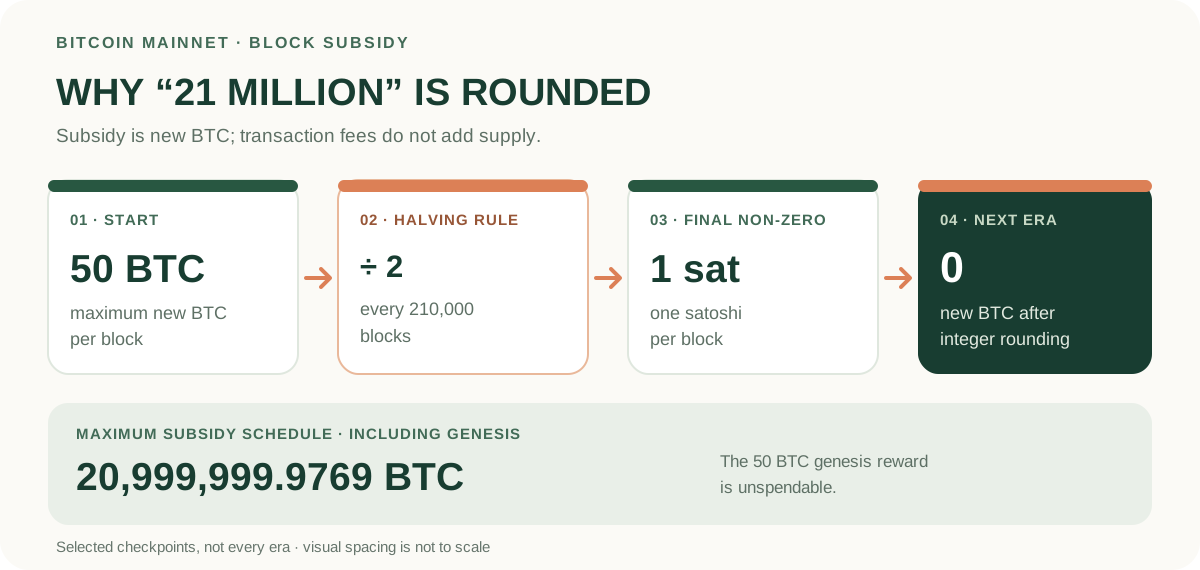
Only the subsidy creates new BTC; transaction fees do not. Selected schedule checkpoints, not a scale drawing; the total includes the unspendable genesis reward.
- Subsidy means newly issued BTC: Bitcoin mainnet starts at 50 BTC per block.
- Every 210,000 blocks, integer-satoshi arithmetic halves the subsidy.
- The last non-zero subsidy is one satoshi per block; the next era's subsidy is zero.
- The scheduled sum includes 50 genesis BTC that cannot be spent, so the headline total is not circulating supply.
When you see a Bitcoin supply figure, ask: scheduled maximum, issued rewards, unspent outputs, or estimated accessible coins?
How many bitcoins will ever exist?
Bitcoin is commonly described as having a 21 million BTC limit. That is a rounded headline. Summing the maximum block subsidies allowed by Bitcoin Core v31.1's mainnet subsidy schedule in whole satoshis gives 20,999,999.9769 BTC, including the genesis-block subsidy. Core identifies the genesis subsidy as unspendable; subtracting its 50 BTC gives a theoretical ceiling of 20,999,949.9769 BTC in spendable subsidies if every later block claimed its full subsidy and paid it to spendable outputs. Neither number is a live count of coins people can currently spend.
Where does the limit come from?
A block's subsidy is newly issued BTC that a miner may claim for a valid block. Transaction fees are different: they come from transactions included in the block. Together, subsidy and fees make up the block reward, but only the subsidy creates new BTC. Bitcoin's block-chain guide explains the distinction.
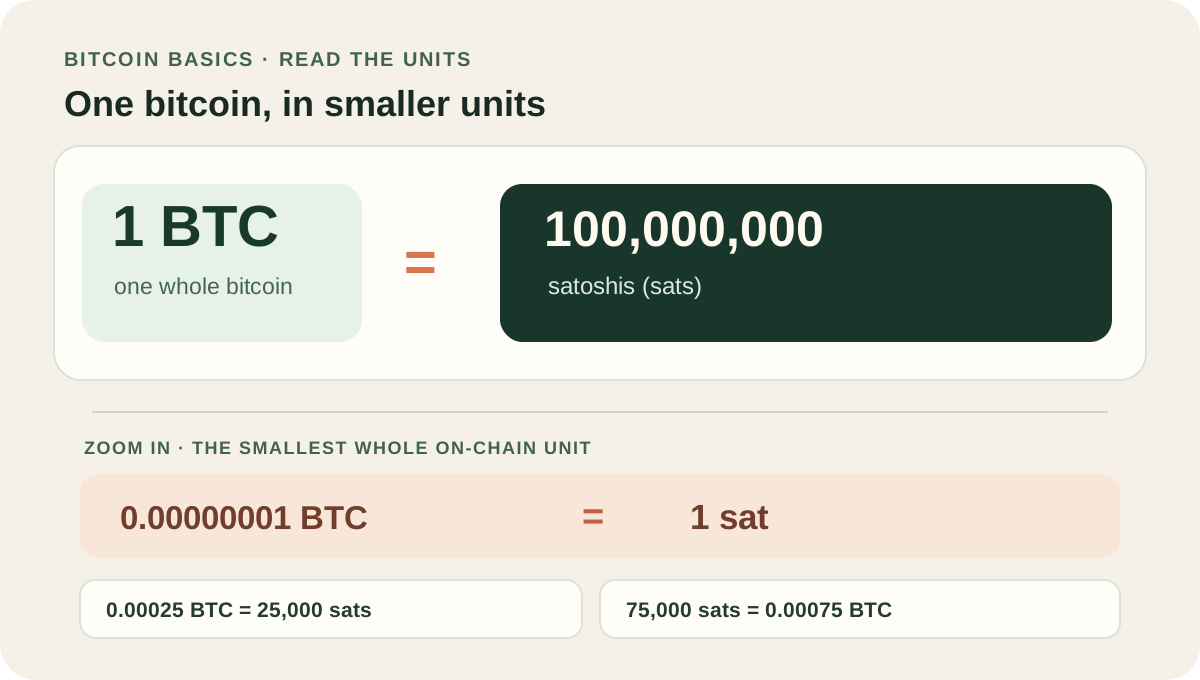
Bitcoin Core's mainnet rules start the block subsidy at 50 BTC and halve it after each interval of 210,000 blocks. Core represents one bitcoin as 100 million satoshis in its amount definition, then halves the subsidy using integer arithmetic in its subsidy calculation. The mainnet parameters set the 210,000-block interval. In the final non-zero era, the reward is one satoshi per block; the next right-shift rounds it to zero. Add the maximum scheduled subsidy across all non-zero eras and the total falls just short of 21 million because fractions smaller than one satoshi are discarded at each halving. The result above is a calculation from those rules, not a separate supply number printed by Core. The familiar rounded figure appears on Bitcoin.org's halving schedule.
Is 21 million the amount in circulation now?
No. It describes the upper limit implied by scheduled block subsidies, not how many coins are currently available to spend. A miner can claim less than the permitted subsidy; Core's validation code rejects a block that claims more than subsidy plus fees. Core's UTXO accounting separately identifies the unspendable genesis subsidy and fee rewards miners did not claim. Coins can also become inaccessible when keys are lost, but that does not create extra issuance room or let anyone count those coins precisely.
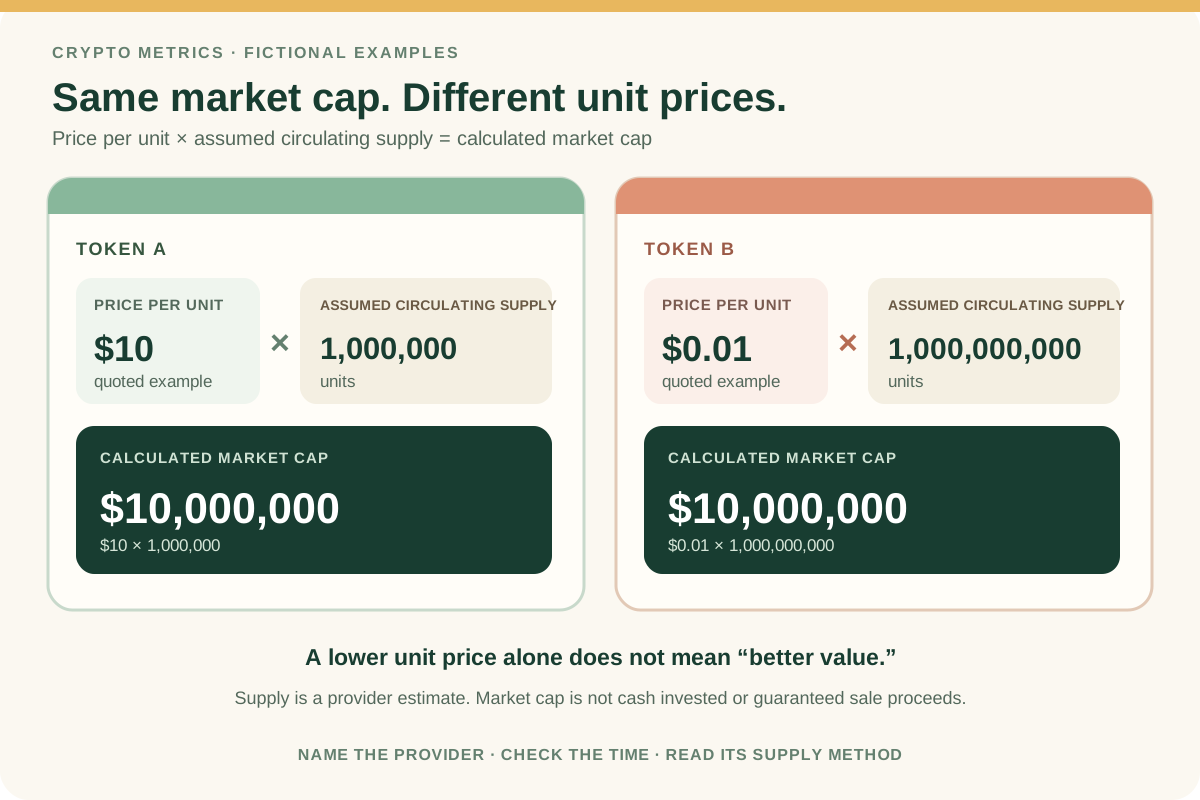
There is another easy-to-misread number in Core: MAX_MONEY is set to 21 million BTC as a validation sanity bound. Core's own amount definition says it is not the total money supply. Do not use that constant as a measurement of coins mined, spendable, or circulating. For the issuance rhythm rather than the total, read how Bitcoin halvings work; for what market capitalization can and cannot tell you, see price, supply and market cap.
What should a beginner remember?
"21 million" is a useful rounded description of Bitcoin's subsidy limit under the cited rules. The more exact subsidy arithmetic is slightly lower because rewards are whole satoshis, and the genesis reward cannot be spent. Actual spendable, circulating and economically accessible amounts are different measures. Scarcity rules describe issuance; they do not predict BTC's price or make a purchase suitable for you.
Try this no-money check: when a page reports a Bitcoin "supply" number, ask whether it means the scheduled limit, rewards already issued, current unspent outputs, or an estimate that excludes coins believed lost. Those figures answer different questions.
Check your understanding.
Why is Bitcoin's 21 million limit not the same as today's spendable supply?
A correct answer records local learning progress, not a qualification or proof of financial readiness.
Put this lesson in context
Begin with the Bitcoin network, then follow the guides on wallets, fees and confirmation.
Sources & context
- Bitcoin.org — Bitcoin Halving Countdown and Schedule ↗Consulted 2026-10-11
- Bitcoin Core — Block subsidy calculation (v31.1) ↗Consulted 2026-10-11
- Bitcoin Core — Mainnet subsidy halving interval (v31.1) ↗Consulted 2026-10-11
- Bitcoin Core project — Bitcoin amount definition: satoshis per BTC (v31.1) ↗Consulted 2026-10-07
- Bitcoin Core — UTXO-set accounting and unspendable amounts (v31.1) ↗Consulted 2026-10-05
- Bitcoin Developer Guide — Block Chain ↗Consulted 2026-10-11
Original educational content prepared for this project. Sources provide context, not endorsement or a guarantee that every statement remains current. Rules, product interfaces and availability can change.
Keep learning in Telegram.
Open this published guide in the learning bot. No account connection or wallet is needed.
Join the $STONKB community.
Follow project updates, share useful ideas and meet other builders. You do not need to buy $STONKB to join.
Take what you learned.
Leave the pressure behind.