This guide is educational, not personalized financial, legal or security advice. A checklist reduces avoidable mistakes; it cannot make a transaction risk-free.
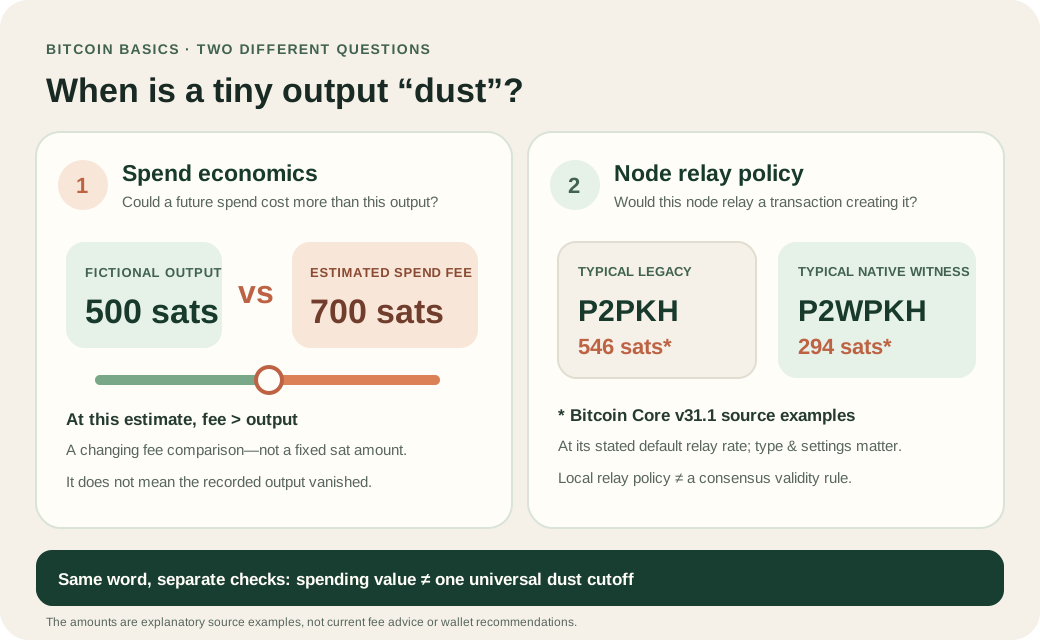
Two meanings of dust: an output may be uneconomical to spend at an estimate, while a node applies its own configurable relay policy. Core's examples are versioned and rate-dependent.
- Compare the fictional output value with its estimated future spend fee; changing fee conditions can change that comparison.
- Bitcoin Core v31.1 gives 546 sats for a typical legacy P2PKH output and 294 sats for a typical native-witness P2WPKH output at its stated default relay rate.
- Output type and configurable node relay policy matter; these examples are not one universal cutoff.
- A node's relay policy is separate from the consensus rule for whether an output is valid in a block.
In the fictional example, the estimated fee is 700 sats and the output is 500 sats. What does that comparison suggest—and what does it not prove about other fee conditions or a node's relay policy?
The short answer
“Bitcoin dust” is an informal name for a very small unspent transaction output (UTXO). If the fee to spend that output is close to, or greater than, its value, spending it may not make economic sense at that fee estimate. Bitcoin Core also uses dust for a specific output threshold in a node's relay policy. These ideas are related, but they are not the same—and there is no single satoshi amount that is a universal dust line.
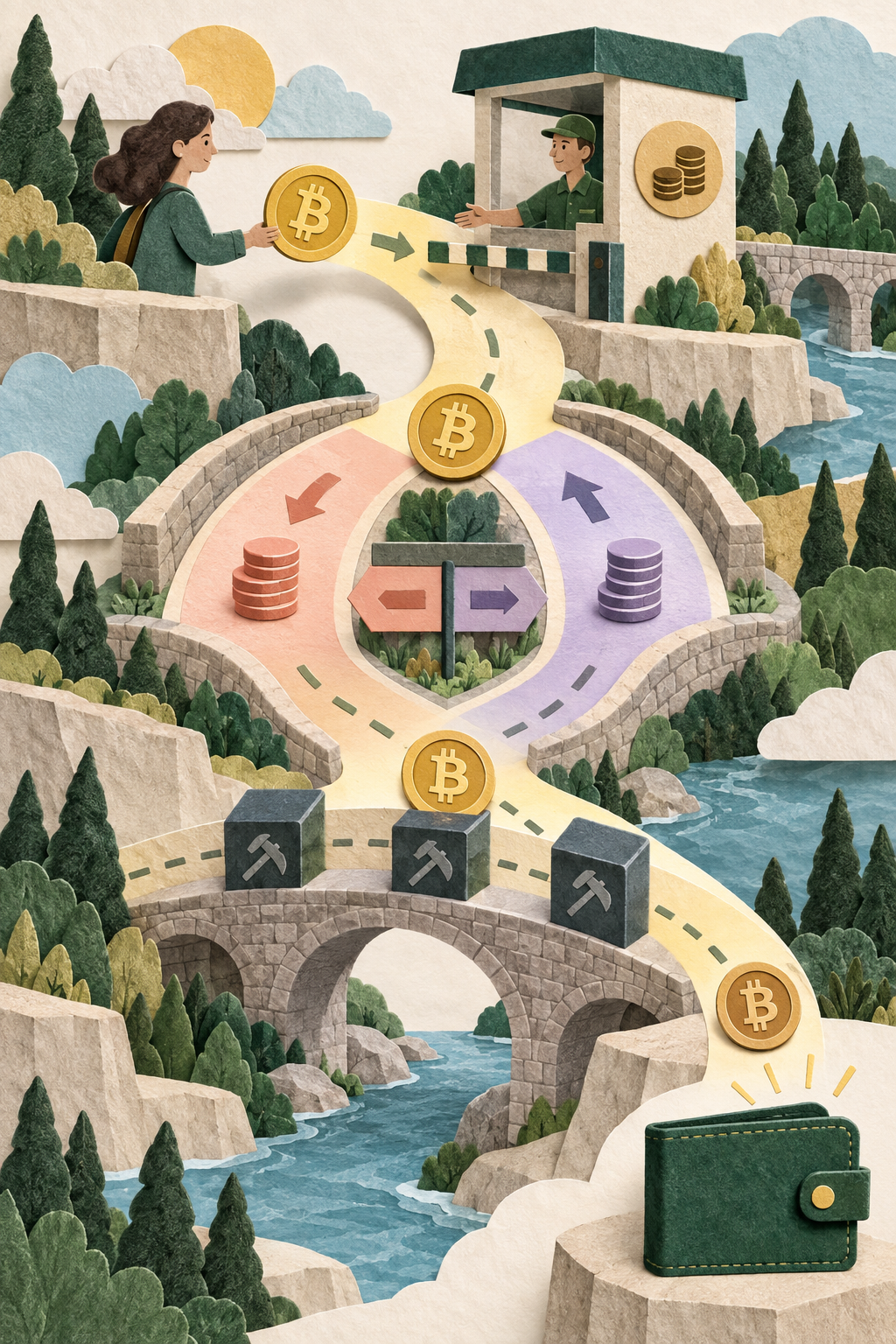
The illustration separates the two questions: would this output be worth spending at an estimated fee? and would this node's current policy relay a transaction creating it? The values are examples for comparison, not fee quotes or instructions to act.
Economic dust depends on the future spend
An output is not a separate coin sitting in a wallet. It is a recorded amount that can later be referenced as a transaction input. Spending it requires a transaction, and the size and fee rate affect the fee. If an output is worth 500 sats but a hypothetical spend is estimated to cost 700 sats, the output may be uneconomical to spend under that estimate. At a different fee rate or with a different transaction design, the comparison can change.
This is why a balance can be visible yet not useful to combine right now. “Uneconomical” is a fee-and-value comparison, not proof that the output is deleted, invalid, or permanently impossible to spend. For how size and sat/vB affect fees, see Bitcoin transaction fees explained and what a satoshi is.
Bitcoin Core's relay-policy dust threshold
Bitcoin Core v31.1 calculates its policy threshold using a configurable dust relay fee and the estimated size of both the output and a typical future input. Its source comments use a default dust-relay rate of 3,000 sat/kvB: at that rate, the examples are 546 sats for a typical legacy P2PKH output and 294 sats for a typical native-SegWit P2WPKH output. Those examples explain why 546 sats is often repeated; they are not universal thresholds for every output type, node setting, wallet, or fee condition.
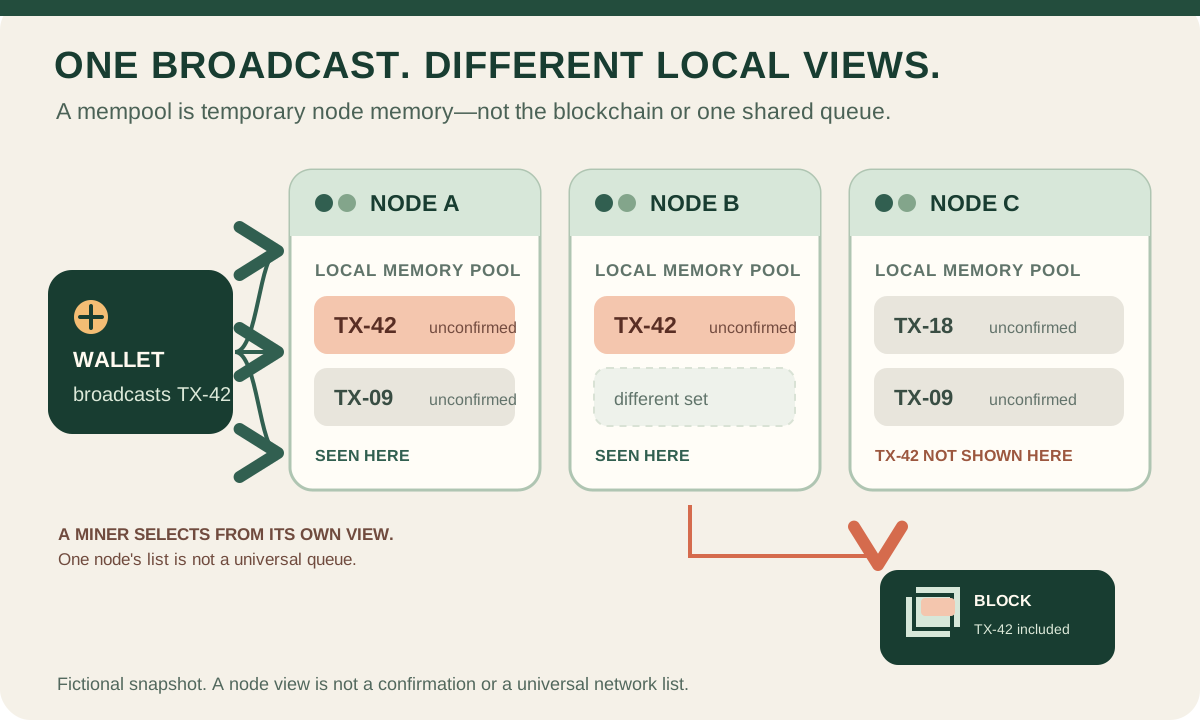
This is a local transaction-relay policy setting, not a consensus rule declaring that every smaller on-chain output is invalid. Individual nodes can have different software and configuration. A policy threshold helps decide what that node relays; it does not by itself erase an output already recorded on chain. See the Bitcoin Core v31.1 threshold calculation and its dust relay fee option.
What is a dusting attempt?
Researchers describe a Bitcoin dust attack as a possible privacy tactic: send a very small, unsolicited output hoping it is later spent with other inputs. A peer-reviewed study of historical Bitcoin transactions explains how the multi-input heuristic can then provide a clue that addresses may be linked. That clue is not proof of shared control or identity, and a small incoming output alone does not prove that an attack occurred. The transaction does not expose a private key by itself; wallet behavior and context matter. Bitcoin.org's privacy guidance explains how spending patterns can link public transaction history.
If an unfamiliar small amount appears, there is no need to panic or rush to “clean” it. Avoid links or unsolicited instructions asking you to connect a wallet, sign a message, or share a recovery phrase. If privacy matters, do not combine an unknown output with unrelated funds just to remove it; check your wallet's own documentation or support guidance before acting. Never share a seed phrase or private key.
A no-money check
Imagine a fictional 500-sat output and a wallet's current estimate of 700 sats to spend it. The simple comparison says the estimated fee exceeds the amount—not that 500 sats is always dust, and not that every node applies the same relay threshold. Then ask a separate question: what output type and dust-relay setting does the specific node use?
For the pieces around this lesson, continue to how Bitcoin transactions work, Bitcoin fees explained, or Bitcoin wallets explained.
Check your understanding.
Why is 546 sats not a universal Bitcoin dust threshold?
A correct answer records local learning progress, not a qualification or proof of financial readiness.
Put this lesson in context
Begin with the Bitcoin network, then follow the guides on wallets, fees and confirmation.
Sources & context
- Bitcoin Developer Guide — Transactions ↗Consulted 2026-10-10
- Bitcoin.org — Bitcoin transaction fees ↗Consulted 2026-10-10
- Bitcoin Core project — Dust threshold calculation in transaction policy (v31.1) ↗Consulted 2026-10-10
- Bitcoin Core project — Configurable dust relay fee option (v31.1) ↗Consulted 2026-10-10
- Bitcoin.org — Protect your privacy ↗Consulted 2026-10-10
- Applied Network Science — Is Bitcoin gathering dust? An analysis of low-amount Bitcoin transactions ↗Consulted 2026-10-10
Original educational content prepared for this project. Sources provide context, not endorsement or a guarantee that every statement remains current. Rules, product interfaces and availability can change.
Keep learning in Telegram.
Open this published guide in the learning bot. No account connection or wallet is needed.
Join the $STONKB community.
Follow project updates, share useful ideas and meet other builders. You do not need to buy $STONKB to join.
Take what you learned.
Leave the pressure behind.