This guide is educational, not personalized financial, legal or security advice. A checklist reduces avoidable mistakes; it cannot make a transaction risk-free.
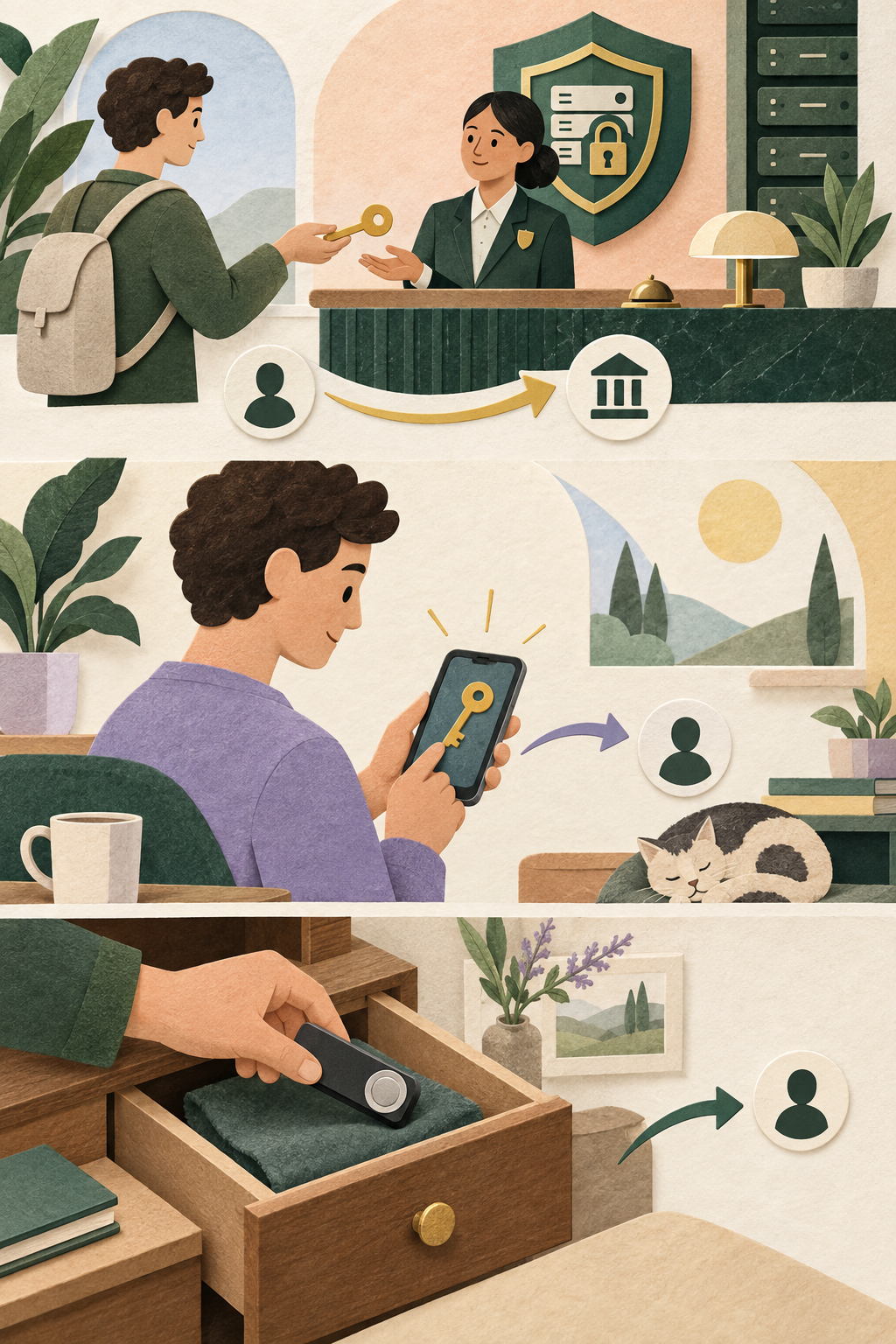
The interface can change while the central question stays the same: who controls authorization, and how does recovery work?
- A hosted account adds provider controls and counterparty dependence.
- A software wallet gives direct device access but adds local security work.
- Offline storage reduces ordinary online exposure but raises backup responsibility.
- No visual category is a universal safety guarantee.
For each scene, identify who can authorize a withdrawal and what failure the learner must prepare for.
A wallet is an access arrangement, not a vault
A Bitcoin wallet helps generate addresses, track spendable outputs and create or approve transactions. The asset is recorded on the network; the wallet manages the credentials and software needed to authorize a spend. That is why the first comparison is not “Which app looks easiest?” It is “Who can authorize a withdrawal, and what is the recovery path?”
A hosted account keeps the operational keys with a provider. The provider may offer a familiar login, support process and recovery flow, but it also controls withdrawals and can impose identity, availability or policy limits. Self-custody gives the user direct control of the signing material, while moving responsibility for backups, device security, address checks and transaction mistakes to the user. A hardware signer can create a separate approval surface, but it does not decide whether a recipient or application is honest.
Compare the failure modes
For a hosted account, investigate account lockout, withdrawal policy, provider solvency, identity requirements and what happens during an outage. For self-custody, investigate loss of the recovery method, malware, phishing, damaged devices, incorrect backups and an approval that the user did not understand. “Not your keys” is a useful prompt about control; it is not a complete risk score.
A paper comparison
Create two columns and answer the same questions for each arrangement:
- Who holds the signing material?
- What must be backed up?
- Who can pause or approve a withdrawal?
- What happens if the device, password or provider is unavailable?
- How would a trusted person learn the recovery plan without seeing a secret?
Do not enter a real recovery phrase while doing the exercise. The purpose is to expose responsibility before funds are involved.
Choose for the responsibility you can carry
A polished interface, a large brand or a hardware device is not evidence that your recovery plan works. Read the current provider or device documentation, make a small non-critical test only when appropriate and keep recovery material private. For a signer walkthrough, read how a Ledger hardware wallet works; for the transaction itself, see how Bitcoin transactions work.
Check your understanding.
What question comes first when comparing Bitcoin wallets?
A correct answer records local learning progress, not a qualification or proof of financial readiness.
Sources & context
- Bitcoin.org — Securing your wallet ↗Consulted 2026-09-23
- Bitcoin.org — Some things you need to know ↗Consulted 2026-09-23
Original educational content prepared for this project. Sources provide context, not endorsement or a guarantee that every statement remains current. Rules, product interfaces and availability can change.
Take what you learned.
Leave the pressure behind.