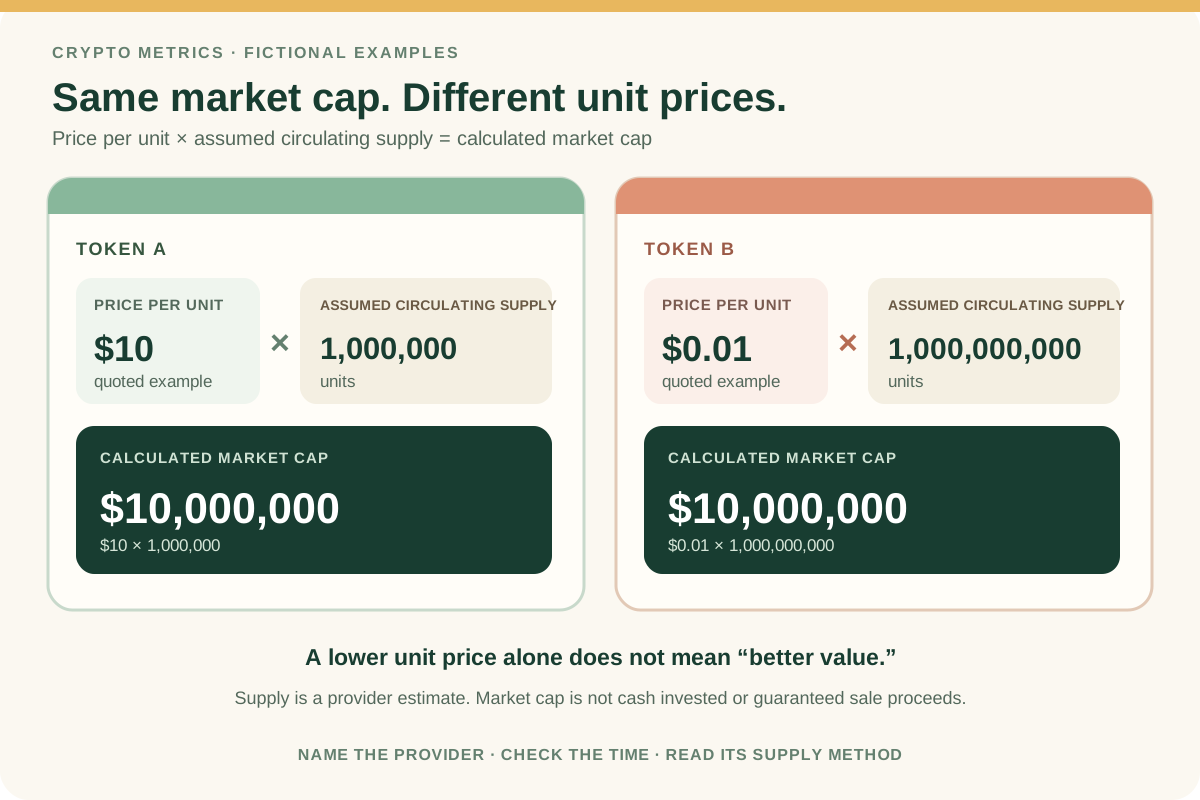
This guide is educational, not personalized financial, legal or security advice. A checklist reduces avoidable mistakes; it cannot make a transaction risk-free.
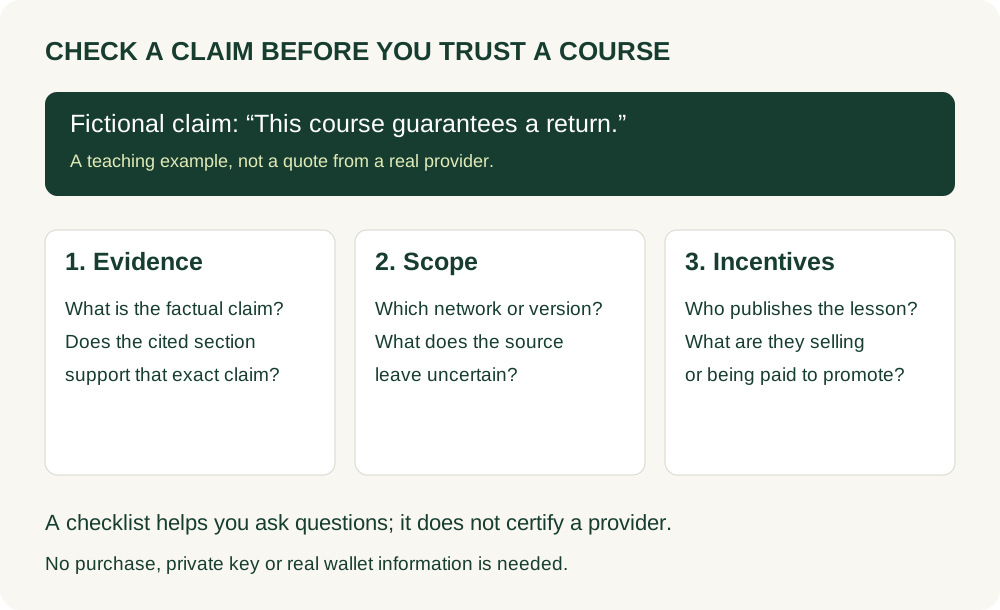
An invented claim examined through evidence, scope and incentives. A checklist is not certification.
- Identify the factual claim and its supporting source section.
- Check the network, version and limits of the explanation.
- Identify the publisher and its commercial incentives.
Use one sample lesson to fill out the source-checking worksheet without buying anything.
You have found three beginner courses. One promises an income, one lists dozens of topics, and one offers a short lesson about how a transaction works. Which should get your time? Start by deciding what you want to understand and looking at an actual lesson. A course title, price or certificate cannot answer that question for you.
This checklist is an editorial method for comparing learning resources. It does not certify a provider, establish legal compliance or predict an investment outcome. StonkBuilder is one of the resources you can assess with it.
Choose one question before choosing a course
Write a question you would like to answer in ordinary language: what a blockchain records, what a wallet signs, or how to identify the network used for a transfer. Look for a lesson that answers that question and makes its prerequisites clear.
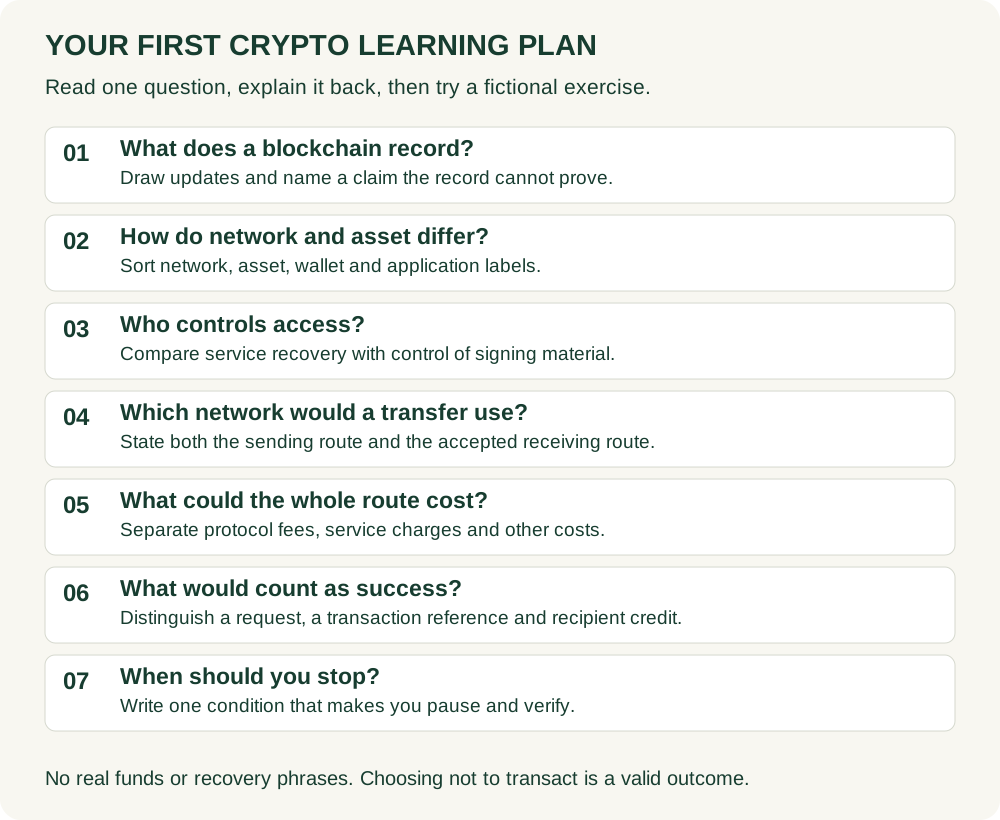
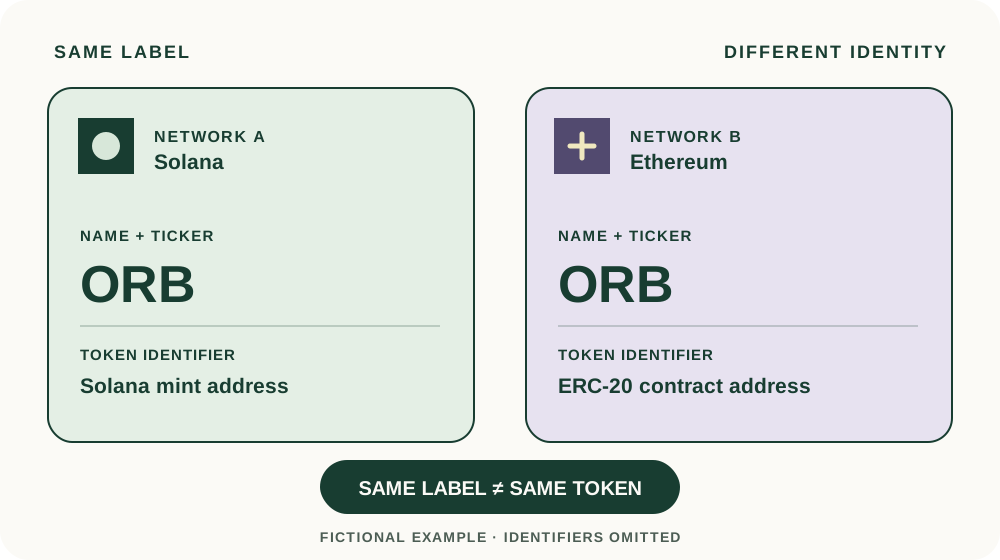
For a first session, a paper exercise can be enough. You could draw the difference between a network, an asset and a wallet. You do not need to make a purchase to compare how well two guides explain that distinction. Our first learning plan offers a sequence of questions if you need a starting point.
Inspect the evidence inside one lesson
Open one factual link instead of counting how many references appear at the bottom. Can you find the sentence, section or worked example that supports the claim? Does it concern the same network, product version and circumstances?
For example, Bitcoin.org's explanation describes private keys being used to sign transactions. That supports a statement about authorization. It does not support a promise that a particular wallet will prevent every loss, or that learning about signatures will make an investment profitable.
Treat a publication date as a clue to investigate. A recently edited page can repeat an old claim; an older explanation can still be useful for a stable concept. For changing fees or product features, seek the relevant current documentation and the conditions attached to the statement.
Make the person and the incentives visible
Look for a named author or accountable publishing organization, a way to report a correction, and an explanation of how substantial changes are reviewed. A claimed credential deserves its own check. A biography is useful context, rather than proof that every lesson is correct.
Then ask what happens after you read. Does the provider sell access, receive referral payments, promote a token, or offer a related service? Clear disclosure helps you assess those incentives. Neither a paid course nor a free guide earns automatic trust from its price. Our own editorial standards should be judged by this same approach.
Prefer a lesson you can explain back
After a sample lesson, close the page and explain its main distinction to someone else. Identify one thing it establishes and one thing it leaves uncertain. If you can repeat the vocabulary but cannot use it in a fictional example, try a different explanation before adding more topics.
Google's people-first content guidance offers useful questions about evidence, clear attribution and whether the reader leaves with an answer. It is guidance for publishing helpful content, not an accreditation system for courses.
A fictional comparison
Course A says “learn blockchain and earn every day,” with no accessible sample. Course B shows a lesson that explains a shared record, links its technical claims and asks you to name a fact the record cannot prove. You still need to check B's sources and commercial terms. Its sample simply gives you more material to assess.
Your next action might be to request a sample from A, read B's cited explanation, or choose neither. This comparison is fictional and does not rate any real provider.
Use this worksheet
- My learning question:
- Sample lesson and stated prerequisites:
- One factual claim I checked, with the supporting source section:
- What that source does not establish:
- Author or publisher and correction route:
- Payment, referral or promotion interests I found:
- Exercise I can do with fictional information:
- One unanswered question and my next step:
Take the worksheet to the learning library, choose one guide, and test whether its explanation helps you answer your question. If you need an exercise, use the Practice Lab. Never include real recovery phrases or private account details in a comparison worksheet.
Check your understanding.
What can this course-checking worksheet establish?
A correct answer records local learning progress, not a qualification or proof of financial readiness.
Put this lesson in context
Start with how the technology works, then separate assets, accounts and wallet control.
Sources & context
- Bitcoin.org — How does Bitcoin work? ↗Consulted 2026-10-25
- Google Search Central — Creating helpful, reliable, people-first content ↗Consulted 2026-10-25
Original educational content prepared for this project. Sources provide context, not endorsement or a guarantee that every statement remains current. Rules, product interfaces and availability can change.
Keep learning in Telegram.
Open this published guide in the learning bot. No account connection or wallet is needed.
Join the $STONKB community.
Follow project updates, share useful ideas and meet other builders. You do not need to buy $STONKB to join.
Take what you learned.
Leave the pressure behind.