This guide is educational, not personalized financial, legal or security advice. A checklist reduces avoidable mistakes; it cannot make a transaction risk-free.
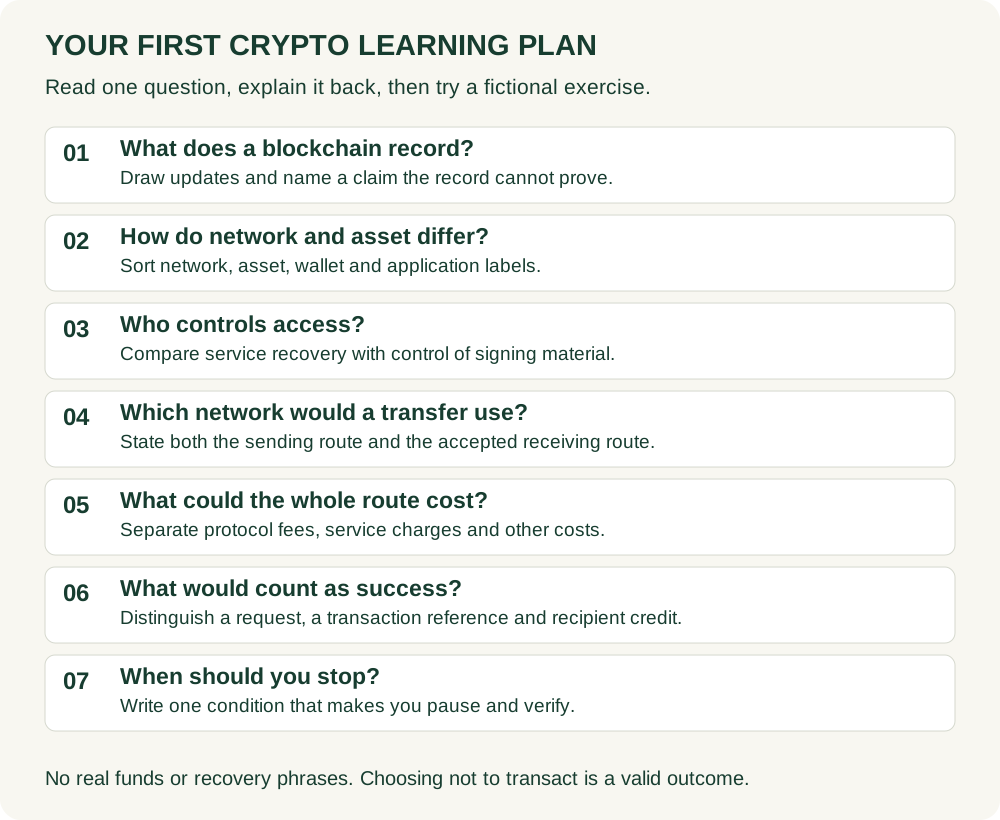
Seven questions and paper exercises. No real funds or recovery phrases are needed.
- What does a blockchain actually record?
- How do the network and the asset differ?
- Who controls access?
- Which network would a transfer use?
- What could the whole route cost?
- What would count as a successful result?
- When should you stop?
Choose one question and explain it with fictional information before continuing.
Start with a question, not a purchase
You can learn what a blockchain records, how a wallet signs and why networks matter without buying a token. Begin with one question you can explain in your own words. Read the related guide, try the paper exercise, and decide what remains unclear before continuing.
This plan is an educational sequence. Finishing it is not a qualification, a security assessment or a recommendation to buy crypto.
1. What does a blockchain actually record?
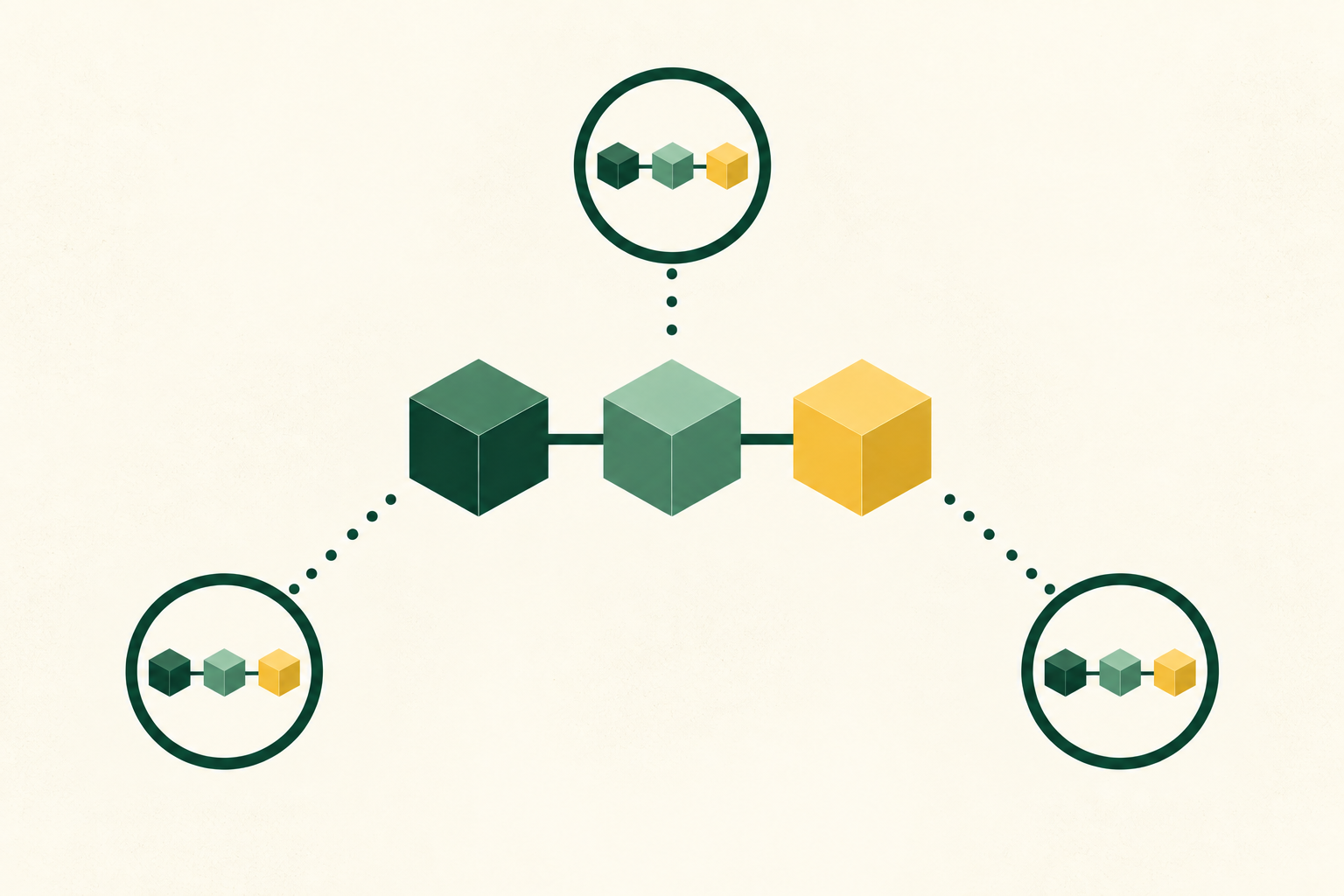
Read how blockchain works. Draw three connected blocks and write one update inside each. Explain which rules make an update acceptable. Then name one outside-world claim the record cannot prove, such as whether a seller delivered an object.
Continue when you can distinguish agreement about a record from trust in a person or business.
2. How do the network and the asset differ?
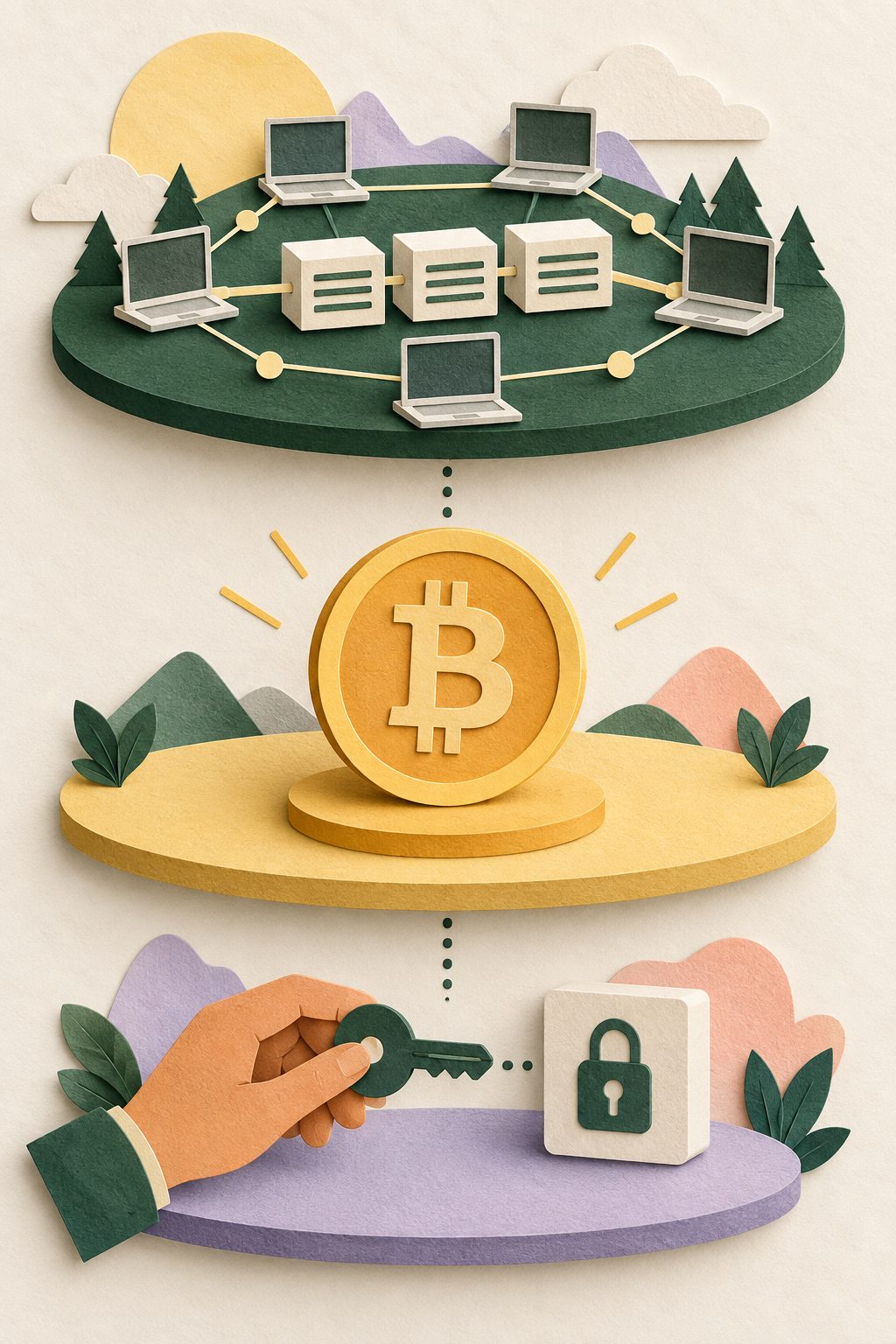
Read what Bitcoin is and how Solana, SOL and other tokens differ. Make four labels on paper: network, asset, wallet and application. Put each example under a label and explain your choice.
You are learning the vocabulary, not choosing which asset to buy. Use the network comparison if the names still blur together.
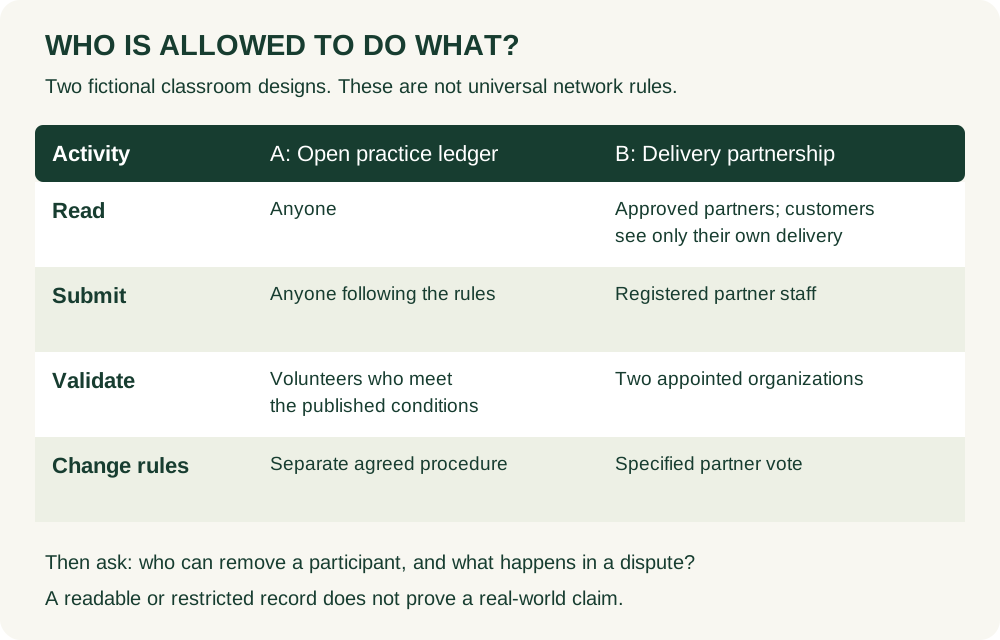
3. Who controls access?
Read custody versus ownership and public addresses, private keys and passwords. Compare an account controlled by a service with a wallet whose signing material you control. Write down what recovery depends on in each case.
Use fictional examples. Never enter a real recovery phrase into a website or put it into a practice document.
4. Which network would a transfer use?
Read the first-transfer checklist and same token on different networks. Invent an asset, sender and recipient. State the sending network and the network accepted by the recipient before drawing an arrow between them.
Try the network-match exercise. A matching name or ticker is not enough to establish the transfer route.
5. What could the whole route cost?
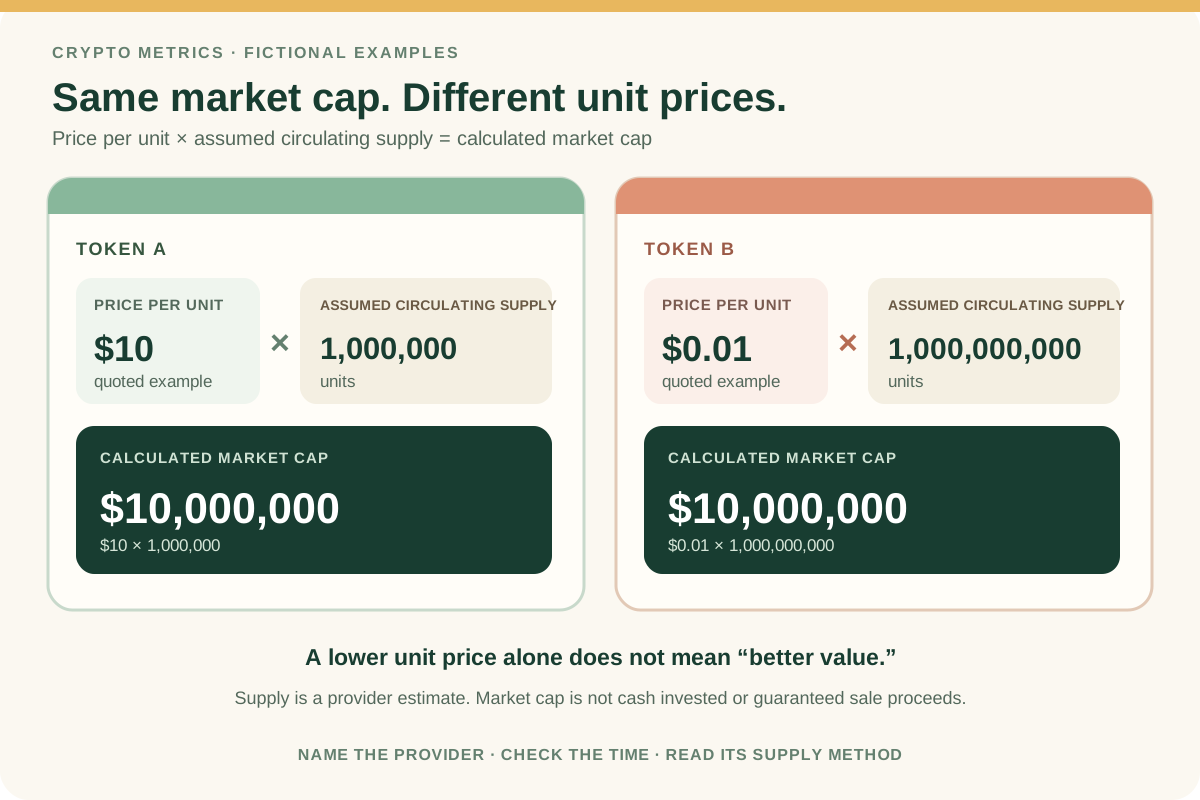
Read fees and spreads. List the possible costs of your fictional route, including service fees and currency conversion where relevant. Keep a protocol network fee separate from what a service charges.
Use the fictional fee exercise to compare assumptions. Practice figures are not live quotes, and the cheapest-looking first step may not be the cheapest complete route.
6. What would count as a successful result?
Read transaction status and the explorer guide. Identify the network, transaction reference, recorded status and any error. Explain what the record establishes and what must still be checked with the recipient or service.
A signed request, a transaction identifier and a completed payment are different pieces of evidence. Do not move real money for this exercise.
7. When should you stop?
Read how to recognize a crypto scam. Write a stop condition for your fictional scenario: the network is unclear, the request is unreadable, a source cannot be verified, or someone asks for a recovery phrase.
Choosing to wait or not to use crypto can be a useful outcome. Keep a short list of unanswered questions and return to the relevant lesson instead of guessing.
Check your understanding.
What is a successful learning outcome?
A correct answer records local learning progress, not a qualification or proof of financial readiness.
Put this lesson in context
Start with how the technology works, then separate assets, accounts and wallet control.
Sources & context
- NIST — Blockchain Technology Overview, NISTIR 8202, October 2018 ↗Consulted 2026-10-25
- Bitcoin.org — How does Bitcoin work? ↗Consulted 2026-10-25
- Solana documentation — Transactions ↗Consulted 2026-10-25
- Solana documentation — Fees ↗Consulted 2026-10-25
Original educational content prepared for this project. Sources provide context, not endorsement or a guarantee that every statement remains current. Rules, product interfaces and availability can change.
Keep learning in Telegram.
Open this published guide in the learning bot. No account connection or wallet is needed.
Join the $STONKB community.
Follow project updates, share useful ideas and meet other builders. You do not need to buy $STONKB to join.
Take what you learned.
Leave the pressure behind.