This guide is educational, not personalized financial, legal or security advice. A checklist reduces avoidable mistakes; it cannot make a transaction risk-free.
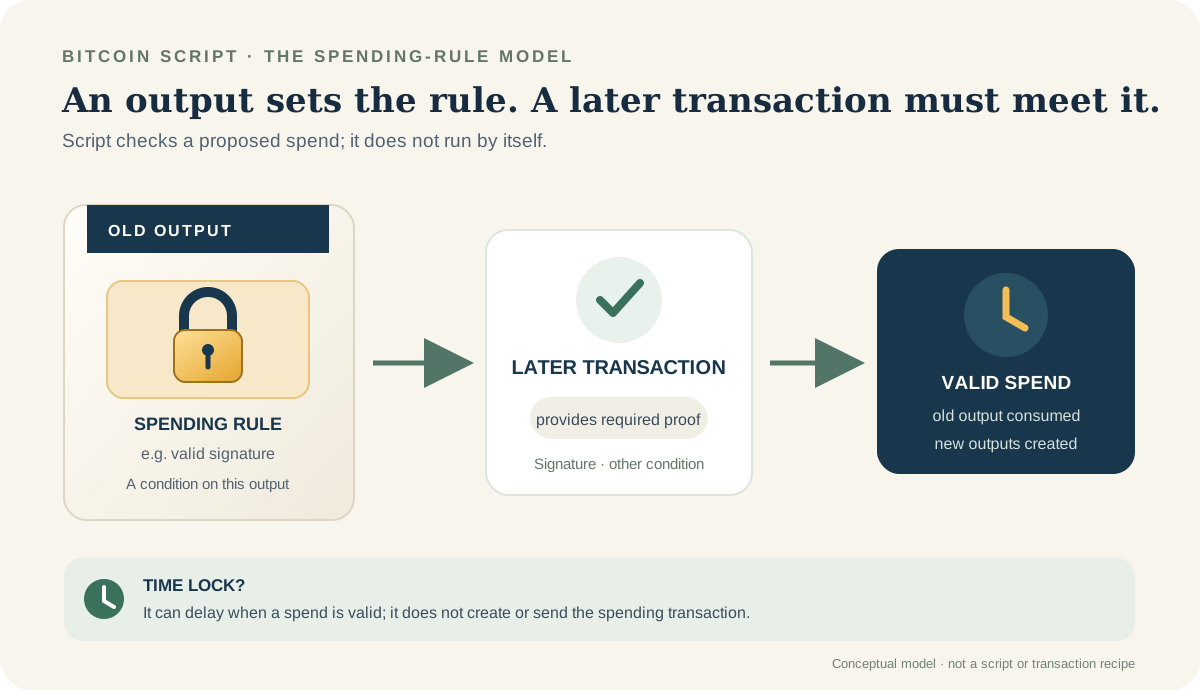
The output sets spend conditions; a later transaction supplies the spend. A time lock is a constraint, not an automatic payment.
- An unspent Bitcoin output carries conditions that define how it may be spent later.
- A later transaction supplies a signature or other data required by those conditions.
- Nodes check the proposed spend; a valid spend consumes the old output and creates new outputs.
- A time lock can delay a valid spend but does not create or broadcast the spending transaction.
Point to the old output, name the proof the later transaction supplies, and explain why reaching a time-lock condition does not itself send bitcoin.
The short answer: yes, with an important distinction
Bitcoin can enforce rules that determine when and how a transaction output may be spent. People sometimes call these rules Bitcoin smart contracts. More precisely, Bitcoin's base layer uses Script, a deliberately constrained language for checking spending conditions. It is not the same as a general-purpose contract platform where applications run arbitrary program logic.
The visual shows the useful mental model: an output carries a rule; a later transaction must satisfy it. The rule does not wake up or move bitcoin by itself.
How a Bitcoin spending rule works
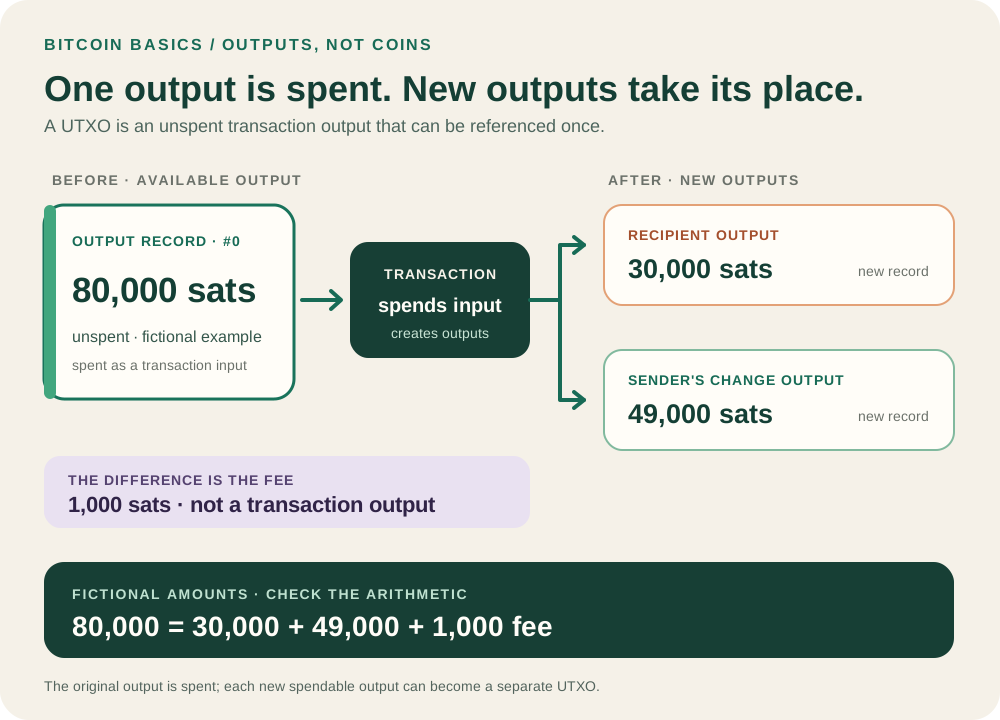
A Bitcoin transaction creates outputs, and each output specifies conditions for spending it later. When someone tries to spend one, the transaction supplies the required data—often a signature—and Bitcoin nodes check whether the conditions pass. If the spend is valid under the network's rules, the old output is consumed and the new transaction creates its own outputs. For the broader record lifecycle, see how Bitcoin UTXOs work and how Bitcoin transactions work.
For a familiar example, a standard output can require a valid signature associated with the right public key. Other scripts can require multiple signatures, or impose a time condition. Bitcoin's transaction guide describes Script as stack-based and deliberately stateless and not Turing complete; the design has no loops or gotos. So Script is programmable, but within a narrower, more predictable set of checks.
A time lock is a condition, not an alarm
Bitcoin's BIP 65 specifies OP_CHECKLOCKTIMEVERIFY, which can make an output unspendable until a block height or time condition is reached. Once that condition is met, a person or wallet still has to create and broadcast a valid spending transaction. Nothing automatically pays someone at the deadline.
This illustrates what the word “contract” can and cannot mean here. Bitcoin Script can check transaction data and defined conditions. It cannot independently confirm an off-chain event such as a parcel arriving, decide whether a promise was fair, or guarantee a legal outcome. A system that depends on outside information needs another source to provide it, with separate trust assumptions.
How this differs from general-purpose smart contracts
Ethereum and Solana support richer on-chain application code, though their execution and storage models differ. Bitcoin's base-layer Script focuses on validating spends and intentionally limits the kinds of logic it can express. “Bitcoin has no smart contracts” is therefore too absolute; “Bitcoin works just like Ethereum contracts” is also misleading. The accurate answer depends on how broadly someone is using the term. For the network-level contrast, see Bitcoin vs Ethereum and the smart-contract basics guide.
A no-wallet check
Look at the diagram and ask: what rule is attached to the old output, what must the spending transaction provide, and what does the time lock *not* do? You can understand the idea without connecting a wallet, writing a script, or moving bitcoin.
Check your understanding.
What does a Bitcoin time lock do in a spending rule?
A correct answer records local learning progress, not a qualification or proof of financial readiness.
Put this lesson in context
Begin with the Bitcoin network, then follow the guides on wallets, fees and confirmation.
Sources & context
- Bitcoin Developer Guide — Transactions ↗Consulted 2026-10-11
- Bitcoin Improvement Proposals — BIP 65: OP_CHECKLOCKTIMEVERIFY ↗Consulted 2026-10-04
Original educational content prepared for this project. Sources provide context, not endorsement or a guarantee that every statement remains current. Rules, product interfaces and availability can change.
Keep learning in Telegram.
Open this published guide in the learning bot. No account connection or wallet is needed.
Join the $STONKB community.
Follow project updates, share useful ideas and meet other builders. You do not need to buy $STONKB to join.
Take what you learned.
Leave the pressure behind.