This guide is educational, not personalized financial, legal or security advice. A checklist reduces avoidable mistakes; it cannot make a transaction risk-free.
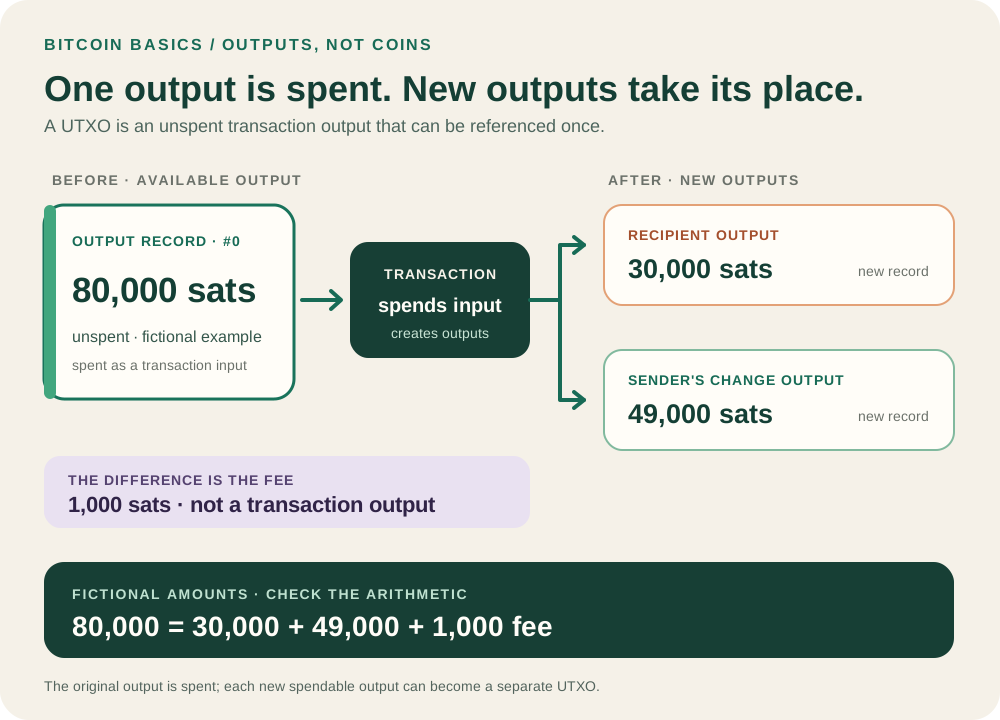
One old output is spent to create new outputs. Wallets can total outputs into a displayed balance; Bitcoin does not store a physical coin inside the wallet.
- A UTXO is a transaction output that has not been spent and can be referenced under its spending conditions.
- A transaction input points to a specific earlier transaction output; that output is consumed once when the spend is included in the chain.
- The transaction creates new outputs, such as a recipient payment and a sender's change. A wallet can aggregate available outputs into a displayed balance.
- In this fictional example, 80,000 input sats minus 30,000 payment sats and 49,000 change sats leaves a 1,000-sat fee. These are not live fee guidance.
Trace the 80,000-sat input: which two new outputs are created, which old record is spent, and how much is left as a fee?
The short answer
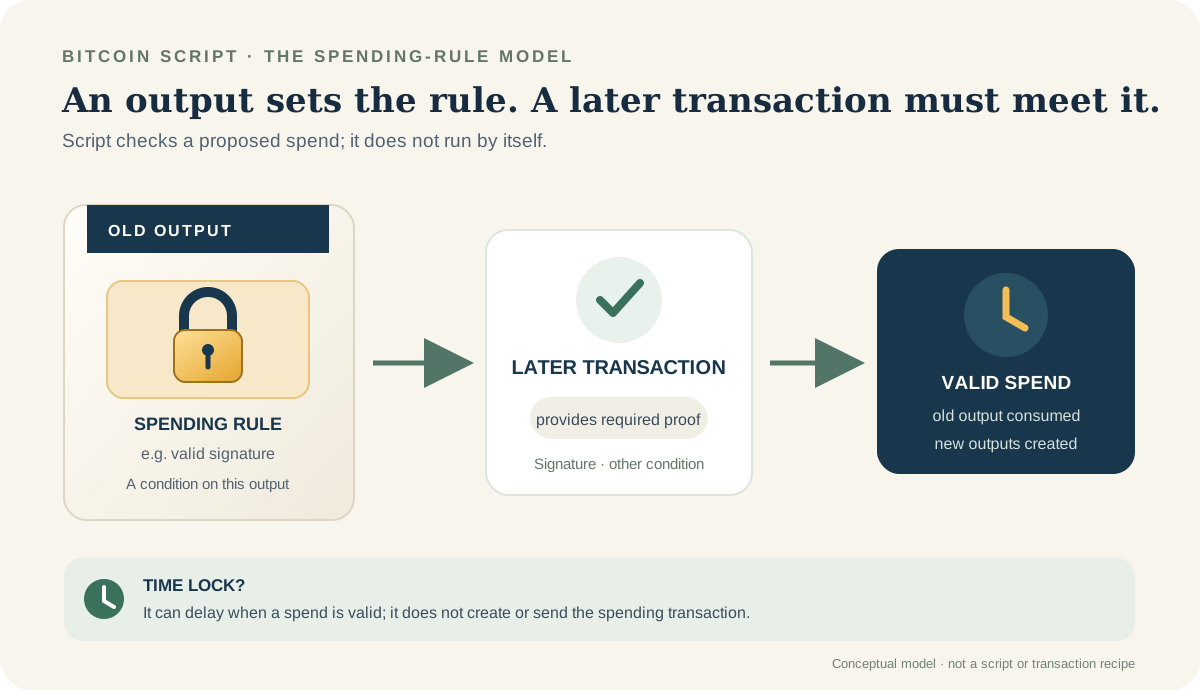
A UTXO is an unspent transaction output: a Bitcoin transaction output that has not yet been spent and can be referenced by a later transaction under its spending conditions. Bitcoin's transaction guide describes each output as waiting as a UTXO until a later input spends it. It is not a little coin stored inside a wallet. Bitcoin records amounts in transaction outputs; wallet software can add up outputs it recognizes as available to show a balance.
The name is literal: unspent transaction output. A transaction input points to a particular earlier output, identified by its transaction ID and output number; the Developer Guide explains this input reference. When that spend is included in the chain, the old output is no longer unspent. The new transaction creates its own outputs.
One output can fund a payment, change, and a fee
Suppose a fictional wallet selects one 80,000-satoshi UTXO to make a 30,000-satoshi payment. The transaction might create a 30,000-satoshi recipient output and a 49,000-satoshi change output for the sender. The remaining 1,000 satoshis are the fee: 80,000 − 30,000 − 49,000 = 1,000. These are invented teaching values, not a current fee quote or a recommended transaction.
The change is not returned as a physical coin. It is another transaction output. If that output meets the conditions for spending and has not been spent later, it is a new UTXO. The recipient output can also become a UTXO for the recipient. The original 80,000-satoshi output has been consumed; it cannot be used again.
A wallet may combine several UTXOs when one is not enough, or select an output larger than the payment and create change. For an ordinary wallet-spend transaction, the total of its inputs must cover its outputs; the difference is the transaction fee. Bitcoin's fees-and-change guidance explains this relationship; coinbase transactions are a special case. Fee size and rate are separate from the face value of the UTXO. Continue with Bitcoin transaction fees explained for that distinction.
UTXOs are not wallet accounts
A wallet's displayed balance is a convenient total, not one on-chain account entry. It may reflect multiple outputs with different amounts and histories. Bitcoin full nodes use the current set of unspent outputs when checking whether an ordinary transaction tries to spend available value; the node's UTXO set is not a list of customer names or exchange account balances.
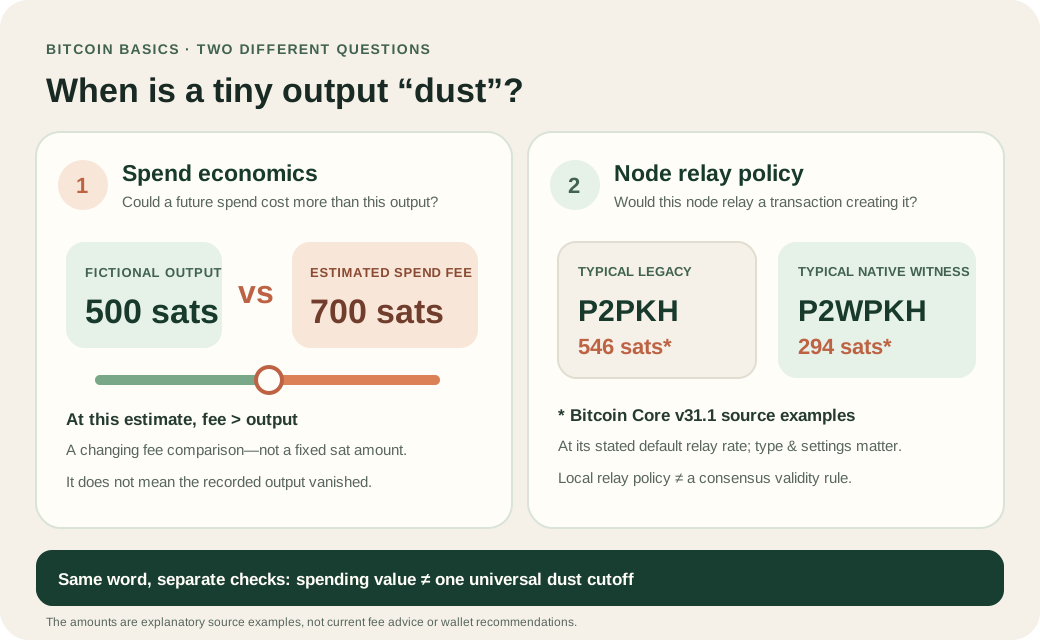
This model helps explain why two wallets showing the same total can build different transactions: they may select different outputs. It also connects to Bitcoin dust: a small output can exist but may be uneconomical to spend when the fee estimate is high.
Check the example without moving money
Trace the diagram: which record is used as an input, which outputs are created, and where does the difference go? Add the amounts before and after. Then compare the broader sequence in how Bitcoin transactions work and the network overview in what Bitcoin is. This lesson uses fictional values; it does not inspect a wallet or construct a real transaction.
Check your understanding.
What makes a transaction output a UTXO?
A correct answer records local learning progress, not a qualification or proof of financial readiness.
Put this lesson in context
Begin with the Bitcoin network, then follow the guides on wallets, fees and confirmation.
Sources & context
- Bitcoin Developer Guide — Transactions ↗Consulted 2026-10-11
- Bitcoin Developer Guide — Block Chain ↗Consulted 2026-10-11
Original educational content prepared for this project. Sources provide context, not endorsement or a guarantee that every statement remains current. Rules, product interfaces and availability can change.
Keep learning in Telegram.
Open this published guide in the learning bot. No account connection or wallet is needed.
Join the $STONKB community.
Follow project updates, share useful ideas and meet other builders. You do not need to buy $STONKB to join.
Take what you learned.
Leave the pressure behind.