This guide is educational, not personalized financial, legal or security advice. A checklist reduces avoidable mistakes; it cannot make a transaction risk-free.
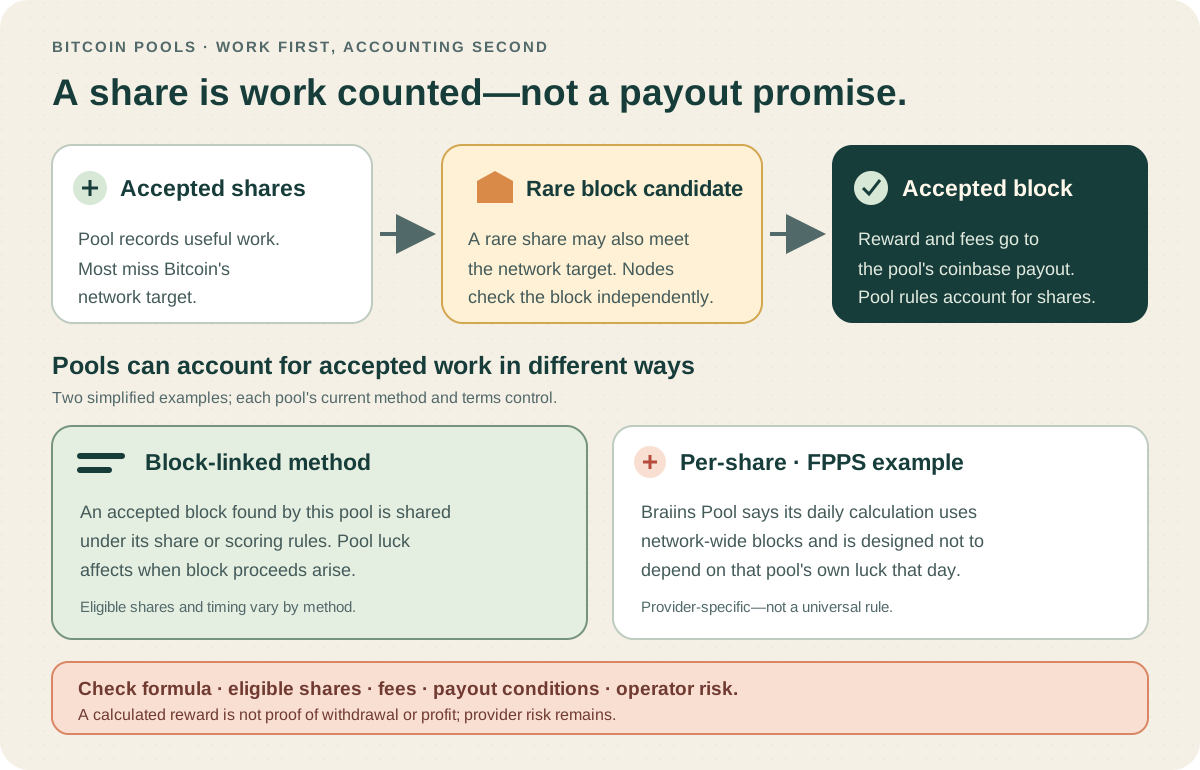
The same accepted work can be accounted for differently. Braiins Pool's FPPS example is provider-specific, not a universal payout rule or a profit guarantee.
- A pool counts accepted shares as evidence of work; most do not meet Bitcoin's network target.
- A rare qualifying result can become a candidate block, which independent nodes validate under Bitcoin's rules.
- Block-linked methods allocate proceeds from a pool block under their share or scoring rules.
- A per-share example such as Braiins Pool's published FPPS calculates shares under provider terms and may not depend on that pool finding a block in that period.
- Check current eligibility, fees, payout conditions and operator risk; no method guarantees profit or provider payment.
A pool reports accepted shares but no block found by that pool. Which payout details would you check before deciding whether a reward is due?
Short answer
A Bitcoin mining pool coordinates work from multiple miners and counts accepted shares—proof that each miner completed some assigned work. A share is not necessarily a Bitcoin block. More importantly, accepted shares do not all turn into rewards in the same way: some payout methods divide proceeds from blocks the pool finds, while per-share methods calculate rewards from shares under published terms. The method, fees, eligibility and payout rules matter; a dashboard or share count is not a profit or payment guarantee.
If proof of work and block validation are new, start with how Bitcoin mining works.
A share is not a block
A mining share is evidence that a submitted hash met the pool's work threshold. That threshold is easier to meet than Bitcoin's network target, so miners can report useful work more often. Most accepted shares do not meet the network target and are not block solutions. A rare result may meet both targets; the pool can submit it as a candidate block, which independent nodes still check against Bitcoin's rules.
The Bitcoin Developer Guide's mining chapter explains that shares help pools measure contributed work and that only shares also meeting the network target are sent as block candidates. A pool dashboard showing many accepted shares does not prove that the pool found the same number of blocks—or any block during that period.
Pool payout methods account for shares differently
Block-linked methods: When a pool finds a block that is accepted into Bitcoin, its coinbase transaction claims the permitted subsidy and included transaction fees. A block-linked reward method allocates some of those proceeds among miners according to its share or scoring rules. The result depends on the pool finding an accepted block and on the method's accounting window; the Bitcoin Developer Guide gives a simplified share-based example. Other rules can change which shares count and how timing or variance is handled.
Per-share methods: A pay-per-share method calculates rewards from accepted shares according to the pool's formula and terms. As one provider-specific example, Braiins Pool's published FPPS specification says its daily calculation uses blocks mined across the whole Bitcoin network and is designed to provide rewards regardless of that pool's own block-finding luck. That is Braiins' description of its own method—not a rule for every pool, an independent guarantee that an operator will pay, or evidence that mining will be profitable.
The research paper Analysis of Bitcoin Pooled Mining Reward Systems compares reward-accounting trade-offs, but it is a conceptual paper from 2011, not a description of today's provider terms. Before relying on a pool, check its current reward formula, fees, share eligibility, payout threshold and timing, and who controls the payout account. Equipment, electricity, downtime, network competition, pool terms and payout value all affect economics; joining a pool does not make mining profitable by itself.
The operator is part of the trust model
A pool may coordinate work, validate shares, construct or distribute jobs, and handle reward accounting. The Stratum V2 protocol overview describes a pool-server role that validates shares and helps propagate blocks. Some protocol arrangements support a separate job-declaration role, so transaction-selection control can vary; do not assume every pool gives miners the same control.
Never provide a recovery phrase or private key to a pool operator. A pool's displayed balance, accepted-share total or reward estimate is not independent evidence of the operator's solvency or trustworthiness. Read the current terms and investigate the operator before directing work or relying on an account balance.
Practise without mining
A fictional dashboard shows 40 accepted shares and no block found by that pool. What does that establish? It indicates that the pool counted submitted work under its share rules. It does not mean 40 Bitcoin blocks were found, prove that a payout is due, or reveal whether the activity was profitable. Under some block-linked rules, no pool block can mean no block proceeds for that accounting round; a per-share method may calculate a reward anyway if its terms say so. In either case, check the method and actual payout conditions.
For the wider process, read Bitcoin mining and block validation and Bitcoin confirmations. The visual below separates share accounting, the network block path, and two simplified payout approaches.
Check your understanding.
A mining pool reports 40 accepted shares but no block found by that pool. What do those shares prove?
A correct answer records local learning progress, not a qualification or proof of financial readiness.
Put this lesson in context
Begin with the Bitcoin network, then follow the guides on wallets, fees and confirmation.
Sources & context
- Bitcoin Developer Guide — Mining ↗Consulted 2026-10-11
- Stratum V2 — Protocol Overview ↗Consulted 2026-10-07
- Meni Rosenfeld — Analysis of Bitcoin Pooled Mining Reward Systems ↗Consulted 2026-10-07
- Braiins Pool — Rewards & Payouts (FPPS Specification) ↗Consulted 2026-10-07
Original educational content prepared for this project. Sources provide context, not endorsement or a guarantee that every statement remains current. Rules, product interfaces and availability can change.
Keep learning in Telegram.
Open this published guide in the learning bot. No account connection or wallet is needed.
Join the $STONKB community.
Follow project updates, share useful ideas and meet other builders. You do not need to buy $STONKB to join.
Take what you learned.
Leave the pressure behind.