This guide is educational, not personalized financial, legal or security advice. A checklist reduces avoidable mistakes; it cannot make a transaction risk-free.
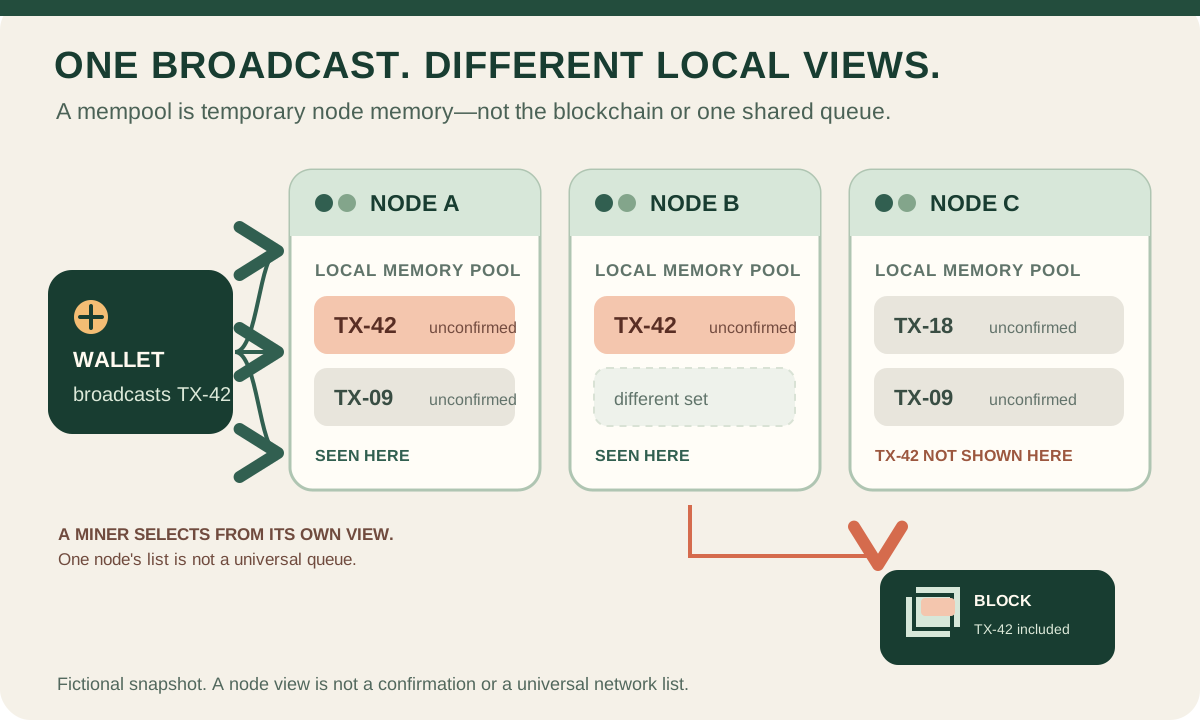
Fictional local views, not live transaction data. A node's mempool is temporary and distinct from confirmed block history.
- A wallet broadcasts a transaction to peers; each node applies its own local relay policy.
- Different nodes can know or retain different unconfirmed transactions at the same time.
- An explorer displays the view available to its own service, not a universal network list.
- Block inclusion creates chain history; later confirmations and a receiver's credit rule are separate.
Explorer A lists fictional TX-42 and Explorer B does not. Name two checks before deciding what happened; why is one empty result inconclusive?
A mempool is a node's temporary view
A Bitcoin mempool—short for memory pool—is a node's temporary list of unconfirmed transactions it knows about at that moment and may consider for a block. It is not part of Bitcoin's permanent blockchain history. Bitcoin has no single, globally synchronized waiting list that every wallet, miner and explorer sees in exactly the same way.
The Bitcoin Developer Guide describes an older Bitcoin Core behavior in which a node's pool was lost at shutdown. In Bitcoin Core 31.1, the -persistmempool setting is enabled by default: a node saves its pool at shutdown and attempts to load it on restart. That preserves the node's own local view; it does not create a synchronized network queue or permanent blockchain history. Other node software and settings can differ, and nodes can still have different pending sets. Bitcoin Core 31.1 also describes mempool admission as local transaction-relay policy in addition to consensus rules.
Why two screens can disagree
A wallet broadcasts a signed transaction to peers. Peers relay transaction data, and a node may add a transaction to its own pool after applying the rules it follows. Messages take time to travel, nodes can have different local policies, and a node may not retain every unconfirmed transaction. So two nodes, wallets or explorer services can show different pending sets without either screen being a complete view of every machine in the network.
A block explorer is a service that presents information from its own data sources. If one explorer cannot find a transaction, that tells you what that service returned for the network and identifier you selected; by itself, it does not prove that no wallet broadcast happened, that the transaction is invalid, or that a recipient has received spendable funds. Check the transaction identifier and network in your wallet, then compare the relevant service's current evidence. Do not send a duplicate payment just because one screen is empty.
From a local pool into the blockchain
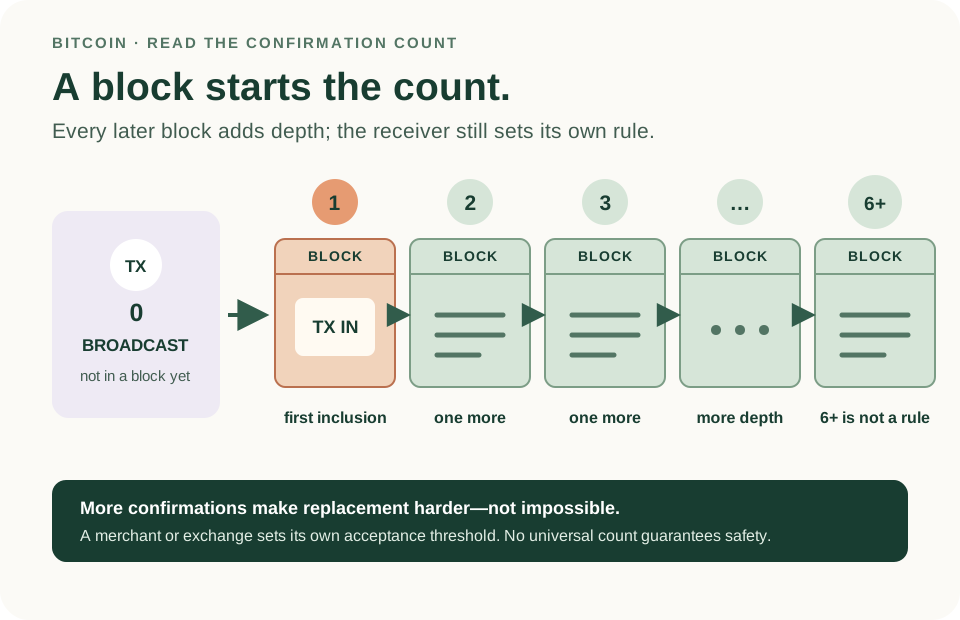
A miner can choose transactions from the view available to its block-building process and propose a candidate block. Other full nodes check the block against the consensus rules they follow. If a valid block containing the transaction becomes part of the chain being viewed, the transaction is now recorded in block history and is no longer merely unconfirmed. Later blocks add confirmations; a receiving exchange or merchant can still apply its own acceptance policy.
A mempool display is therefore not a confirmation count, a guarantee of future inclusion, or proof that a merchant credited a payment. For the step-by-step transaction lifecycle, read how Bitcoin transactions work. For the later-block count, see Bitcoin confirmations explained.
Fees affect competition, not a timer
Transactions compete for limited block space. Fee rate can affect a miner's selection, but the pool's contents and fee conditions change, and a fee estimate cannot promise which block will include a transaction or when. A mempool chart is a view from a service, not a universal countdown. Compare current wallet instructions and the actual fee before deciding whether to wait or use a supported fee-bumping option. For how wallet-supported replacement works—and why it is not a cancellation guarantee—see what Bitcoin transaction cancellation can and cannot do. Never assume a replacement is safe or available without checking the wallet's current behavior. See Bitcoin fees explained for how transaction size and fee rate differ from an exchange's withdrawal charge.
Practise without sending bitcoin
Imagine Explorer A lists fictional transaction TX-42 while Explorer B does not. The useful conclusion is not “the network rejected it” or “the payment definitely happened.” First ask which Bitcoin network each service is showing, whether both have the same full transaction identifier, and what your wallet reports. Then check the receiving service's own confirmation policy before treating any deposit as available.
The diagram shows three illustrative node-local views and one later block record. Its labels are fictional; it is neither a transaction lookup nor a complete network-wide list. If a real transaction is unresolved, preserve its identifier and use the wallet/provider's current support guidance. Never share a recovery phrase or private key with someone offering to locate it.
Check your understanding.
What does an explorer's empty result prove about an unconfirmed Bitcoin transaction?
A correct answer records local learning progress, not a qualification or proof of financial readiness.
Put this lesson in context
Begin with the Bitcoin network, then follow the guides on wallets, fees and confirmation.
Sources & context
- Bitcoin Developer Guide — P2P Network — Memory Pool ↗Consulted 2026-10-11
- Bitcoin Core — Mempool persistence arguments (v31.1) ↗Consulted 2026-10-11
- Bitcoin Core — Transaction Relay Policy (v31.1) ↗Consulted 2026-10-11
- Bitcoin Developer Guide — Transactions ↗Consulted 2026-10-11
- Bitcoin Developer Guide — Payment Processing ↗Consulted 2026-10-11
- Bitcoin Core — Bitcoin Core Releases ↗Consulted 2026-10-11
Original educational content prepared for this project. Sources provide context, not endorsement or a guarantee that every statement remains current. Rules, product interfaces and availability can change.
Keep learning in Telegram.
Open this published guide in the learning bot. No account connection or wallet is needed.
Join the $STONKB community.
Follow project updates, share useful ideas and meet other builders. You do not need to buy $STONKB to join.
Take what you learned.
Leave the pressure behind.