This guide is educational, not personalized financial, legal or security advice. A checklist reduces avoidable mistakes; it cannot make a transaction risk-free.
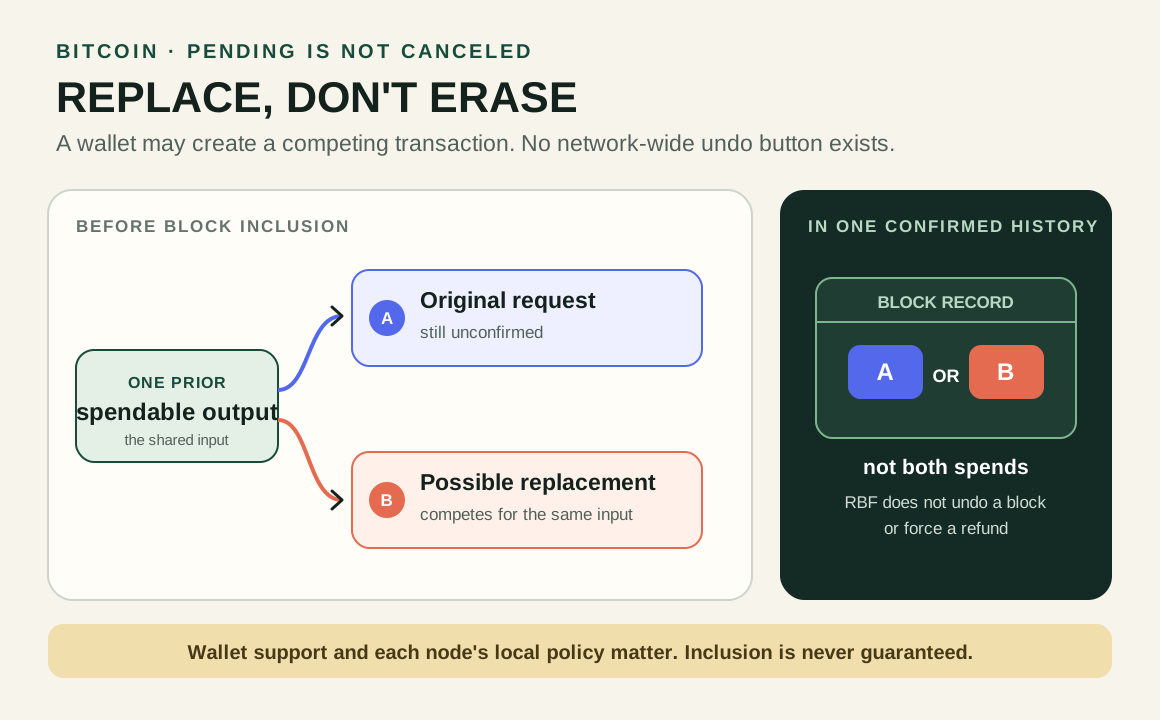
A replacement competes with the original; it does not erase every pending view or reverse a block. Node policies and wallet support vary.
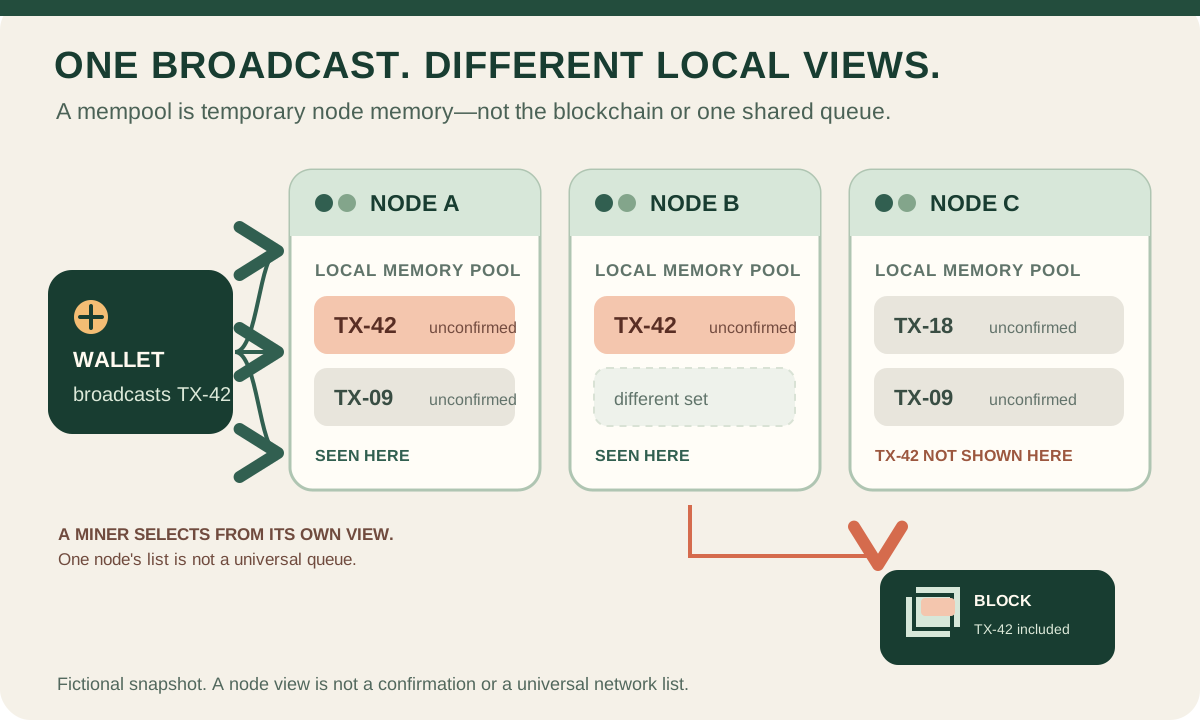
- A broadcast transaction can remain unconfirmed while nodes hold different local views.
- Some wallets can create a replacement that conflicts by spending at least one of the same inputs.
- Nodes apply local relay policy; a replacement or a higher fee does not guarantee inclusion.
- After block inclusion, RBF cannot reverse the payment. Any refund is a separate action.
For a fictional zero-confirmation payment, explain what a wallet's replacement option changes—and what it cannot guarantee. No wallet or transaction is needed.
The short answer: Bitcoin has no central cancel button
After a Bitcoin transaction is broadcast, no central service can erase it from every node. If it is still unconfirmed, some wallets may let the sender create a replacement transaction. That is a new transaction competing with the first—not an undo command, a guaranteed cancellation, or a promise that the recipient will return funds. If a transaction has already been included in a block, Replace-by-Fee (RBF) is no longer a way to reverse it.
A custodial app or exchange may let you request cancellation before a Bitcoin transaction is broadcast; its status names and rules are provider-specific. For example, Kraken's funding FAQ says an “Initiated” withdrawal can be canceled and a “Pending” withdrawal may still be cancelable—but not after the transaction is broadcast. That is a provider feature, not a Bitcoin-network feature; do not assume another service uses the same statuses.
First identify the transaction's state
- Not yet broadcast: If a service says a withdrawal is queued, check that provider's official status and cancellation rules. Do not assume a Bitcoin transaction ID exists yet.
- Broadcast, zero confirmations: Match the full transaction ID and Bitcoin network in the wallet or explorer. Read the wallet's own current RBF instructions before deciding whether to wait or use a supported replacement. A separate second payment can create a second obligation.
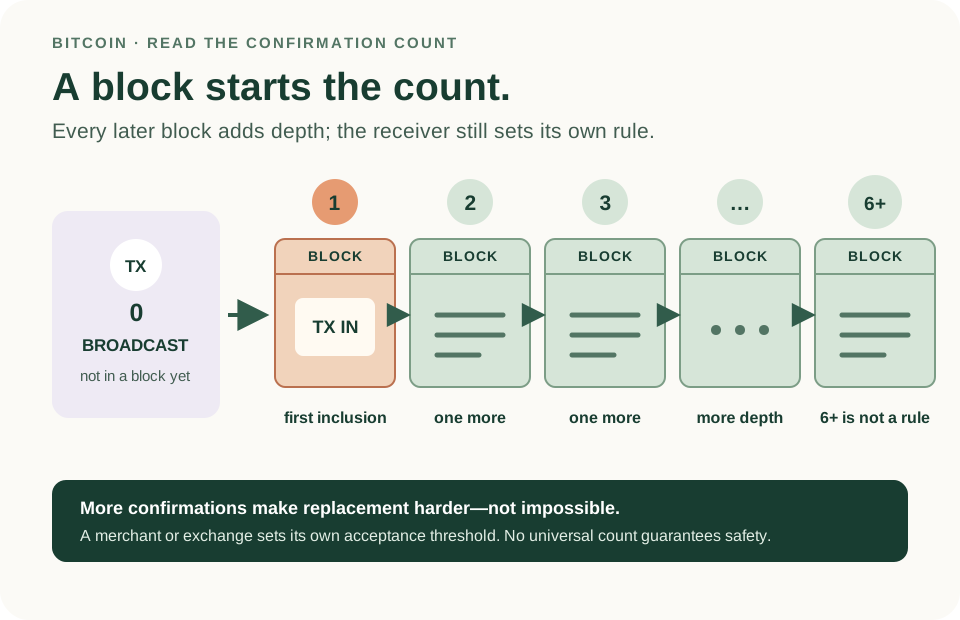
- Included in a block: RBF is for replacing unconfirmed transactions, not reversing a confirmed payment. If you sent to someone by mistake, contact the recipient or the service through a route you independently trust. Any return would be a separate action; it is not guaranteed.
This guide describes general differences; it does not inspect a particular transaction or replace your wallet provider's official instructions. A wallet status or one explorer showing no result does not, by itself, prove that the transaction failed. See how Bitcoin mempool views differ and what confirmations mean.
What Replace-by-Fee actually changes
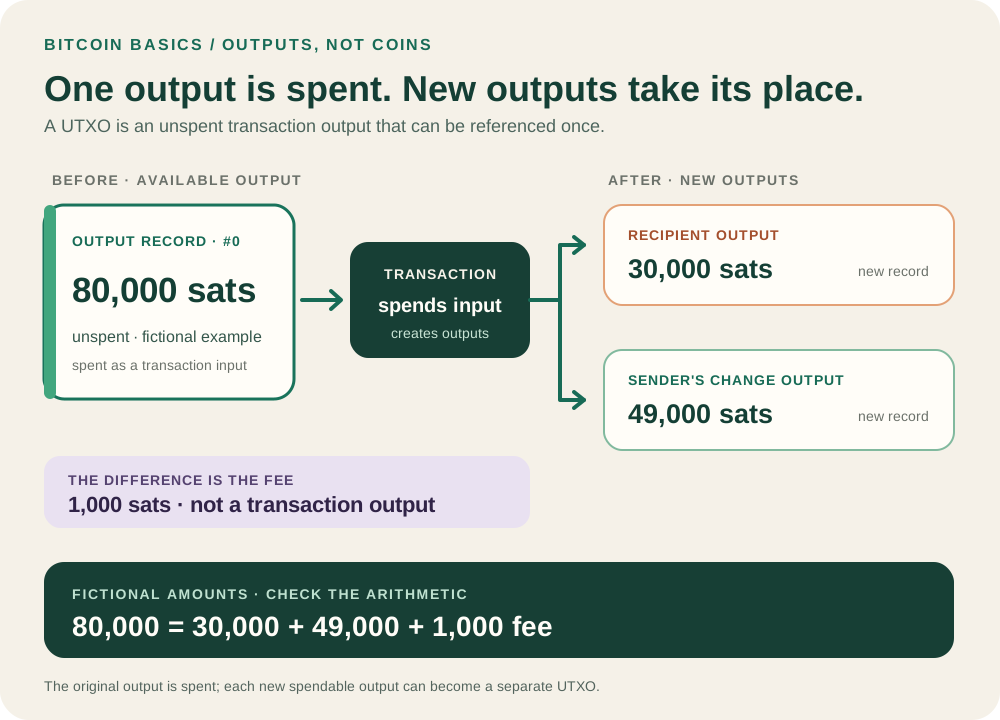
A Bitcoin transaction spends one or more earlier outputs. A replacement conflicts with the original when it tries to spend at least one of the same inputs. A wallet that supports RBF can prepare a different transaction—for example, to revise its fee—while the original remains unconfirmed. The wallet's available options and labels differ.
An older shortcut is to assume a transaction cannot be replaced unless it signaled RBF in advance. That is not a safe general rule: Bitcoin Core's v31.1 replacement-policy history says prior opt-in signaling is no longer required under its full-RBF policy, which became the default in v28.0; the v28.0 release notes document that default change. This describes Bitcoin Core policy, not every node, wallet, exchange, or payment service; their support and settings can differ. A missing RBF label is therefore not proof that a transaction is impossible to replace, and a replacement attempt is still not a guaranteed cancellation.
Nodes apply local rules to unconfirmed transactions, as Bitcoin Core's relay-policy overview explains. A node may accept and relay a replacement only when it meets that node's policy, including its fee requirements. Another node or service may have a different view. Bitcoin Core's documented replacement rules are mempool policy, not a network-wide cancellation mechanism. So a wallet showing “replaced” describes that wallet's view; it is not proof that every peer has forgotten the original or that a particular transaction will confirm next.
Two transactions spending the same input cannot both appear as valid spends in the same confirmed chain history. But before confirmation, different nodes can know about different candidates. A replacement can therefore fail to propagate or lose the race to confirmation. Do not treat RBF as a guaranteed way to stop a payment.
Keep the fee decision separate from the cancel question
A replacement may require a higher fee under the wallet and node policies involved; the exact requirements can change with software and configuration. Paying more is not a guarantee of a particular confirmation time or outcome. For the arithmetic behind virtual size and fee rate, read Bitcoin transaction fees explained. For the broader path from authorization to confirmation, see how Bitcoin transactions work.
Never give a recovery phrase or private key to anyone offering to cancel, reverse, or recover a transaction. A legitimate troubleshooting conversation does not need those secrets.
Check your understanding.
What does Replace-by-Fee do for an unconfirmed Bitcoin transaction?
A correct answer records local learning progress, not a qualification or proof of financial readiness.
Put this lesson in context
Begin with the Bitcoin network, then follow the guides on wallets, fees and confirmation.
Sources & context
- Bitcoin Developer Guide — Transactions ↗Consulted 2026-10-11
- Bitcoin Core — Transaction Relay Policy (v31.1) ↗Consulted 2026-10-11
- Bitcoin Core — Current mempool replacement policy (v31.1) ↗Consulted 2026-10-09
- Bitcoin Core — Bitcoin Core 28.0 release notes: full-RBF default ↗Consulted 2026-10-05
- Kraken Support — Cryptocurrency Funding FAQ ↗Consulted 2026-10-05
Original educational content prepared for this project. Sources provide context, not endorsement or a guarantee that every statement remains current. Rules, product interfaces and availability can change.
Keep learning in Telegram.
Open this published guide in the learning bot. No account connection or wallet is needed.
Join the $STONKB community.
Follow project updates, share useful ideas and meet other builders. You do not need to buy $STONKB to join.
Take what you learned.
Leave the pressure behind.