This guide is educational, not personalized financial, legal or security advice. A checklist reduces avoidable mistakes; it cannot make a transaction risk-free.
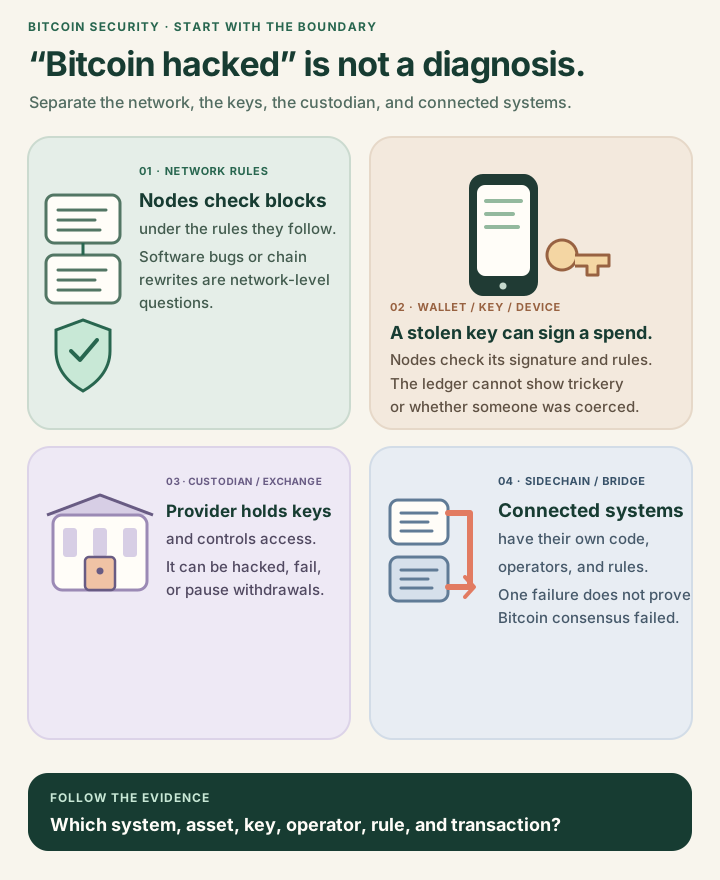
“Bitcoin hacked” is not a diagnosis. First identify the chain or service, key, operator, rule, and transaction involved. A connected-system incident alone does not prove Bitcoin’s base-layer rules failed.
- Bitcoin network: nodes check blocks under the consensus rules they follow; software bugs and chain-rewrite claims belong to this boundary.
- Wallet or device: exposed signing access can authorize a transaction that nodes accept; the ledger does not reveal whether a person was tricked or coerced.
- Custodian or exchange: a provider holding keys can be hacked, fail, or pause access under its own operations and policies.
- Sidechain or bridge: connected systems use separate software, operators, and rules; their incident does not alone show Bitcoin accepted an invalid base-layer transaction.
A report describes an exploit in a federated sidechain followed by a Bitcoin peg-out. Which system did the report identify as the source of the bug, and what would the Bitcoin transaction alone not prove?
Short answer: ask which Bitcoin system failed
“Can Bitcoin be hacked?” has no useful yes-or-no answer until you know what the headline means by *Bitcoin*. It might refer to Bitcoin’s base-layer software and consensus rules, a wallet or signing device, an exchange that holds customers’ keys, or a separate sidechain or bridge connected to Bitcoin. Those systems have different code, operators, and failure paths. No one should describe any software system as impossible to compromise.
A loss at an exchange or connected network does not, by itself, prove Bitcoin’s base-layer rules were broken. And a transaction recorded on Bitcoin does not prove that the person who authorized it intended the payment.
What can happen at Bitcoin’s base layer?
Full nodes independently check blocks against the consensus rules they follow. Miners propose blocks; they do not get to make an invalid block acceptable to a node that rejects it. A competing chain can replace recent history in a reorganization, and a sufficiently powerful mining attacker may try to censor or double-spend their own payment. The risk depends on the attack, network conditions, and how many confirmations the recipient waits for; no fixed count is a universal guarantee. Bitcoin.org’s validation explanation describes the limits of lightweight verification and the possibility of chain rewrites.
Bitcoin software can also contain bugs. In 2018, Bitcoin Core disclosed a vulnerability that could have allowed an inflation bug in affected versions and released fixes. The disclosure said maintainers were unaware of attempts to exploit it at that time. This is evidence that consensus software needs maintenance—not evidence that the vulnerability was successfully used or remains present. Read the primary Bitcoin Core disclosure of CVE-2018-17144.
A wallet or key can be compromised without breaking Bitcoin
A wallet manages the signing material used to authorize transactions; it does not store coins inside the device. If malware, phishing, a compromised backup, or access to a signing key lets someone produce a transaction that satisfies the destination’s spending rules, Bitcoin nodes can treat that transaction as valid. The ledger records the transaction; it does not determine whether the person was tricked or coerced. Bitcoin.org’s wallet-security guidance and scam guidance describe these user and device risks.
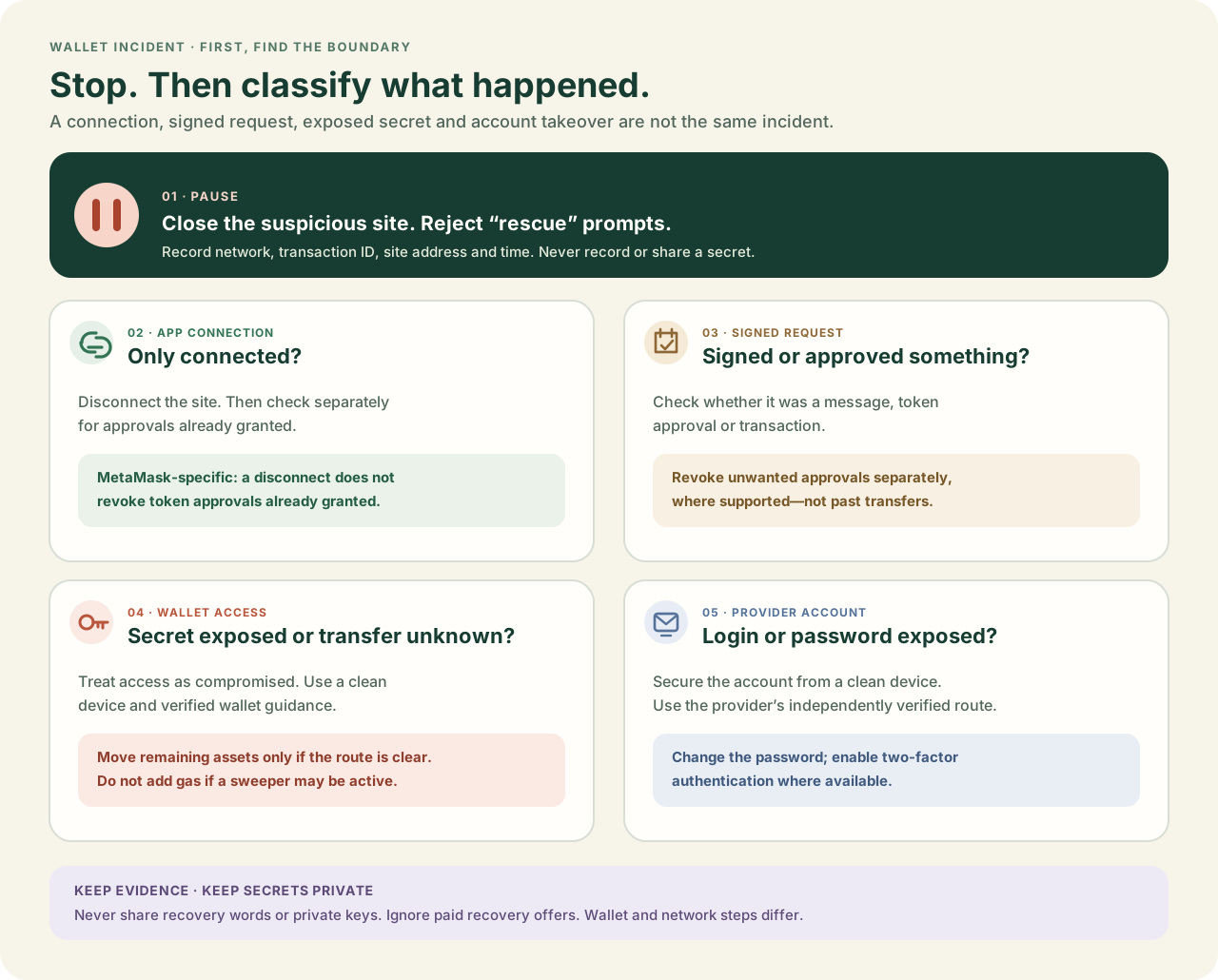
If you suspect a wallet incident, stop before signing or sending anything else. Never share a recovery phrase or private key with a supposed investigator or recovery service. Use the wallet’s verified support route and preserve non-secret details. For a step-by-step incident map, see what to do if a crypto wallet may be compromised; for the difference between custody and storage, read Bitcoin wallets explained.
An exchange or sidechain has its own boundary
When a service holds the signing keys, an account breach, operational failure, or withdrawal pause is a risk at that service. Bitcoin.org notes that online services can be hacked, fail, or freeze access; this is not the same claim as a consensus failure in Bitcoin.
Bitcoin-linked systems can also have separate rules. Liquid’s developer documentation describes Liquid as a federated sidechain that uses Elements software and its own block-signing process. In a September 2026 incident, Blockstream’s technical assessment attributed the exploit to an Elements rangeproof-cache vulnerability: it reports that roughly 4,000 unbacked LBTC were accepted on Liquid and BTC then left a Liquid reserve through a peg-out on Bitcoin. This is a report by a project participant, not an independent investigation. The example shows why the exact chain and failure path matter; it does not establish that Bitcoin’s base-layer consensus accepted an invalid Bitcoin transaction. See how Liquid works and the broader guide to blockchain bridge risks.
How to read a “Bitcoin hacked” headline
Before sharing or acting on a claim, ask four questions: Which chain or service? Which asset was affected? What key, software, operator, or rule failed? What evidence supports that explanation? Check an incident report against the relevant network’s own records and primary technical documentation. A token label, account balance, or headline alone does not identify the system that failed.
Practice without a wallet: a report describes an exploit in a federated sidechain followed by a Bitcoin peg-out. State which system’s bug the report identifies, which transaction the Bitcoin base layer recorded, and what the event does *not* prove about Bitcoin consensus. Then continue with what Bitcoin is or how Bitcoin confirmations work.
Check your understanding.
A technical report says a bug in a federated Bitcoin sidechain led to BTC leaving its peg reserve through a Bitcoin transaction. What does that establish by itself?
A correct answer records local learning progress, not a qualification or proof of financial readiness.
Put this lesson in context
Begin with the Bitcoin network, then follow the guides on wallets, fees and confirmation.
Sources & context
- Bitcoin.org — Bitcoin Core Validation ↗Consulted 2026-10-11
- Bitcoin Core — Disclosure of CVE-2018-17144 ↗Consulted 2026-10-11
- Bitcoin.org — Securing your wallet ↗Consulted 2026-10-11
- Bitcoin.org — Avoid scams ↗Consulted 2026-10-11
- Liquid Network Developer Documentation — How Liquid Works ↗Consulted 2026-10-11
- Blockstream (Liquid technical provider) — Liquid Network Security Incident Assessment ↗Consulted 2026-10-11
Original educational content prepared for this project. Sources provide context, not endorsement or a guarantee that every statement remains current. Rules, product interfaces and availability can change.
Keep learning in Telegram.
Open this published guide in the learning bot. No account connection or wallet is needed.
Join the $STONKB community.
Follow project updates, share useful ideas and meet other builders. You do not need to buy $STONKB to join.
Take what you learned.
Leave the pressure behind.