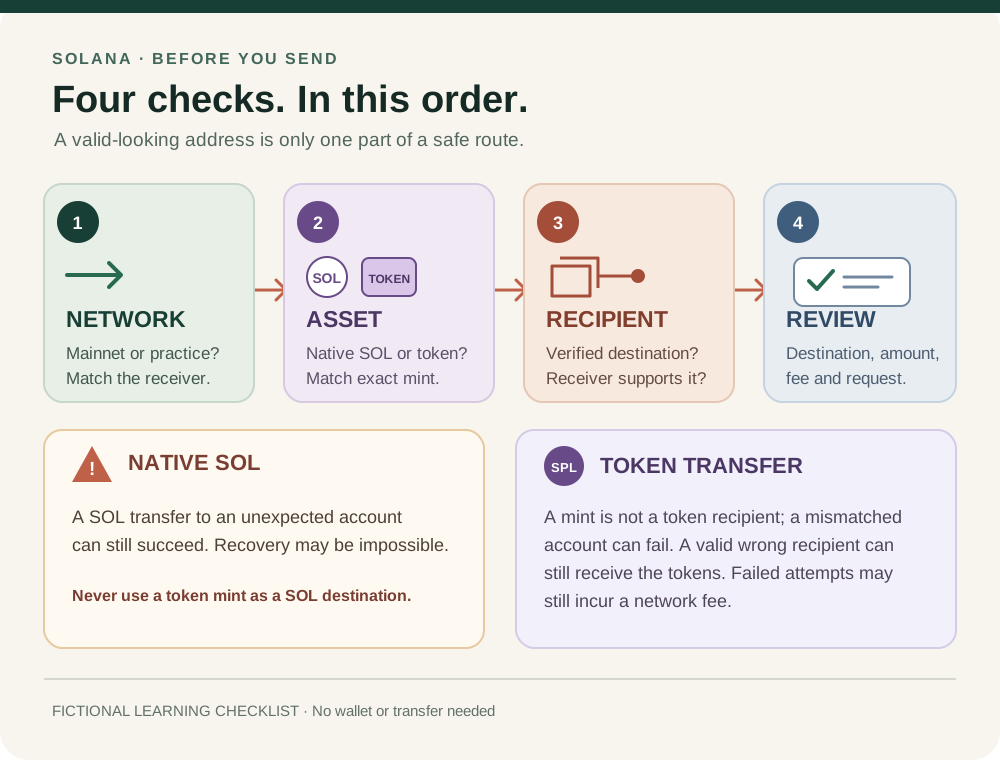
This guide is educational, not personalized financial, legal or security advice. A checklist reduces avoidable mistakes; it cannot make a transaction risk-free.

Solana is the network. A wallet helps authorize requests, SOL is its native asset, and each other token has a separate on-chain identity.
- Solana is the shared network; programs apply rules and accounts hold on-chain state.
- A wallet interface helps authorize a specific request; who controls its signing keys depends on the wallet model.
- SOL is the native asset used for protocol fees; an application may arrange a separate fee sponsor.
- Other tokens have their own mint identities; a ticker or logo alone is not proof.
Point to the network, the signing interface, the native fee asset, and a separate token. Which one is not a wallet?
The short answer
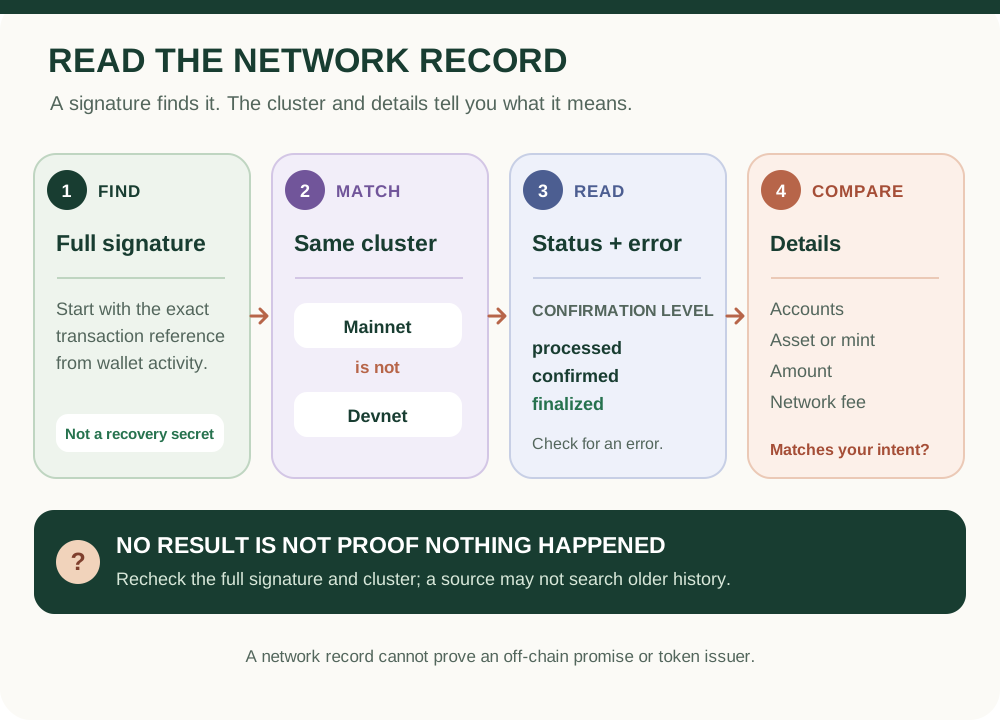
Solana is a public blockchain network: computers running its validator software process transactions and maintain a shared record of account state under the network's rules. Solana's core concepts guide introduces accounts, programs, instructions, and transactions. Applications can ask the network to perform actions by submitting transactions. Anyone can inspect public on-chain data, but an explorer only reports what the network recorded; it cannot prove an off-chain promise.
What happens when you use it
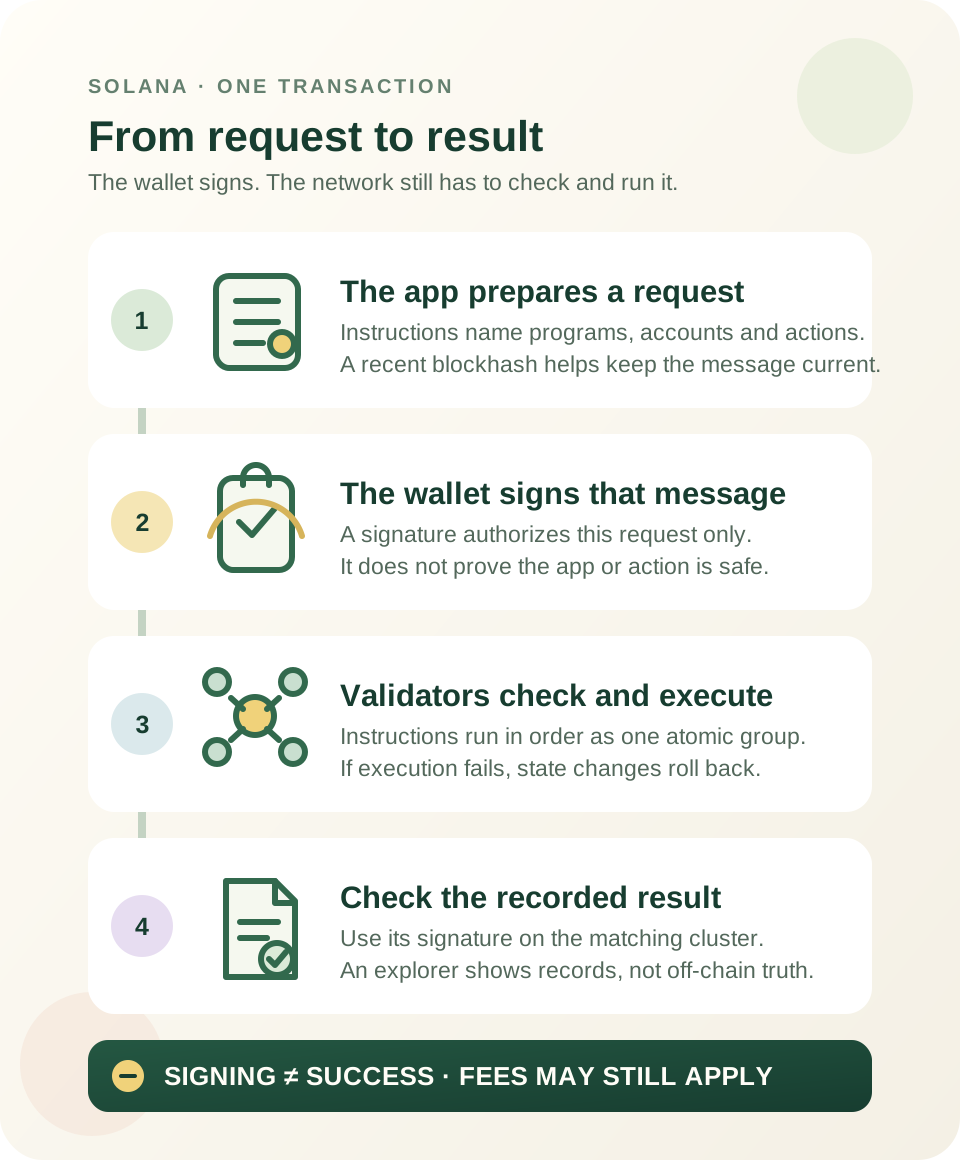
An application prepares a request. A wallet interface can show what the app is asking and help authorize the request; Solana's wallet directory describes wallets as a way to connect to apps and approve transactions. With a self-custody wallet, you approve it with a key you control; a custodial service may manage signing differently. Authorization applies to a specific message; it does not certify the website, token, or outcome. Solana's transaction guide explains that a transaction can contain multiple instructions: they execute together, and if one fails the state changes are reverted, though the network fee may still be charged.
The network's data is organized in accounts, and on-chain programs apply rules to instructions. You do not need to understand the account data format to begin. The useful beginner idea is that a wallet is how you access or authorize blockchain actions; it is not where the blockchain's shared record lives. Who controls the signing keys depends on the wallet or service model.
Keep four things separate
- Solana is the network and its rule system.
- SOL is the network's native asset. Protocol fees are denominated in SOL, as Solana's fee guide explains; a designated sponsor can sometimes pay the fee for a user under fee sponsorship, so check the actual wallet request rather than assuming who pays.
- A wallet is an app, device, or service used to access crypto accounts and authorize actions. Depending on its model, you or a provider may control the signing keys. A wallet does not make an application or request trustworthy.
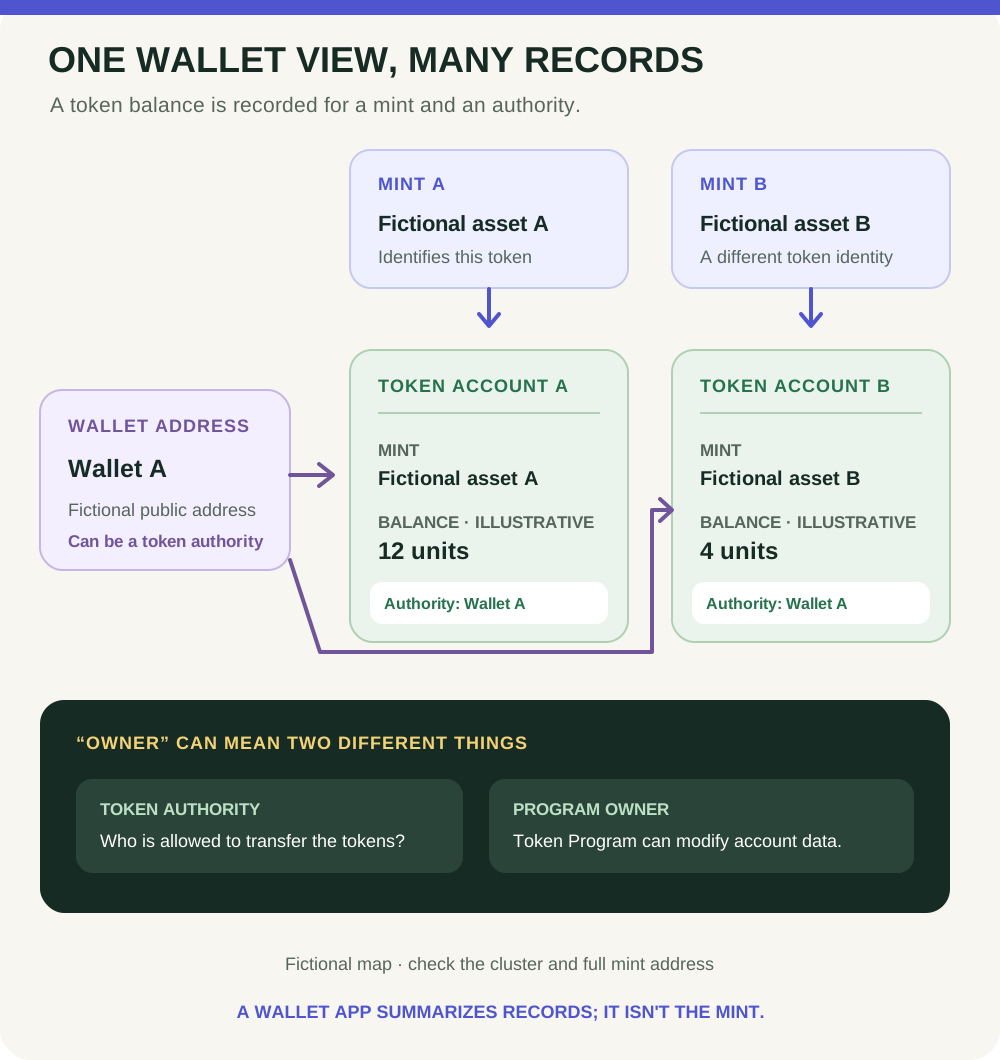
- Other tokens are separate assets represented through Solana's token programs and accounts. A mint address identifies a token; a token account tracks units of that mint for an owner. These on-chain identities do not make a familiar ticker or logo proof of identity, safety, or value.
A no-money example
Imagine a fictional game that records a score on Solana. The game screen is the app. A wallet interface presents the request and helps authorize it; whether you or a service controls the signer depends on the wallet model. A program applies the game's rules to account data, and the network records the result. SOL is the protocol's fee asset, while a game token—if the game has one—is a separate asset with its own mint. Reading this diagram and checking public documentation requires no wallet connection or purchase.
What this does not promise
A public record can show that a transaction was recorded; it cannot establish that a project's marketing is true, that a token has useful rights, or that a swap is safe. Fees and application behavior can vary. If a wallet request does not match the action you intended or is too unclear to evaluate, decline it. Never enter a recovery phrase into a website or share it with support.
Choose your next lesson
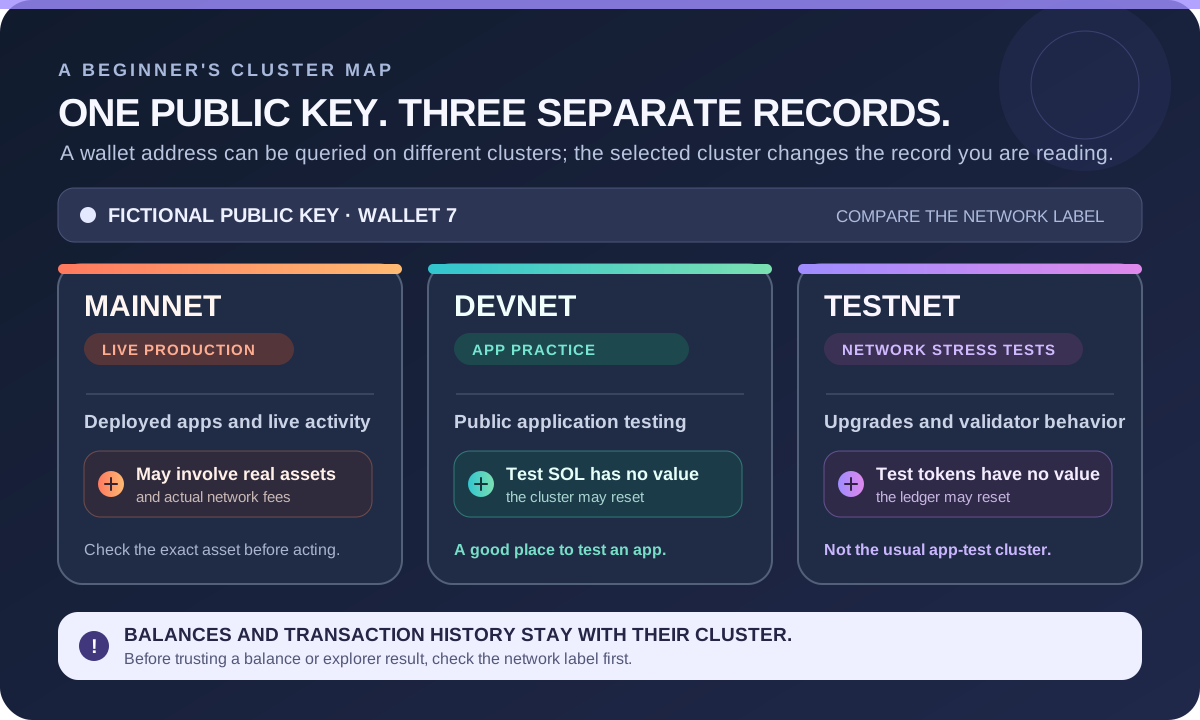
For the exact signing-to-result sequence, read how Solana transactions work. To understand token balances, continue with Solana accounts and token accounts. If you are exploring practice networks, see Devnet and Mainnet. If you want a practical token-identity example, continue with how to verify the $STONKB token address; it compares a project's stated mint with on-chain data and requires no wallet connection or purchase. A wallet connection and buying $STONKB are optional; learn the concepts first.
Check your understanding.
Which statement correctly separates the Solana network, SOL and a wallet?
A correct answer records local learning progress, not a qualification or proof of financial readiness.
Put this lesson in context
Separate the network, SOL and other tokens before learning accounts and transaction results.
Sources & context
- Solana Foundation — What is Solana? ↗Consulted 2026-10-04
- Solana Documentation — Core Concepts ↗Consulted 2026-10-06
- Solana Foundation — Solana wallets: compare features and platforms ↗Consulted 2026-10-04
- Solana Documentation — Accounts ↗Consulted 2026-10-11
- Solana Documentation — Tokens, mints, and token accounts ↗Consulted 2026-10-10
- Solana documentation — Transactions ↗Consulted 2026-10-11
- Solana documentation — Transaction pipeline ↗Consulted 2026-10-11
- Solana documentation — Fee Structure ↗Consulted 2026-10-11
- Solana documentation — Fee Abstraction ↗Consulted 2026-10-11
Original educational content prepared for this project. Sources provide context, not endorsement or a guarantee that every statement remains current. Rules, product interfaces and availability can change.
Keep learning in Telegram.
Open this published guide in the learning bot. No account connection or wallet is needed.
Join the $STONKB community.
Follow project updates, share useful ideas and meet other builders. You do not need to buy $STONKB to join.
Take what you learned.
Leave the pressure behind.